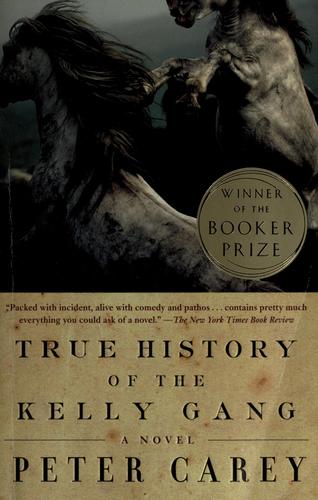
Talk to True History of the Kelly Gang like its author wrote you back.
Get the ideas that fit your life — not generic summaries.
- Chat with the book
- Audiobook-style main ideas
- Adapts to your life and goals
- Helps you take action
What it argues
Ned Kelly, the infamous Australian bushranger executed in 1880, writes a long confession to his infant daughter that explains — from his point of view — everything that led him to outlawry, armor, and the gallows. Peter Carey invents this voice wholesale: unpunctuated, breathless, vernacular, full of misspellings and run-on sentences, but also shot through with a peasant intelligence and a legitimate fury at the colonial system that victimized his family from his earliest memory.
The novel is built on a simple premise: what if Ned Kelly's actual "Jerilderie Letter" — a real, rambling document Kelly dictated justifying his actions — had been longer, more complete, more personal? Carey gives Kelly back his childhood, his family's poverty and persecution at the hands of the colonial police, his love affairs and his loyalties, and makes the case that his transformation into a bushranger was not chosen but constructed by every humiliation visited on his class and his Irish immigrant community in Victoria.
What it gets right
- 1.
The unpunctuated, vernacular prose is not a stylistic exercise — it is an argument about whose stories get told and in what form, and about the violence of literate culture toward the illiterate.
- 2.
Kelly's armor becomes an image of what working-class people make from what they have: improvised, ungainly, and a genuine act of defiance against a system designed to grind them down.
- 3.
Carey shows how outlawry is not chosen in a vacuum — it is produced by systematic dispossession, police harassment, and a colonial legal system that treated Irish-Australians as inherently criminal.
What it covers
Who wrote it
Peter Carey is an Australian novelist born in 1943 in Bacchus Marsh, Victoria. He is one of only four writers to have won the Booker Prize twice, for Oscar and Lucinda (1988) and True History of the Kelly Gang (2001). His other major novels include Illywhacker (1985), Jack Maggs (1997), and Amnesia (2014). Carey lived in New York for many years and has become something of an expatriate examining Australian history from a distance. He is known for his formal range and his willingness to inhabit historical voices from the inside out.
