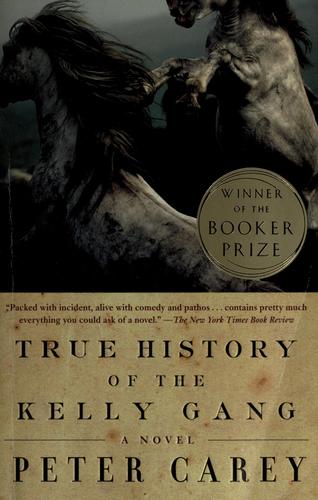
True History of the Kelly Gang by Peter Carey is a 2000 historical fiction book about colonial injustice, outlaw mythology, class and dispossession. The unpunctuated, vernacular prose is not a stylistic exercise — it is an argument about whose stories get told and in what form, and about the violence of literate culture toward the illiterate.
Summary
Ned Kelly, the infamous Australian bushranger executed in 1880, writes a long confession to his infant daughter that explains — from his point of view — everything that led him to outlawry, armor, and the gallows. Peter Carey invents this voice wholesale: unpunctuated, breathless, vernacular, full of misspellings and run-on sentences, but also shot through with a peasant intelligence and a legitimate fury at the colonial system that victimized his family from his earliest memory.
The novel is built on a simple premise: what if Ned Kelly's actual "Jerilderie Letter" — a real, rambling document Kelly dictated justifying his actions — had been longer, more complete, more personal? Carey gives Kelly back his childhood, his family's poverty and persecution at the hands of the colonial police, his love affairs and his loyalties, and makes the case that his transformation into a bushranger was not chosen but constructed by every humiliation visited on his class and his Irish immigrant community in Victoria.
The form is the argument. Carey's Kelly does not write in sentences that obey grammar because he was not educated in the schools that taught grammar — he was working class, barely literate, Irish-descended, and he writes the way he thinks. The prose is unrelenting and tiring by design: reading it is meant to approximate the experience of living in Kelly's world, where nothing ever quite pauses and nothing ever quite resolves. The armor Kelly fabricated — which he and his gang wore in their final battle — becomes the novel's central image of improvised dignity in the face of a system that sees you as disposable.
Carey won his second Booker Prize for this novel, and it holds up as one of the most formally daring historical novels of the modern era. Readers who can lean into the breathless vernacular will find the voice genuinely moving by the end. Those who need conventional punctuation and clear chapter breaks will find it exhausting in a way that feels more like endurance than reading.
Talk to True History of the Kelly Gang like its author wrote you back.
Get the ideas that fit your life — not generic summaries.
- Chat with the book
- Audiobook-style main ideas
- Adapts to your life and goals
- Helps you take action
Key takeaways
- 1.
The unpunctuated, vernacular prose is not a stylistic exercise — it is an argument about whose stories get told and in what form, and about the violence of literate culture toward the illiterate.
- 2.
Kelly's armor becomes an image of what working-class people make from what they have: improvised, ungainly, and a genuine act of defiance against a system designed to grind them down.
- 3.
Carey shows how outlawry is not chosen in a vacuum — it is produced by systematic dispossession, police harassment, and a colonial legal system that treated Irish-Australians as inherently criminal.
- 4.
The novel is addressed to Kelly's infant daughter, which gives it an intimacy and a desperation unusual for historical fiction: he is trying to explain himself before it is too late.
- 5.
National myth-making is interrogated throughout: Kelly is simultaneously the romantic Australian bushman of legend and a frightened, loyal, very specific young man.
- 6.
Class is the novel's bedrock argument — the Kelly gang's crimes are inseparable from the economics of colonial Victoria, where land and law belonged to the wealthy and the Irish poor had neither.
- 7.
Loyalty and betrayal alternate in close succession, and the novel refuses to make villains of the people who fail Kelly — it insists on the structural forces that make people betray each other.
- 8.
The ending, despite its inevitability, is not defeatist — Carey makes Kelly's execution feel like something that cannot fully extinguish what he was trying to say.
Discussion questions
Use these on your own, with a book club, or as chat starters in Superbook. Book club version, ready to copy or print →
- 1.
Carey invents Ned Kelly's voice wholesale, based on a few real documents. Does that feel like an act of sympathy, an act of appropriation, or something in between?
- 2.
The unpunctuated prose style is deliberately difficult. Did it work on you emotionally, or did you find it a barrier to the story?
- 3.
The novel presents Kelly's crimes as produced by the system. Does it succeed in making that case without making Kelly unaccountable for the violence he commits?
- 4.
Kelly's mother and her many disasters are central to his story. How does Carey use her character to ground the novel's political argument?
- 5.
The armor Kelly and his gang wore is one of Australian history's most famous images. What does Carey do with it as a symbol?
- 6.
Australia has a complicated relationship with the Kelly legend — he's simultaneously a criminal and a folk hero. Does this novel change how you think about outlaw mythology in general?
- 7.
The novel is addressed to Kelly's infant daughter. How does that framing device — writing to someone who cannot yet understand — affect the emotional register of the book?
- 8.
Compare this to another novel written in an invented historical voice — Hilary Mantel's Wolf Hall, for instance, or Colm Tóibín's The Master. How does the choice of 'uneducated' vernacular versus cultivated literary prose change the moral argument?
- 9.
Kelly is partly a nationalist figure — an Irish-Australian resisting British-Australian authority. How much of the novel's sympathy is political rather than personal?
- 10.
The ending is historically fixed — we know Kelly will hang. Did that inevitability add to or diminish your engagement with the story?
- 11.
What is the novel saying about the difference between the story we tell about ourselves and the story others will tell about us after we're gone?
- 12.
Which character besides Kelly surprised you the most, and why?
Themes
Frequently asked questions
-
Is True History of the Kelly Gang worth reading?
Yes, for readers who can commit to an unconventional prose style. The voice Carey invents for Kelly is one of modern fiction's great sustained performances, and the novel's argument about colonial class violence is made through that voice rather than around it.
-
Is the novel hard to read because of the punctuation?
The lack of punctuation is the biggest obstacle. Most readers report that it takes 30-50 pages to calibrate to the rhythm, after which the style becomes almost invisible and the voice becomes compelling. The initial difficulty is real but surmountable.
-
How accurate is the novel historically?
Carey takes real events and real figures and supplements them with invented dialogue, psychology, and scenes. The broad historical outline is accurate — Kelly's family background, the police conflicts, the Glenrowan siege — but Carey invents extensively within that frame. The novel does not claim to be documentary.
-
Who shouldn't read this book?
Readers who need conventional prose and clear chapter structure will find this relentless and tiring. The novel is not sympathetic to the police or to Victorian colonial authority, and readers who find outlaws unromantic will find Carey's framing frustrating.
-
Is there an adaptation?
Justin Kurzel directed a film adaptation in 2019, starring George MacKay as Ned Kelly and Russell Crowe as his father figure. It is atmospheric and strange, capturing some of the novel's guerrilla intensity, though it necessarily simplified the voice.