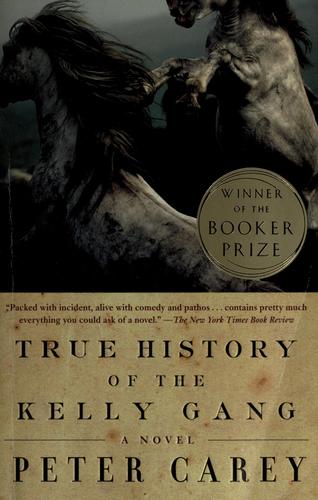
Talk to True History of the Kelly Gang like its author wrote you back.
Get the ideas that fit your life — not generic summaries.
- Chat with the book
- Audiobook-style main ideas
- Adapts to your life and goals
- Helps you take action
True History of the Kelly Gang, in detail
Ned Kelly, the infamous Australian bushranger executed in 1880, writes a long confession to his infant daughter that explains — from his point of view — everything that led him to outlawry, armor, and the gallows. Peter Carey invents this voice wholesale: unpunctuated, breathless, vernacular, full of misspellings and run-on sentences, but also shot through with a peasant intelligence and a legitimate fury at the colonial system that victimized his family from his earliest memory.
The novel is built on a simple premise: what if Ned Kelly's actual "Jerilderie Letter" — a real, rambling document Kelly dictated justifying his actions — had been longer, more complete, more personal? Carey gives Kelly back his childhood, his family's poverty and persecution at the hands of the colonial police, his love affairs and his loyalties, and makes the case that his transformation into a bushranger was not chosen but constructed by every humiliation visited on his class and his Irish immigrant community in Victoria.
The form is the argument. Carey's Kelly does not write in sentences that obey grammar because he was not educated in the schools that taught grammar — he was working class, barely literate, Irish-descended, and he writes the way he thinks. The prose is unrelenting and tiring by design: reading it is meant to approximate the experience of living in Kelly's world, where nothing ever quite pauses and nothing ever quite resolves. The armor Kelly fabricated — which he and his gang wore in their final battle — becomes the novel's central image of improvised dignity in the face of a system that sees you as disposable.
Carey won his second Booker Prize for this novel, and it holds up as one of the most formally daring historical novels of the modern era. Readers who can lean into the breathless vernacular will find the voice genuinely moving by the end. Those who need conventional punctuation and clear chapter breaks will find it exhausting in a way that feels more like endurance than reading.
The big ideas
- 1.
The unpunctuated, vernacular prose is not a stylistic exercise — it is an argument about whose stories get told and in what form, and about the violence of literate culture toward the illiterate.
- 2.
Kelly's armor becomes an image of what working-class people make from what they have: improvised, ungainly, and a genuine act of defiance against a system designed to grind them down.
- 3.
Carey shows how outlawry is not chosen in a vacuum — it is produced by systematic dispossession, police harassment, and a colonial legal system that treated Irish-Australians as inherently criminal.
