Business · Book club
Understanding Michael Porter: The Essential Guide to Competition and Strategy book club questions
Here are 12 book club questions for Understanding Michael Porter: The Essential Guide to Competition and Strategy by Joan Magretta, ordered to open easily and end somewhere worth arguing about. Copy them, print them, or bring them up one at a time.
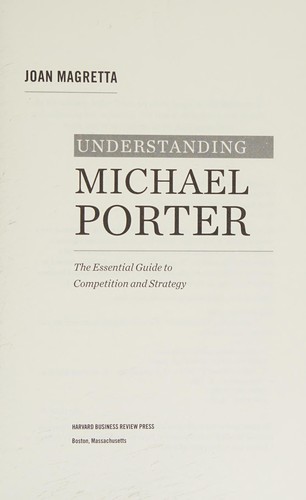
Understanding Michael Porter is Joan Magretta's attempt to translate Porter's ideas — notoriously dense in their original form — into something practicing managers can actually use.
Joan Magretta · 2012 · 4h 0m
Full summary and key takeaways →The 12 questions
- 1.
Magretta distinguishes operational effectiveness from strategy. Which one does your organization primarily compete on, and is that a conscious choice?
- 2.
Think of a company you admire. What specific tradeoffs has it made that define its strategic position? What has it deliberately chosen not to do?
- 3.
Porter's five forces analyze industry structure. Pick an industry you know well. Which of the five forces most limits profitability there, and why?
- 4.
The book argues that trying to be all things to all people is the most common strategic failure. Where in your organization are you still trying to please everyone?
- 5.
IKEA, Southwest, and Zara are the canonical examples of distinctive strategic positions. What makes their positions durable? Could you replicate them tomorrow?
- 6.
Magretta says price competition is a race to the bottom. When is competing on price actually the right strategy, and what conditions make it sustainable?
- 7.
A value chain maps all the activities that create value in your business. Which activity in your organization creates the most distinctive value relative to competitors, and which creates the least?
- 8.
Strategy requires continuity, but markets change. How do you distinguish between a necessary strategic pivot and the kind of repositioning Porter warns against?
- 9.
Porter argues that industry structure determines whether profit is possible. Have you ever worked in or invested in an industry where structural forces made profitability nearly impossible regardless of execution?
- 10.
The book was written in 2012. Which of Porter's frameworks feel most relevant to today's competitive environment? Which feel most dated?
- 11.
Magretta says most strategy discussions are really discussions about operational effectiveness. What would a genuine strategy conversation look like in your organization?
- 12.
If you had to describe your organization's strategy in one sentence — distinctive position, unique activities, specific tradeoffs — what would it say?
How to run the discussion
- Pick six to eight, not all of them. An hour of real discussion covers fewer questions than anyone expects, and racing the list is what makes a book club feel like homework.
- Open with what people noticed, not what they concluded. Asking for a verdict first hardens opinions before anyone has heard each other.
- Let the disagreement run. The questions below that split a room are the ones worth the time; the ones everyone answers the same way can be skipped.
- Ask the quiet person a specific question. A direct, narrow question is far easier to answer than an open invitation to contribute.
Themes worth steering toward
If the conversation stalls, these are the threads that usually restart it.
Common questions
What are good book club questions for Understanding Michael Porter: The Essential Guide to Competition and Strategy?
Here are 12 book club questions for Understanding Michael Porter: The Essential Guide to Competition and Strategy by Joan Magretta, ordered to open easily and end somewhere worth arguing about. The strongest openers ask what each reader noticed rather than what they concluded, and the discussion usually turns on strategy, competition, competitive advantage.
How long should a book club discussion of Understanding Michael Porter: The Essential Guide to Competition and Strategy last?
Most groups run 60 to 90 minutes of actual discussion. That is roughly six to eight questions, not all of them, so pick the ones that suit your group rather than working down the list in order.
What are the main themes in Understanding Michael Porter: The Essential Guide to Competition and Strategy?
Strategy, Competition, Competitive advantage, Industry analysis, Value creation. Those are the threads most likely to divide a room, which makes them the useful places to steer a discussion that has gone quiet.
Picking the next one? See books like Understanding Michael Porter: The Essential Guide to Competition and Strategy or questions for other book club picks.
