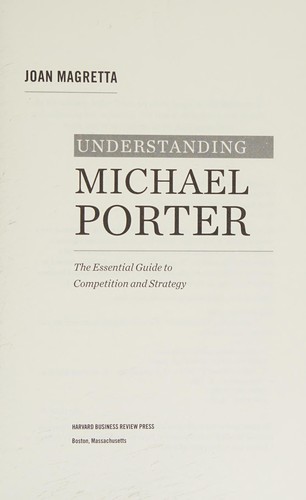
Understanding Michael Porter: The Essential Guide to Competition and Strategy by Joan Magretta is a 2012 business book about strategy, competition, competitive advantage. Operational effectiveness — doing what competitors do, but more efficiently — is not strategy. Real strategy is about choosing a distinctive position and making tradeoffs that make that position defensible.
Summary
Understanding Michael Porter is Joan Magretta's attempt to translate Porter's ideas — notoriously dense in their original form — into something practicing managers can actually use. Magretta worked closely with Porter at the Harvard Business School, and the book has his endorsement, which matters: there's a long tradition of people misrepresenting his frameworks. Magretta's core argument is that Porter's work is more coherent and more practical than either his critics or his simplifiers allow, and that much of what passes for strategy in business isn't strategy at all.
Porter's five forces framework gets a thorough treatment. The five forces — rivalry among existing competitors, threat of new entrants, threat of substitutes, bargaining power of buyers, and bargaining power of suppliers — are tools for analyzing industry structure and profitability, not a checklist. Magretta emphasizes that the goal is to understand why some industries are structurally more attractive than others, and to choose where to compete with that understanding in mind.
The second major contribution is the distinction between operational effectiveness and strategy. Operational effectiveness — doing what competitors do, but better — is necessary but not sufficient. Real strategy is about doing something different: making choices that create a unique position, choosing not to serve certain customers or provide certain products, and accepting the tradeoffs that make the position defensible. Magretta argues, following Porter, that the inability to make tradeoffs is the most common strategic failure.
The book is accessible without being superficial. Magretta uses examples from IKEA, Southwest Airlines, and Zara to make the abstract frameworks concrete. Its weakness is that it is primarily explanatory rather than diagnostic — it tells you what the frameworks mean better than it tells you how to apply them when your specific situation doesn't fit the canonical examples. But as an introduction to Porter, it is far more readable than the originals and far more rigorous than most strategy summaries.
Talk to Understanding Michael Porter: The Essential Guide to Competition and Strategy like its author wrote you back.
Get the ideas that fit your life — not generic summaries.
- Chat with the book
- Audiobook-style main ideas
- Adapts to your life and goals
- Helps you take action
Key takeaways
- 1.
Operational effectiveness — doing what competitors do, but more efficiently — is not strategy. Real strategy is about choosing a distinctive position and making tradeoffs that make that position defensible.
- 2.
The five forces framework analyzes industry structure and profitability. The goal is to choose where to compete with an understanding of which structural features determine whether an industry can be profitable at all.
- 3.
Tradeoffs are the heart of strategy. A company that tries to serve everyone will be outcompeted by specialists in every segment. Choosing not to do something is as important as choosing what to do.
- 4.
Competitive advantage is not just about being different — it is about being different in ways that create superior value for customers and that rivals cannot easily replicate.
- 5.
A value chain analysis maps all the activities a company performs to deliver a product or service. Competitive advantage comes from either doing specific activities at lower cost or doing them in ways that create differentiated value.
- 6.
The five forces apply to an industry, not a company. Understanding the structural forces shaping profitability in your industry is a prerequisite for setting strategy, not a substitute for it.
- 7.
Price competition destroys value for everyone. Competing on price is a race to the bottom unless you have a genuine cost advantage — and most companies that think they do, don't.
- 8.
Strategy requires continuity. Frequent repositioning destroys the investments that build competitive advantage and signals to customers and employees that the company doesn't know what it stands for.
Discussion questions
Use these on your own, with a book club, or as chat starters in Superbook. Book club version, ready to copy or print →
- 1.
Magretta distinguishes operational effectiveness from strategy. Which one does your organization primarily compete on, and is that a conscious choice?
- 2.
Think of a company you admire. What specific tradeoffs has it made that define its strategic position? What has it deliberately chosen not to do?
- 3.
Porter's five forces analyze industry structure. Pick an industry you know well. Which of the five forces most limits profitability there, and why?
- 4.
The book argues that trying to be all things to all people is the most common strategic failure. Where in your organization are you still trying to please everyone?
- 5.
IKEA, Southwest, and Zara are the canonical examples of distinctive strategic positions. What makes their positions durable? Could you replicate them tomorrow?
- 6.
Magretta says price competition is a race to the bottom. When is competing on price actually the right strategy, and what conditions make it sustainable?
- 7.
A value chain maps all the activities that create value in your business. Which activity in your organization creates the most distinctive value relative to competitors, and which creates the least?
- 8.
Strategy requires continuity, but markets change. How do you distinguish between a necessary strategic pivot and the kind of repositioning Porter warns against?
- 9.
Porter argues that industry structure determines whether profit is possible. Have you ever worked in or invested in an industry where structural forces made profitability nearly impossible regardless of execution?
- 10.
The book was written in 2012. Which of Porter's frameworks feel most relevant to today's competitive environment? Which feel most dated?
- 11.
Magretta says most strategy discussions are really discussions about operational effectiveness. What would a genuine strategy conversation look like in your organization?
- 12.
If you had to describe your organization's strategy in one sentence — distinctive position, unique activities, specific tradeoffs — what would it say?
Themes
Frequently asked questions
-
Is Understanding Michael Porter worth reading?
Yes, especially if you've found Porter's original texts — Competitive Strategy and Competitive Advantage — impenetrable. Magretta's version is far more readable while remaining rigorous. If you've already read Porter himself, the book mostly reinforces rather than extends, but it's useful for correcting common misreadings of his frameworks.
-
Do I need to read Porter's originals after reading this?
Not necessarily. Magretta covers the essential frameworks clearly enough that many readers won't need the originals for practical purposes. Porter's own books are valuable for depth and nuance, particularly Competitive Advantage, but Understanding Michael Porter is an adequate standalone introduction.
-
What are Porter's five forces?
The five forces that shape industry profitability: rivalry among existing competitors, threat of new entrants, threat of substitute products, bargaining power of buyers, and bargaining power of suppliers. Analyzing them helps determine whether an industry is structurally attractive and where competitive pressure originates.
-
Who should read this book?
Anyone in a strategy, product, or general management role who needs to think clearly about competition. It's especially useful for people who've heard the terms 'competitive advantage' and 'five forces' for years without understanding what they actually mean or how to apply them.
-
What's the most important idea in Understanding Michael Porter?
The distinction between operational effectiveness and strategy. Most companies compete by doing what their rivals do, only better. Real strategy is about choosing a different position, making tradeoffs that competitors find difficult to replicate, and committing to that position long enough for the advantage to compound.
Similar books
Competitive Strategy
Michael E. Porter
Good Strategy Bad Strategy
Richard Rumelt
Playing to Win: How Strategy Really Works
Roger L. Martin and A.G. Lafley
Blue Ocean Strategy
W. Chan Kim and Renée Mauborgne
