Science · Book club
Universal Principles of Design book club questions
Here are 11 book club questions for Universal Principles of Design by William Lidwell, Kritina Holden, and Jill Butler, ordered to open easily and end somewhere worth arguing about. Copy them, print them, or bring them up one at a time.
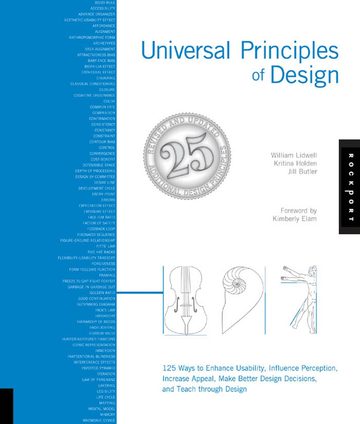
Universal Principles of Design is a reference book organized as an encyclopedia: 125 design principles, each given a two-page spread with a clear definition, a visual example, and a brief note on application.
William Lidwell, Kritina Holden, and Jill Butler · 2003 · 5h 0m
Full summary and key takeaways →The 11 questions
- 1.
The book argues that design is applied knowledge rather than taste or inspiration. Does that framing feel accurate to your experience as a designer or as a user of designed things?
- 2.
Which of the 125 principles have you encountered most often in your work, and which have been most useful when you've applied them explicitly?
- 3.
The aesthetic-usability effect suggests that attractive design is perceived as more functional. Does that create a problem — are there situations where it leads users astray?
- 4.
Fitts's Law has been enormously influential in interface design. Can you think of interfaces you use regularly where it's been applied well, and others where it's been ignored?
- 5.
The book spans graphic design, industrial design, architecture, and software. Does the claim to universality hold up, or do some principles feel more discipline-specific than the format implies?
- 6.
Affordances — the perceived properties that suggest use — are central to good product design. What's an example of a badly designed affordance you encounter regularly?
- 7.
The encyclopedic format means each principle gets two pages. Which principles felt underexplained, and which felt well-served by the concision?
- 8.
The Gestalt principles describe how visual systems group things automatically. How consciously do you apply that knowledge when you design, or does it operate mostly as intuition?
- 9.
The book has been revised several times. What principles do you think have been added correctly in newer editions, and what gaps remain?
- 10.
Cognitive load reduction is one of the book's recurring themes. Where do you see cognitive load problems in things you use or make, and what would it take to fix them?
- 11.
The book is used in design education as well as professional practice. What's the difference between learning these principles in school and applying them under real project constraints?
How to run the discussion
- Pick six to eight, not all of them. An hour of real discussion covers fewer questions than anyone expects, and racing the list is what makes a book club feel like homework.
- Open with what people noticed, not what they concluded. Asking for a verdict first hardens opinions before anyone has heard each other.
- Let the disagreement run. The questions below that split a room are the ones worth the time; the ones everyone answers the same way can be skipped.
- Ask the quiet person a specific question. A direct, narrow question is far easier to answer than an open invitation to contribute.
Themes worth steering toward
If the conversation stalls, these are the threads that usually restart it.
Common questions
What are good book club questions for Universal Principles of Design?
Here are 11 book club questions for Universal Principles of Design by William Lidwell, Kritina Holden, and Jill Butler, ordered to open easily and end somewhere worth arguing about. The strongest openers ask what each reader noticed rather than what they concluded, and the discussion usually turns on design principles, human factors, visual communication.
How long should a book club discussion of Universal Principles of Design last?
Most groups run 60 to 90 minutes of actual discussion. That is roughly six to eight questions, not all of them, so pick the ones that suit your group rather than working down the list in order.
What are the main themes in Universal Principles of Design?
Design principles, Human factors, Visual communication, Cognitive psychology, Product design. Those are the threads most likely to divide a room, which makes them the useful places to steer a discussion that has gone quiet.
Picking the next one? See books like Universal Principles of Design or questions for other book club picks.
