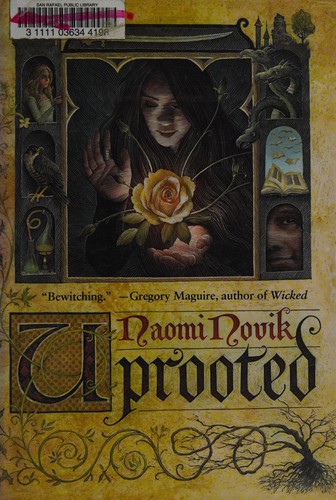
Uprooted by Naomi Novik is a 2015 fantasy book about coming of age, nature and corruption, knowledge and power. The Wood is the novel's most memorable creation — a corruption that doesn't kill but transforms, making its victims still-themselves but changed in ways that can't be undone. It's more unsettling than a monster.
Summary
Uprooted is a standalone fantasy novel inspired by Polish folklore. Every ten years, the wizard known as the Dragon takes a girl from the villages near the Wood — a vast, sentient, corrupting forest that constantly pushes against the boundaries of the kingdom. The chosen girl lives in his tower for a decade, then is released. Most leave without looking back. When it's Agnieszka's village's turn, everyone expects him to choose her beautiful, graceful best friend Kasia. He chooses Agnieszka instead. The story begins there, in the confusion of that choice and what it reveals.
Uprooted is about the Wood as much as it's about Agnieszka. The forest is genuinely strange — not a metaphor for evil but something more specific, a corruption that takes hold of living things and transforms them from the inside, twisting their nature without destroying it. The novel asks what it would take to heal something like that, and whether healing and destroying are always different operations. Agnieszka's magic is chaotic and intuitive, resistant to the Dragon's ordered systems, and the tension between their approaches to power is the book's central intellectual argument.
Novik's prose is warm and assured. The fairy-tale register is deliberate — this is a novel that knows its genre and is in conversation with it rather than trying to subvert it. The romance is slow-burn and occupies more space than some readers want from an otherwise plot-driven book, but Novik earns it rather than forcing it. The Wood sequences are the strongest writing in the novel: genuinely unsettling, visually specific, and emotionally resonant in ways that outlast the plot.
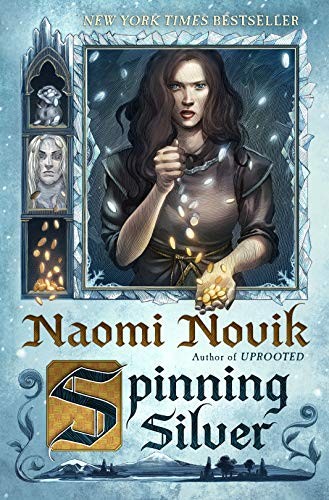
Uprooted won the Nebula Award and is widely considered Novik's best standalone work. It reads in a weekend, moves well, and leaves a strong aftertaste. Readers who want harder edges or more political complexity may find it slight; readers who want an immersive fairy-tale world with genuine stakes will find it close to perfect. The sequel in spirit (not in story) is Spinning Silver — same author, different folklore, equally good.
Talk to Uprooted like its author wrote you back.
Get the ideas that fit your life — not generic summaries.
- Chat with the book
- Audiobook-style main ideas
- Adapts to your life and goals
- Helps you take action
Key takeaways
- 1.
The Wood is the novel's most memorable creation — a corruption that doesn't kill but transforms, making its victims still-themselves but changed in ways that can't be undone. It's more unsettling than a monster.
- 2.
Agnieszka's magic is characterized by its resistance to system. Novik is writing about different ways of knowing — intuitive versus formal, embodied versus theoretical — and arguing neither is sufficient alone.
- 3.
The Dragon is the classic difficult mentor figure, but Novik complicates the archetype: his coldness is not withholding, it's a genuine limitation he has to work past.
- 4.
The friendship between Agnieszka and Kasia is the novel's emotional spine, not the romance. What the Wood does to that friendship, and what Agnieszka does to reclaim it, is where the book's real weight lives.
- 5.
The fairy-tale register is intentional: Novik is working in a tradition and knows it. The novel is in conversation with Slavic folklore rather than retrofitting modern values onto a medieval setting.
- 6.
The question of whether the Wood can be healed — or whether it needs to be destroyed — organizes the book's second half. Novik's answer is more complicated than either option suggests.
- 7.
Place matters here more than in most fantasy: the valley, the villages, the tower, and the Wood are not backdrop but actors. Agnieszka's love of her home landscape is the source of her power.
- 8.
The novel argues that two systems of magic in conflict can accomplish something neither can do alone — a metaphor about collaboration that runs through the entire book without being forced.
Discussion questions
Use these on your own, with a book club, or as chat starters in Superbook. Book club version, ready to copy or print →
- 1.
The Dragon chooses Agnieszka, not Kasia, even though no one expects it. What do you think he sees that everyone else misses, and does the novel answer this clearly?
- 2.
Agnieszka's magic is messy, intuitive, and against system. Does the novel suggest this is inherently better than the Dragon's formal approach, or just different?
- 3.
The Wood is not evil in the way fantasy villains usually are — it's more like a force that acts according to its own nature. Does that make it more or less frightening to you?
- 4.
Kasia's fate and what Agnieszka risks to undo it drive a large section of the novel. What does this subplot say about the cost of friendship and the limits of love?
- 5.
The romance between Agnieszka and the Dragon is slow-burn and takes up substantial space. Did you find it earned or distracting? Does it strengthen or weaken the book's other themes?
- 6.
The villagers' relationship to the Dragon is fearful and grateful at the same time. How does the novel use that ambivalence to talk about the relationship between power and protection?
- 7.
The ending involves a decision about the Wood that is both destructive and generative. Was that resolution satisfying? Did Novik earn the mythic register she uses for it?
- 8.
Novik draws on Polish folklore rather than the usual Western European sources. Did the unfamiliarity of the folkloric elements enrich the world-building or leave you wanting more context?
- 9.
Agnieszka is a heroine who repeatedly ignores advice, trusts her instincts, and causes chaos. Is she a reliable protagonist, or is the novel asking you to read her critically?
- 10.
Compared to Spinning Silver, which covers similar thematic territory with a sharper political edge, where does Uprooted feel stronger or weaker?
- 11.
If the Wood is read as a metaphor for trauma — something that gets inside you and changes you without destroying you — how does that reading hold up across the full novel?
- 12.
The novel ends with Agnieszka choosing to stay near the Wood rather than leave. What does that choice say about her relationship to her own power and her own past?
Themes
Frequently asked questions
-
Is Uprooted a standalone novel or part of a series?
Uprooted is a complete standalone novel. Spinning Silver, also by Naomi Novik, is set in a different world but has a similar folkloric sensibility and is often read as a companion piece rather than a sequel.
-
Is Uprooted appropriate for younger readers?
Mostly yes, though there is a brief sexual scene and the Wood sequences are genuinely disturbing. It's commonly recommended for readers 16 and up. The romance is restrained and the horror is more unsettling than graphic.
-
What makes Uprooted different from other fantasy novels?
The Wood as an antagonist — a corruption rather than a villain — gives the book an unusual texture. The folkloric source material is Eastern European rather than the usual Tolkien-derived Western European setting. And the central relationship between Agnieszka and Kasia is a friendship, not a romance, which is rare for the genre.
-
Who shouldn't read Uprooted?
Readers who want grimdark complexity, morally gray protagonists, or sustained political world-building. This is a fairy-tale novel — warmer and more archetypal than realistic. If that register annoys you, this won't convert you.
-
How does Uprooted compare to Spinning Silver?
Both are excellent. Uprooted is warmer and more adventure-driven; Spinning Silver is sharper, more politicized, and more explicitly feminist. Many readers prefer whichever they read first.