Science fiction · Book club
Use of Weapons book club questions
Here are 12 book club questions for Use of Weapons by Iain M. Banks, ordered to open easily and end somewhere worth arguing about. Copy them, print them, or bring them up one at a time.
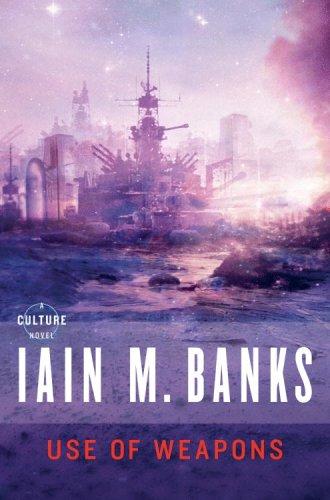
Cheradenine Zakalwe is one of Special Circumstances' most effective agents — a man recruited from outside the Culture and deployed to fight and manipulate wars the Culture wishes to influence without visibly fighting.
Iain M. Banks · 1990 · 7h 45m
Full summary and key takeaways →The 12 questions
- 1.
The ending reveals something about Zakalwe's identity that retroactively changes the meaning of everything that came before. Did you see it coming, and if so, at what point? If not, how did it land?
- 2.
Banks structures the novel with chapters counting forward and backward simultaneously. Did you find this clarifying, disorienting, or both? Does the form justify the cost in readerly effort?
- 3.
Special Circumstances recruits Zakalwe because he can do things the Culture cannot sanction doing directly. What does that recruitment relationship say about the moral consistency of the Culture?
- 4.
Diziet Sma clearly cares about Zakalwe but also uses him repeatedly. Is that a contradiction in her character, or does the novel suggest those two things are compatible?
- 5.
The chair is the novel's central object and its significance is withheld until the end. Once you know what it means, does it change specific earlier scenes? Which ones?
- 6.
Banks once described Use of Weapons as the novel he was most satisfied with. Having read it, do you think that satisfaction was about the ending, the structure, the character of Zakalwe, or something else?
- 7.
Zakalwe is presented as a man defined by violence — but the violence is historical, and the novel shows his tenderness and his capacity for loyalty in parallel. Does Banks ask you to care about him? Does it work?
- 8.
Compare Zakalwe to other broken soldiers or agents in fiction. What distinguishes Banks's treatment from, say, Le Carré's use of similar figures?
- 9.
The Culture is absent from much of the novel — it intervenes through Zakalwe and Sma rather than directly. Does this absence make the Culture seem more or less powerful?
- 10.
The backward narrative chapters are numbered in Roman numerals counting down to a single number. What is the effect of that countdown as a reading experience?
- 11.
Zakalwe's missions always involve propping up or manipulating human(oid) societies toward outcomes the Culture prefers. The people he manipulates rarely know it's happening. Is this different in kind from what empires do, or only in degree?
- 12.
The novel is dense and structurally demanding. If you had to identify the single most important sentence or passage for understanding what the book is doing, what would it be?
How to run the discussion
- Pick six to eight, not all of them. An hour of real discussion covers fewer questions than anyone expects, and racing the list is what makes a book club feel like homework.
- Open with what people noticed, not what they concluded. Asking for a verdict first hardens opinions before anyone has heard each other.
- Let the disagreement run. The questions below that split a room are the ones worth the time; the ones everyone answers the same way can be skipped.
- Ask the quiet person a specific question. A direct, narrow question is far easier to answer than an open invitation to contribute.
Themes worth steering toward
If the conversation stalls, these are the threads that usually restart it.
Common questions
What are good book club questions for Use of Weapons?
Here are 12 book club questions for Use of Weapons by Iain M. Banks, ordered to open easily and end somewhere worth arguing about. The strongest openers ask what each reader noticed rather than what they concluded, and the discussion usually turns on guilt and atonement, war and complicity, identity and the past.
How long should a book club discussion of Use of Weapons last?
Most groups run 60 to 90 minutes of actual discussion. That is roughly six to eight questions, not all of them, so pick the ones that suit your group rather than working down the list in order.
What are the main themes in Use of Weapons?
Guilt and atonement, War and complicity, Identity and the past, Manipulation and agency, Violence and civilization. Those are the threads most likely to divide a room, which makes them the useful places to steer a discussion that has gone quiet.
Picking the next one? See books like Use of Weapons or questions for other book club picks.
