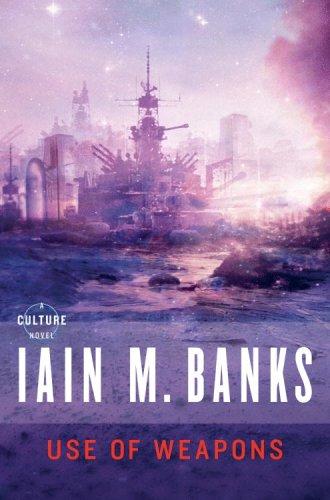
Use of Weapons by Iain M. Banks is a 1990 science fiction book about guilt and atonement, war and complicity, identity and the past. The dual-timeline structure — one moving forward, one backward — is not a stylistic flourish but a structural argument: Zakalwe's present is intelligible only as a flight from his past.
Summary
Cheradenine Zakalwe is one of Special Circumstances' most effective agents — a man recruited from outside the Culture and deployed to fight and manipulate wars the Culture wishes to influence without visibly fighting. The novel tells his story in two interlocking narrative threads moving in opposite directions: one forward in time through a series of missions, one backward into his past. The reader understands from very early on that something in that past is catastrophic, and that the present is, in some sense, a flight from it.
The structure is the book. Banks alternates chapters numbered sequentially forward with chapters numbered sequentially backward — roman numerals counting down, arabic counting up — so that the mystery of Zakalwe's past is excavated as his present missions continue. The technique creates a ratcheting tension that intensifies as both timelines approach their convergence. It is demanding but not gimmicky; the structure enacts the novel's meaning rather than decorating it.
The book is Banks's most direct engagement with the moral cost of the Culture's methods. Special Circumstances recruits people who are already broken in ways that make them useful — who can commit acts the Culture wishes done but cannot do itself — and then employs them until they're used up. Zakalwe is not a villain; he is a man shaped by violence into an instrument of violence, deployed by a civilization that congratulates itself on its nonviolence. The irony is structural rather than declared.
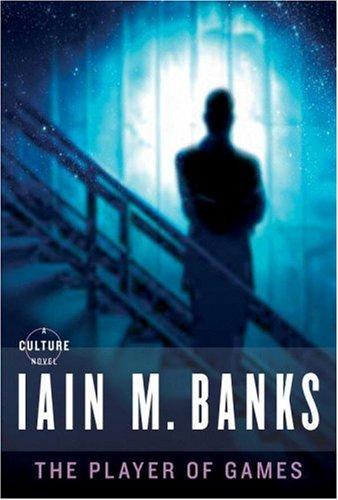
This is not the best entry point for Banks; The Player of Games is gentler and more self-contained. Use of Weapons rewards readers who already care about Zakalwe and the Culture's ethical contradictions, and it demands more structural patience than most science fiction asks for. The ending is one of the most discussed in the genre — it reframes the entire novel, and the reframing is not comfortable. Banks once said it was the novel he was most satisfied with, and the claim is defensible.
Talk to Use of Weapons like its author wrote you back.
Get the ideas that fit your life — not generic summaries.
- Chat with the book
- Audiobook-style main ideas
- Adapts to your life and goals
- Helps you take action
Key takeaways
- 1.
The dual-timeline structure — one moving forward, one backward — is not a stylistic flourish but a structural argument: Zakalwe's present is intelligible only as a flight from his past.
- 2.
Special Circumstances is here at its most morally compromised: an organization that deploys broken people to do necessary violence so the Culture can maintain its clean hands.
- 3.
Zakalwe's capacity for violence is presented as having been forged rather than innate. Banks is interested in how circumstances shape what a person becomes capable of.
- 4.
The chair — a recurring object in the backward narrative — functions as an image whose full significance is withheld until the end. When it lands, it retroactively changes everything.
- 5.
Diziet Sma, Zakalwe's handler, is one of Banks's most fully realized characters: an idealist operating inside a system whose methods undermine the ideals she holds.
- 6.
The Culture's benevolence is consistently undermined by what it requires of people outside its borders. Use of Weapons is the series' clearest account of what that requirement costs.
- 7.
Identity in the novel is multiply unstable: Zakalwe's name, his history, his relationship to the person he was are all put under pressure before the ending makes the instability exact.
- 8.
The novel earns its ending. Everything the backward narrative reveals has been present in the text throughout; the shock comes not from withheld information but from a recombination of what was visible.
Discussion questions
Use these on your own, with a book club, or as chat starters in Superbook. Book club version, ready to copy or print →
- 1.
The ending reveals something about Zakalwe's identity that retroactively changes the meaning of everything that came before. Did you see it coming, and if so, at what point? If not, how did it land?
- 2.
Banks structures the novel with chapters counting forward and backward simultaneously. Did you find this clarifying, disorienting, or both? Does the form justify the cost in readerly effort?
- 3.
Special Circumstances recruits Zakalwe because he can do things the Culture cannot sanction doing directly. What does that recruitment relationship say about the moral consistency of the Culture?
- 4.
Diziet Sma clearly cares about Zakalwe but also uses him repeatedly. Is that a contradiction in her character, or does the novel suggest those two things are compatible?
- 5.
The chair is the novel's central object and its significance is withheld until the end. Once you know what it means, does it change specific earlier scenes? Which ones?
- 6.
Banks once described Use of Weapons as the novel he was most satisfied with. Having read it, do you think that satisfaction was about the ending, the structure, the character of Zakalwe, or something else?
- 7.
Zakalwe is presented as a man defined by violence — but the violence is historical, and the novel shows his tenderness and his capacity for loyalty in parallel. Does Banks ask you to care about him? Does it work?
- 8.
Compare Zakalwe to other broken soldiers or agents in fiction. What distinguishes Banks's treatment from, say, Le Carré's use of similar figures?
- 9.
The Culture is absent from much of the novel — it intervenes through Zakalwe and Sma rather than directly. Does this absence make the Culture seem more or less powerful?
- 10.
The backward narrative chapters are numbered in Roman numerals counting down to a single number. What is the effect of that countdown as a reading experience?
- 11.
Zakalwe's missions always involve propping up or manipulating human(oid) societies toward outcomes the Culture prefers. The people he manipulates rarely know it's happening. Is this different in kind from what empires do, or only in degree?
- 12.
The novel is dense and structurally demanding. If you had to identify the single most important sentence or passage for understanding what the book is doing, what would it be?
Themes
Frequently asked questions
-
Should I read The Player of Games before Use of Weapons?
The novels are independent, but The Player of Games is recommended as a starting point. It's more accessible and establishes what Special Circumstances is. Use of Weapons is more demanding structurally and emotionally; having some familiarity with the Culture helps.
-
Is the dual-timeline structure hard to follow?
It requires attention. The forward chapters are Arabic numerals increasing; the backward chapters are Roman numerals decreasing. Banks provides enough contextual anchoring that readers who stay with it are rewarded, but skimming is not an option with this novel.
-
What happens in the ending?
The ending reveals information that reframes Zakalwe's identity and the entire backward narrative. Most readers consider it essential not to spoil. If you're curious before reading, be warned: knowing it changes the experience considerably.
-
Is Use of Weapons a dark book?
Yes. It contains significant violence, including violence against civilians, and the novel's moral universe does not offer easy consolation. Banks is examining what violence does to people who commit it and to the institutions that deploy them. The ending is not comforting.
-
Who might not enjoy this book?
Readers who want genre science fiction with forward propulsion and clean plotting will find the dual-timeline structure frustrating. The novel's pleasures require patience and a tolerance for moral complexity. It's demanding in a way that pays off, but you have to meet it.