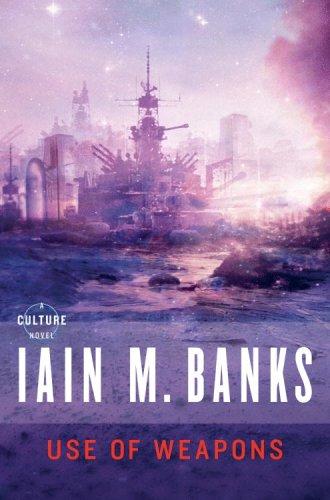
Talk to Use of Weapons like its author wrote you back.
Get the ideas that fit your life — not generic summaries.
- Chat with the book
- Audiobook-style main ideas
- Adapts to your life and goals
- Helps you take action
What it argues
Cheradenine Zakalwe is one of Special Circumstances' most effective agents — a man recruited from outside the Culture and deployed to fight and manipulate wars the Culture wishes to influence without visibly fighting. The novel tells his story in two interlocking narrative threads moving in opposite directions: one forward in time through a series of missions, one backward into his past. The reader understands from very early on that something in that past is catastrophic, and that the present is, in some sense, a flight from it.
The structure is the book. Banks alternates chapters numbered sequentially forward with chapters numbered sequentially backward — roman numerals counting down, arabic counting up — so that the mystery of Zakalwe's past is excavated as his present missions continue. The technique creates a ratcheting tension that intensifies as both timelines approach their convergence. It is demanding but not gimmicky; the structure enacts the novel's meaning rather than decorating it.
What it gets right
- 1.
The dual-timeline structure — one moving forward, one backward — is not a stylistic flourish but a structural argument: Zakalwe's present is intelligible only as a flight from his past.
- 2.
Special Circumstances is here at its most morally compromised: an organization that deploys broken people to do necessary violence so the Culture can maintain its clean hands.
- 3.
Zakalwe's capacity for violence is presented as having been forged rather than innate. Banks is interested in how circumstances shape what a person becomes capable of.
What it covers
Who wrote it
Iain M. Banks (1954–2013) was a Scottish novelist who published literary fiction as Iain Banks and science fiction as Iain M. Banks. His Culture series — ten novels set in a post-scarcity interstellar civilization governed by benevolent AIs — is among the most celebrated sequences in science fiction. Use of Weapons, third in the series, is often regarded as his masterpiece. His literary novels include The Wasp Factory, The Crow Road, and Complicity. He was known for political intelligence, structural invention, and a mordant wit. He announced his terminal cancer diagnosis publicly in 2013 and died the same year.
