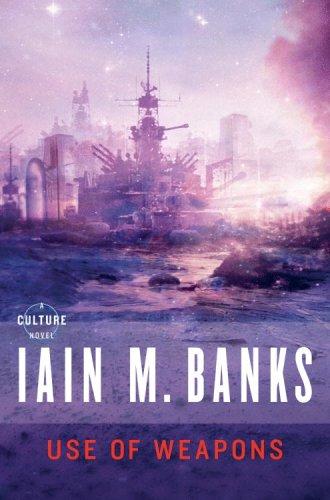
Talk to Use of Weapons like its author wrote you back.
Get the ideas that fit your life — not generic summaries.
- Chat with the book
- Audiobook-style main ideas
- Adapts to your life and goals
- Helps you take action
Use of Weapons, in detail
Cheradenine Zakalwe is one of Special Circumstances' most effective agents — a man recruited from outside the Culture and deployed to fight and manipulate wars the Culture wishes to influence without visibly fighting. The novel tells his story in two interlocking narrative threads moving in opposite directions: one forward in time through a series of missions, one backward into his past. The reader understands from very early on that something in that past is catastrophic, and that the present is, in some sense, a flight from it.
The structure is the book. Banks alternates chapters numbered sequentially forward with chapters numbered sequentially backward — roman numerals counting down, arabic counting up — so that the mystery of Zakalwe's past is excavated as his present missions continue. The technique creates a ratcheting tension that intensifies as both timelines approach their convergence. It is demanding but not gimmicky; the structure enacts the novel's meaning rather than decorating it.
The book is Banks's most direct engagement with the moral cost of the Culture's methods. Special Circumstances recruits people who are already broken in ways that make them useful — who can commit acts the Culture wishes done but cannot do itself — and then employs them until they're used up. Zakalwe is not a villain; he is a man shaped by violence into an instrument of violence, deployed by a civilization that congratulates itself on its nonviolence. The irony is structural rather than declared.
This is not the best entry point for Banks; The Player of Games is gentler and more self-contained. Use of Weapons rewards readers who already care about Zakalwe and the Culture's ethical contradictions, and it demands more structural patience than most science fiction asks for. The ending is one of the most discussed in the genre — it reframes the entire novel, and the reframing is not comfortable. Banks once said it was the novel he was most satisfied with, and the claim is defensible.
The big ideas
- 1.
The dual-timeline structure — one moving forward, one backward — is not a stylistic flourish but a structural argument: Zakalwe's present is intelligible only as a flight from his past.
- 2.
Special Circumstances is here at its most morally compromised: an organization that deploys broken people to do necessary violence so the Culture can maintain its clean hands.
- 3.
Zakalwe's capacity for violence is presented as having been forged rather than innate. Banks is interested in how circumstances shape what a person becomes capable of.
