Science · Book club
Welcome to the Universe book club questions
Here are 12 book club questions for Welcome to the Universe by Neil deGrasse Tyson, Michael A. Strauss, and J. Richard Gott, ordered to open easily and end somewhere worth arguing about. Copy them, print them, or bring them up one at a time.
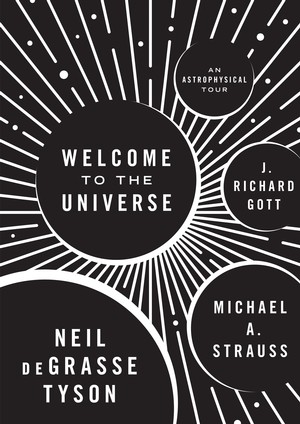
Welcome to the Universe began as a popular astrophysics course at Princeton taught by three faculty members — Neil deGrasse Tyson, Michael Strauss, and J.
Neil deGrasse Tyson, Michael A. Strauss, and J. Richard Gott · 2016 · 10h 0m
Full summary and key takeaways →The 12 questions
- 1.
The book uses actual equations in places where most popular science books avoid them. Did that add to your understanding or make you skip ahead, and what does your answer reveal about how you engage with science?
- 2.
Stars produce the heavy elements that make up planets, life, and your own body through nuclear fusion and supernovae. Does knowing that change how you think about the relationship between humans and the cosmos?
- 3.
The event horizon of a black hole is a point of no return, but an infalling observer would not notice anything unusual as they crossed it. What does this imply about the nature of physical laws at extreme scales?
- 4.
General relativity predicts that time passes more slowly near massive objects. GPS satellites have to correct for this effect. When does theoretical physics stop feeling abstract and start feeling practical?
- 5.
Gott discusses time travel as a theoretical possibility consistent with general relativity. Where do you draw the line between speculative physics and science fiction?
- 6.
Dark matter and dark energy make up about 95% of the universe, yet we have no direct evidence of either. How does cosmology proceed as a discipline when the majority of its subject matter is undetectable?
- 7.
The book is the product of a university course. Does knowing it was designed for classroom use change how you read it — do you engage it more or less critically than a solo author's book?
- 8.
Tyson, Strauss, and Gott each bring a different voice and set of concerns to the book. Whose explanations did you find most accessible, and what does your preference suggest about how you like to learn?
- 9.
The scale of the universe — billions of light-years, billions of years — is beyond any intuitive human grasp. Is there any benefit to trying to internalize that scale, or is it enough to know the numbers?
- 10.
Inflation explains the uniformity and flatness of the universe but was invented partly to solve mathematical problems. How much should the elegance of a solution count as evidence for its truth?
- 11.
The possibility of a multiverse follows logically from inflation, but no prediction from multiverse models has been tested. Is an untestable theory still science?
- 12.
If you could choose one concept from the book to understand more deeply — not just accept — what would it be, and what would genuinely understanding it require?
How to run the discussion
- Pick six to eight, not all of them. An hour of real discussion covers fewer questions than anyone expects, and racing the list is what makes a book club feel like homework.
- Open with what people noticed, not what they concluded. Asking for a verdict first hardens opinions before anyone has heard each other.
- Let the disagreement run. The questions below that split a room are the ones worth the time; the ones everyone answers the same way can be skipped.
- Ask the quiet person a specific question. A direct, narrow question is far easier to answer than an open invitation to contribute.
Themes worth steering toward
If the conversation stalls, these are the threads that usually restart it.
Common questions
What are good book club questions for Welcome to the Universe?
Here are 12 book club questions for Welcome to the Universe by Neil deGrasse Tyson, Michael A. Strauss, and J. Richard Gott, ordered to open easily and end somewhere worth arguing about. The strongest openers ask what each reader noticed rather than what they concluded, and the discussion usually turns on astrophysics, cosmology, space exploration.
How long should a book club discussion of Welcome to the Universe last?
Most groups run 60 to 90 minutes of actual discussion. That is roughly six to eight questions, not all of them, so pick the ones that suit your group rather than working down the list in order.
What are the main themes in Welcome to the Universe?
Astrophysics, Cosmology, Space exploration, Relativity, Black holes. Those are the threads most likely to divide a room, which makes them the useful places to steer a discussion that has gone quiet.
Picking the next one? See books like Welcome to the Universe or questions for other book club picks.
