Philosophy · Book club
When Nietzsche Wept book club questions
Here are 12 book club questions for When Nietzsche Wept by Irvin D. Yalom, ordered to open easily and end somewhere worth arguing about. Copy them, print them, or bring them up one at a time.
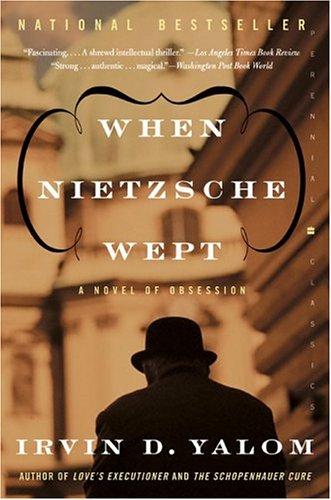
When Nietzsche Wept is a philosophical novel by psychiatrist Irvin Yalom set in Vienna in 1882.
Irvin D. Yalom · 1992 · 7h 45m
Full summary and key takeaways →The 12 questions
- 1.
The eternal recurrence asks: would you choose to live this exact life again? Apply it to your own life right now. What does your answer reveal?
- 2.
Nietzsche's distaste for pity and dependence sits in tension with the therapeutic enterprise. Does Yalom resolve that tension, or does the novel leave it productively open?
- 3.
Breuer's obsession with Anna O. is presented as a symptom of his own unlived life. Do you think that diagnosis is persuasive, or is it too neat?
- 4.
Yalom gives Nietzsche recognizable human vulnerability without diminishing his ideas. Is that a fair portrait of what the philosophy actually meant to Nietzsche the man?
- 5.
The novel suggests that becoming who you are requires a kind of ruthlessness toward conventional expectations. Does that idea feel liberating or irresponsible to you?
- 6.
Will to power, as Yalom presents it, is fundamentally about self-overcoming. How does that reading compare to common misreadings of Nietzsche as endorsing domination?
- 7.
Both characters are simultaneously helping and being helped by each other, though neither fully admits it. Do you recognize that dynamic in professional or personal relationships you've had?
- 8.
Amor fati implies embracing suffering as necessary. Is there a difference between accepting the past and endorsing it? Where does that line fall for you?
- 9.
The setting — Vienna 1882, at the dawn of psychoanalysis — allows Yalom to stage a meeting between philosophy and psychology. Do you think the novel treats both disciplines fairly?
- 10.
Nietzsche says he can help Breuer free himself only if Breuer first confesses the authentic despair he is hiding. Is honest self-disclosure a necessary condition for growth, in your experience?
- 11.
The death of God frames much of the novel's concern with meaning. If traditional frameworks no longer provide guaranteed meaning, what replaces them in your own life?
- 12.
Lou Salomé is a minor but significant character who sets the events in motion. What is Yalom suggesting by making her the catalyst rather than a patient or therapist?
How to run the discussion
- Pick six to eight, not all of them. An hour of real discussion covers fewer questions than anyone expects, and racing the list is what makes a book club feel like homework.
- Open with what people noticed, not what they concluded. Asking for a verdict first hardens opinions before anyone has heard each other.
- Let the disagreement run. The questions below that split a room are the ones worth the time; the ones everyone answers the same way can be skipped.
- Ask the quiet person a specific question. A direct, narrow question is far easier to answer than an open invitation to contribute.
Themes worth steering toward
If the conversation stalls, these are the threads that usually restart it.
Common questions
What are good book club questions for When Nietzsche Wept?
Here are 12 book club questions for When Nietzsche Wept by Irvin D. Yalom, ordered to open easily and end somewhere worth arguing about. The strongest openers ask what each reader noticed rather than what they concluded, and the discussion usually turns on existentialism, psychotherapy, nietzsche.
How long should a book club discussion of When Nietzsche Wept last?
Most groups run 60 to 90 minutes of actual discussion. That is roughly six to eight questions, not all of them, so pick the ones that suit your group rather than working down the list in order.
What are the main themes in When Nietzsche Wept?
Existentialism, Psychotherapy, Nietzsche, Meaning, Will to power. Those are the threads most likely to divide a room, which makes them the useful places to steer a discussion that has gone quiet.
Picking the next one? See books like When Nietzsche Wept or questions for other book club picks.
