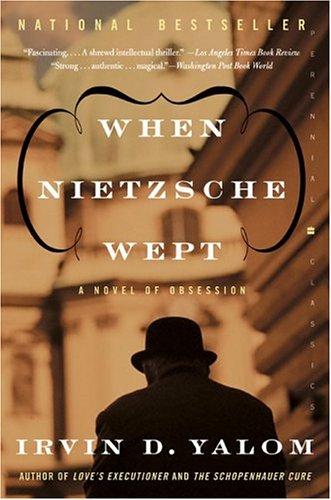
When Nietzsche Wept by Irvin D. Yalom is a 1992 philosophy book about existentialism, psychotherapy, nietzsche. Eternal recurrence — living as if you would choose to relive your life endlessly — is Nietzsche's test for authentic self-affirmation, not a cosmological claim. The question it asks is: have you lived your life, or merely endured it?
Summary
When Nietzsche Wept is a philosophical novel by psychiatrist Irvin Yalom set in Vienna in 1882. Its central conceit: Lou Salomé, who knew both Friedrich Nietzsche and Josef Breuer (Freud's mentor and collaborator), arranges for Breuer to treat Nietzsche in secret for the despair she fears will destroy him, while Nietzsche resists the idea of needing help at all. What follows is a fictional dialogue between two brilliant, suffering men — one who helped invent psychotherapy, one who dismantled the foundations of Western morality — neither of whom fully acknowledges what they are doing for the other.
Yalom uses the therapeutic encounter as a vehicle for dramatizing Nietzsche's ideas. The eternal recurrence, the will to power, amor fati, and the death of God appear not as lecture topics but as points of friction in two lives. Nietzsche's contempt for dependence and pity collides with Breuer's compassionate clinical impulse. Breuer's own secret — his obsessive attachment to a former patient, Anna O. — turns the therapy around: Nietzsche, refusing to be a patient, becomes something closer to a philosophical friend who forces Breuer to examine his own life.
The novel is organized around the existential themes Yalom would later develop in his nonfiction: death anxiety, meaninglessness, freedom, and isolation. Both main characters confront the possibility that their lives lack authentic purpose. Nietzsche's prescription — become who you are, live as if you would choose to live this life again endlessly — is not a comfortable answer, but it is a serious one. Breuer's arc is quieter and more domestic, a midlife confrontation with unlived life.
Yalom wears his scholarship lightly but accurately: the novel's Nietzsche is philosophically recognizable, not a caricature. For readers who find Nietzsche's actual writing too aphoristic or confrontational, the novel is a usable gateway. For readers already familiar with the philosophy, Yalom's dramatization tests the ideas against lived human experience in ways that pages of commentary cannot.
Talk to When Nietzsche Wept like its author wrote you back.
Get the ideas that fit your life — not generic summaries.
- Chat with the book
- Audiobook-style main ideas
- Adapts to your life and goals
- Helps you take action
Key takeaways
- 1.
Eternal recurrence — living as if you would choose to relive your life endlessly — is Nietzsche's test for authentic self-affirmation, not a cosmological claim. The question it asks is: have you lived your life, or merely endured it?
- 2.
Will to power, in Yalom's rendering, is not domination of others but self-overcoming: the drive to grow, create, and become more fully oneself despite difficulty.
- 3.
The therapeutic relationship has a paradox at its center: helping someone often requires them not to feel helped, because the goal is their independence, not their dependence.
- 4.
Breuer's obsessive attachment to Anna O. illustrates the ways professional people who help others can use their patients as a displacement from examining their own lives.
- 5.
Amor fati — love of fate — means embracing not just what you would have chosen but everything that happened, including suffering, as necessary to who you are.
- 6.
Nietzsche's contempt for pity reflects his worry that compassion often expresses a need to feel superior or needed, not genuine care. This is a more uncomfortable argument than it first appears.
- 7.
Both main characters are imprisoned — Nietzsche by isolation and physical suffering, Breuer by domestic respectability and unlived desire. The novel treats these imprisonments as structurally similar.
- 8.
The death of God is not primarily an atheist argument but a diagnosis of the human condition: we have lost the framework that gave life guaranteed meaning, and must now find meaning ourselves.
Discussion questions
Use these on your own, with a book club, or as chat starters in Superbook. Book club version, ready to copy or print →
- 1.
The eternal recurrence asks: would you choose to live this exact life again? Apply it to your own life right now. What does your answer reveal?
- 2.
Nietzsche's distaste for pity and dependence sits in tension with the therapeutic enterprise. Does Yalom resolve that tension, or does the novel leave it productively open?
- 3.
Breuer's obsession with Anna O. is presented as a symptom of his own unlived life. Do you think that diagnosis is persuasive, or is it too neat?
- 4.
Yalom gives Nietzsche recognizable human vulnerability without diminishing his ideas. Is that a fair portrait of what the philosophy actually meant to Nietzsche the man?
- 5.
The novel suggests that becoming who you are requires a kind of ruthlessness toward conventional expectations. Does that idea feel liberating or irresponsible to you?
- 6.
Will to power, as Yalom presents it, is fundamentally about self-overcoming. How does that reading compare to common misreadings of Nietzsche as endorsing domination?
- 7.
Both characters are simultaneously helping and being helped by each other, though neither fully admits it. Do you recognize that dynamic in professional or personal relationships you've had?
- 8.
Amor fati implies embracing suffering as necessary. Is there a difference between accepting the past and endorsing it? Where does that line fall for you?
- 9.
The setting — Vienna 1882, at the dawn of psychoanalysis — allows Yalom to stage a meeting between philosophy and psychology. Do you think the novel treats both disciplines fairly?
- 10.
Nietzsche says he can help Breuer free himself only if Breuer first confesses the authentic despair he is hiding. Is honest self-disclosure a necessary condition for growth, in your experience?
- 11.
The death of God frames much of the novel's concern with meaning. If traditional frameworks no longer provide guaranteed meaning, what replaces them in your own life?
- 12.
Lou Salomé is a minor but significant character who sets the events in motion. What is Yalom suggesting by making her the catalyst rather than a patient or therapist?
Themes
Frequently asked questions
-
Is When Nietzsche Wept fiction or nonfiction?
It is a philosophical novel — fiction built around real historical figures. The events and dialogue are invented, but Yalom grounds them in documented history and authentic philosophy.
-
Do I need to know Nietzsche's philosophy to enjoy this book?
No prior knowledge is required. Yalom introduces Nietzsche's key ideas — eternal recurrence, will to power, amor fati — through dialogue and action, making the novel a readable introduction to the philosophy.
-
Is this book appropriate for people interested in psychotherapy?
Yes, and it is often assigned in psychotherapy training programs. It dramatizes several core dilemmas in therapeutic practice, including the therapist's use of the patient and the paradox of fostering independence.
-
How accurate is the portrayal of the historical Nietzsche?
Yalom's Nietzsche is philosophically accurate and draws on documentary sources. The biographical elements are plausible rather than documented. Readers familiar with Nietzsche's letters and biography will recognize the portrait.
-
Who should read this book?
Readers interested in Nietzsche, existentialism, psychotherapy, or historical fiction. It works particularly well for people who want to engage with philosophy through narrative rather than argument, and for therapists interested in the existential dimensions of clinical work.