Talk to When Prophecy Fails like its author wrote you back.
Get the ideas that fit your life — not generic summaries.
- Chat with the book
- Audiobook-style main ideas
- Adapts to your life and goals
- Helps you take action
What it argues
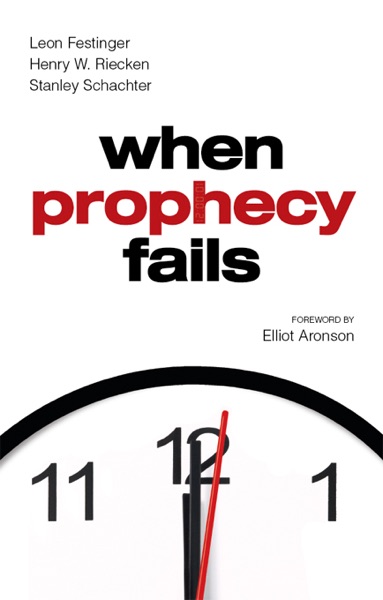
When Prophecy Fails is the account of an observational study Leon Festinger and his colleagues conducted by infiltrating a small doomsday cult in the American Midwest in the early 1950s. The group, led by a housewife named Dorothy Martin (called Marian Keech in the book), believed they had received messages from extraterrestrials warning that a great flood would destroy the earth on December 21, 1954, and that true believers would be taken up in flying saucers before the cataclysm. Festinger's researchers joined the group to observe what would happen when the prophecy failed.
The theoretical prediction that motivated the study came from Festinger's emerging theory of cognitive dissonance: the discomfort that arises when two beliefs a person holds are inconsistent with each other. Festinger predicted that when the flood did not come, group members would not abandon their beliefs — they would double down, rationalize, and then, crucially, seek to convert others. The dissonance between their investment in the belief and the plain evidence of its failure would be resolved not by abandoning the belief but by spreading it more vigorously, because more converts mean more social support for a belief that reality has failed to confirm.
What it gets right
- 1.
Cognitive dissonance — the psychological discomfort of holding contradictory beliefs — is not resolved by revising the belief; it is often resolved by adding new beliefs, seeking social support, or rationalizing the contradiction.
- 2.
Public commitment amplifies belief resistance: people who have publicly staked their identity on a belief are far less likely to abandon it when it is disproved than people who held it privately.
- 3.
Failed predictions do not necessarily weaken belief — they can strengthen it, particularly when the believer generates a plausible narrative that reframes the failure as confirmation.
What it covers
Who wrote it
Leon Festinger (1919–1989) was an American social psychologist whose work at MIT, the University of Minnesota, and Stanford shaped modern social psychology. He is best known for two major contributions: the theory of cognitive dissonance, introduced in When Prophecy Fails and developed formally in A Theory of Cognitive Dissonance (1957), and earlier work on social comparison theory, which proposed that people evaluate their own beliefs and abilities by comparing them to others. His work on dissonance became one of the most studied and replicated findings in social psychology and remains influential in behavioral economics, political science, and organizational behavior.
