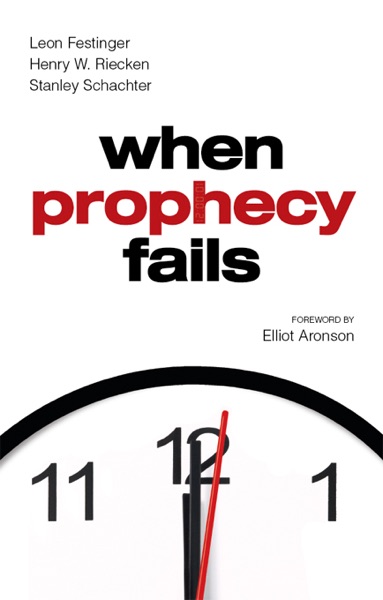
When Prophecy Fails by Leon Festinger is a 1956 psychology book about belief, cognitive dissonance, confirmation bias. Cognitive dissonance — the psychological discomfort of holding contradictory beliefs — is not resolved by revising the belief; it is often resolved by adding new beliefs, seeking social support, or rationalizing the contradiction.
Summary
When Prophecy Fails is the account of an observational study Leon Festinger and his colleagues conducted by infiltrating a small doomsday cult in the American Midwest in the early 1950s. The group, led by a housewife named Dorothy Martin (called Marian Keech in the book), believed they had received messages from extraterrestrials warning that a great flood would destroy the earth on December 21, 1954, and that true believers would be taken up in flying saucers before the cataclysm. Festinger's researchers joined the group to observe what would happen when the prophecy failed.
The theoretical prediction that motivated the study came from Festinger's emerging theory of cognitive dissonance: the discomfort that arises when two beliefs a person holds are inconsistent with each other. Festinger predicted that when the flood did not come, group members would not abandon their beliefs — they would double down, rationalize, and then, crucially, seek to convert others. The dissonance between their investment in the belief and the plain evidence of its failure would be resolved not by abandoning the belief but by spreading it more vigorously, because more converts mean more social support for a belief that reality has failed to confirm.
The prediction was largely borne out. When December 21 passed without flood or saucer, the core members of the group — those who had committed publicly, quit jobs, and given away possessions — remained believers. They quickly generated a new revelation explaining that the faith of the group had been so strong that God had spared the earth. The peripheral members, who had not publicly committed, dispersed. Within days, the core believers were actively seeking converts and media attention they had previously shunned.
The book is a founding document of social psychology and introduced cognitive dissonance as a formal concept. Its methodology is openly unusual — the researchers were participant observers whose presence may have affected the group they studied — and Festinger acknowledges this tension. The writing is dry by modern standards, but the central observation is remarkable and has held up: the more people sacrifice for a belief and the more publicly they hold it, the more resistant they become to disconfirming evidence, and the more likely they are to evangelize rather than recant.
Talk to When Prophecy Fails like its author wrote you back.
Get the ideas that fit your life — not generic summaries.
- Chat with the book
- Audiobook-style main ideas
- Adapts to your life and goals
- Helps you take action
Key takeaways
- 1.
Cognitive dissonance — the psychological discomfort of holding contradictory beliefs — is not resolved by revising the belief; it is often resolved by adding new beliefs, seeking social support, or rationalizing the contradiction.
- 2.
Public commitment amplifies belief resistance: people who have publicly staked their identity on a belief are far less likely to abandon it when it is disproved than people who held it privately.
- 3.
Failed predictions do not necessarily weaken belief — they can strengthen it, particularly when the believer generates a plausible narrative that reframes the failure as confirmation.
- 4.
Social support is a primary mechanism of belief maintenance. Isolated believers are more likely to abandon a failed belief; believers in groups reinforce each other's rationalizations.
- 5.
The core members who had made the greatest sacrifices (quit jobs, given away possessions) were the most resistant to disconfirmation — consistent with the prediction that investment increases belief resilience.
- 6.
Proselytizing after a failed prophecy serves a psychological function: more converts provide more social proof, which substitutes for the empirical proof that has been withdrawn.
- 7.
Peripheral members who had not publicly committed dispersed when the prophecy failed; only those with high sunk costs remained and intensified their belief.
- 8.
The theory of cognitive dissonance generalized well beyond doomsday cults: the same dynamics appear in political beliefs, investment decisions, and medical choices where people have made costly commitments.
Discussion questions
Use these on your own, with a book club, or as chat starters in Superbook. Book club version, ready to copy or print →
- 1.
The researchers joined the cult as undercover observers. Is that methodologically and ethically defensible? What is the alternative?
- 2.
Festinger predicted the group would proselytize after failure, and they did. Does the prediction's success validate the cognitive dissonance framework, or could other explanations account for the same behavior?
- 3.
The core members who had quit their jobs became more committed after the prophecy failed. Where in your own life have you seen that pattern — investment increasing resistance to revision?
- 4.
The peripheral members left when the prophecy failed. Why were they more willing to update their beliefs, and what does that tell you about commitment and belief?
- 5.
The new revelation — that God had spared the earth because of the group's faith — was accepted by core members immediately. What made that narrative satisfying when the literal prediction had failed?
- 6.
Cognitive dissonance was proposed in 1956. Where do you see it operating most visibly in contemporary life?
- 7.
The book is about a fringe doomsday group, but Festinger explicitly argued the dynamics apply broadly. Is there a risk that the exotic case makes it too easy to see in others and too hard to see in yourself?
- 8.
The methodology relied on researchers becoming members of the group. How did their presence affect the group's behavior? Is this a problem that undermines the findings?
- 9.
The group's leader, Dorothy Martin, was a real person who continued to lead groups for decades after the 1954 failure. What does that long career say about the durability of belief systems built on failed predictions?
- 10.
Failed prophecies in history — from religious millenarianism to financial predictions — often follow similar patterns. What conditions determine whether failure kills a belief or intensifies it?
- 11.
How do you personally detect when you're in the grip of motivated reasoning rather than genuine assessment of evidence?
- 12.
The book was published in 1956. Does the behavior it describes feel culturally specific to its era, or would the same study yield similar results today?
Themes
Frequently asked questions
-
Is When Prophecy Fails still scientifically credible?
The core observation — that failed beliefs can strengthen rather than weaken commitment when public investment is high — has been replicated in varied forms. The methodology (participant observation) is unusual and acknowledged as potentially contaminating. The cognitive dissonance framework it helped launch is one of the most studied theories in social psychology.
-
How long is When Prophecy Fails?
Around 250 pages. The writing is academic and sometimes dense, particularly in the theoretical sections. The observational chapters chronicling the group's activities read more like a case study or journalism.
-
Who are the main figures in the book?
The group's leader, Dorothy Martin, is called Marian Keech in the book to protect her identity. Festinger's research team included Henry Riecken and Stanley Schachter. The other group members are also anonymized.
-
What is cognitive dissonance exactly?
Festinger's term for the psychological discomfort caused by holding two beliefs or cognitions that are inconsistent with each other — for example, believing you are a careful decision-maker and knowing you have just made a costly mistake. People are motivated to reduce this discomfort, often by revising beliefs, rationalizing behavior, or seeking information that confirms the existing belief.
-
Is this relevant to understanding politics and misinformation today?
Directly. The dynamics Festinger identified — public commitment amplifying belief resistance, social support substituting for evidence, failed predictions being reframed as confirmation — are visible in political and online belief communities. The book provides language for what is otherwise hard to describe.
Similar books
Thinking, Fast and Slow
Daniel Kahneman
Predictably Irrational
Dan Ariely
You Are Not So Smart
David McRaney
The Righteous Mind: Why Good People Are Divided by Politics and Religion
Jonathan Haidt
