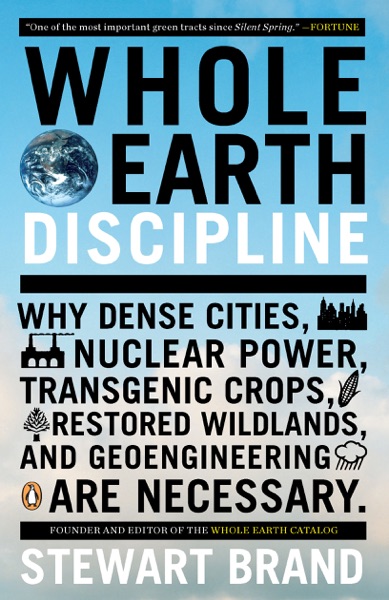
Talk to Whole Earth Discipline like its author wrote you back.
Get the ideas that fit your life — not generic summaries.
- Chat with the book
- Audiobook-style main ideas
- Adapts to your life and goals
- Helps you take action
What it argues
Whole Earth Discipline is Stewart Brand's argument that the environmental movement needs to update its orthodoxies in light of climate change and the actual evidence on the technologies it has historically opposed. Brand — founder of the Whole Earth Catalog and a founding figure of the modern environmental movement — argues in favor of nuclear energy, dense urbanization, and genetic engineering, three positions that put him sharply at odds with much of the movement he helped build.
The nuclear chapter is the book's most carefully argued section. Brand's case rests on a comparison of mortality and carbon output per unit of electricity across different energy sources. He argues that the fear of nuclear power has cost tens of thousands of lives by displacing it with coal, and that the major accidents — Three Mile Island, Chernobyl, and, after the book's publication, Fukushima — have killed fewer people combined than coal kills in most individual years through air pollution and mining accidents. He is not naive about the waste problem or the capital costs but argues that the climate math justifies reconsideration.
What it gets right
- 1.
Nuclear energy has a lower death rate per unit of electricity generated than coal, oil, gas, or even some renewable sources when full lifecycle impacts are counted. The fear of nuclear has been disproportionate to the actual risk.
- 2.
Dense cities are more environmentally efficient than suburbs or rural living by almost every measure: energy, water, land use, transportation. Urbanization is an environmental good, not a problem to be reversed.
- 3.
Slums are not failures of urban planning but entry points to economic opportunity. Squatter settlements become stable neighborhoods over one to two generations when property rights are secured.
What it covers
Who wrote it
Stewart Brand is an American writer, editor, and entrepreneur who helped shape the environmental and technological culture of the late twentieth century. He founded the Whole Earth Catalog in 1968, co-founded The WELL, an early online community, and helped start the Global Business Network and the Long Now Foundation. He has been deeply involved in environmental activism and digital culture for more than fifty years. Whole Earth Discipline, published in 2009, represents a deliberate revision of positions he had held for decades in response to climate change evidence.
