Talk to Whole Earth Discipline like its author wrote you back.
Get the ideas that fit your life — not generic summaries.
- Chat with the book
- Audiobook-style main ideas
- Adapts to your life and goals
- Helps you take action
Whole Earth Discipline, in detail
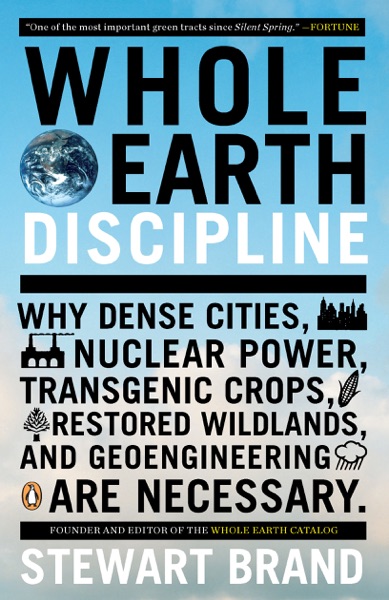
Whole Earth Discipline is Stewart Brand's argument that the environmental movement needs to update its orthodoxies in light of climate change and the actual evidence on the technologies it has historically opposed. Brand — founder of the Whole Earth Catalog and a founding figure of the modern environmental movement — argues in favor of nuclear energy, dense urbanization, and genetic engineering, three positions that put him sharply at odds with much of the movement he helped build.
The nuclear chapter is the book's most carefully argued section. Brand's case rests on a comparison of mortality and carbon output per unit of electricity across different energy sources. He argues that the fear of nuclear power has cost tens of thousands of lives by displacing it with coal, and that the major accidents — Three Mile Island, Chernobyl, and, after the book's publication, Fukushima — have killed fewer people combined than coal kills in most individual years through air pollution and mining accidents. He is not naive about the waste problem or the capital costs but argues that the climate math justifies reconsideration.
On cities, Brand reverses the anti-urban strain common in environmentalism since Thoreau. Dense cities, he argues, are dramatically more resource-efficient than dispersed suburbs or rural living. Urbanization is also where poor people go to stop being poor — slums are the entry point to economic opportunity and, over a generation, become stable urban neighborhoods. Opposing urbanization in the developing world in the name of preserving traditional rural life is, in Brand's view, a form of condescension that serves aesthetics over outcomes.
The biotechnology chapter makes a similar argument: that the opposition to genetically modified organisms, built on the precautionary principle and a mistrust of corporate science, has prevented the deployment of crops that could reduce pesticide use, improve nutrition, and enable farming in drought conditions. Brand acknowledges that corporate control of seed supply is a legitimate concern, but argues it is a policy problem distinct from the safety question the anti-GMO movement typically invokes.
The book is explicitly polemical and does not hide its agenda. Brand is arguing that a certain kind of environmentalism has become more about identity and orthodoxy than about outcomes, and that the outcome that matters most — a stable climate — requires reconsidering the movement's assumptions. Critics on the left found the book a gift to fossil fuel and nuclear industries; critics from more pragmatic environmentalists found it essential.
The big ideas
- 1.
Nuclear energy has a lower death rate per unit of electricity generated than coal, oil, gas, or even some renewable sources when full lifecycle impacts are counted. The fear of nuclear has been disproportionate to the actual risk.
- 2.
Dense cities are more environmentally efficient than suburbs or rural living by almost every measure: energy, water, land use, transportation. Urbanization is an environmental good, not a problem to be reversed.
- 3.
Slums are not failures of urban planning but entry points to economic opportunity. Squatter settlements become stable neighborhoods over one to two generations when property rights are secured.
