Religion & Spirituality · Book club
Why Buddhism Is True book club questions
Here are 11 book club questions for Why Buddhism Is True by Robert Wright, ordered to open easily and end somewhere worth arguing about. Copy them, print them, or bring them up one at a time.
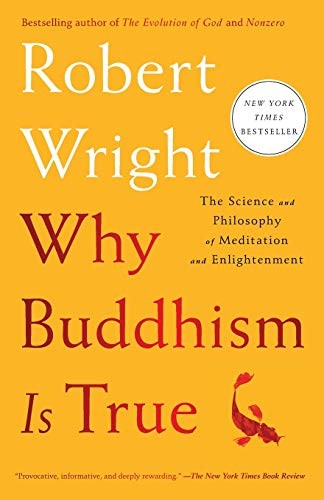
Why Buddhism Is True is Robert Wright's argument that modern evolutionary psychology and neuroscience provide independent confirmation for core Buddhist claims about the mind, suffering, and the nature of the self.
Robert Wright · 2017 · 6h 0m
Full summary and key takeaways →The 11 questions
- 1.
Wright argues that natural selection designed us to suffer in specific ways. Does understanding the evolutionary origins of your unhappiness change anything about how you relate to it?
- 2.
The hedonic treadmill describes how pleasure briefly satisfies craving before generating more craving. Where in your own life do you see this pattern most clearly?
- 3.
Wright makes a distinction between the psychological core of Buddhism (which he defends) and its metaphysical claims (which he brackets). Is that distinction philosophically defensible, or does it gut the religion of its content?
- 4.
The book argues that feelings are evolutionary signals, not accurate guides to reality or wellbeing. Which of your most reliable feelings do you think is most misleading?
- 5.
Neuroscience suggests the unified self is a construction rather than a fact. Does that finding seem liberating or disorienting to you?
- 6.
Wright draws heavily on secular mindfulness research. Does the secular framing of mindfulness strip something important from the Buddhist original, or make it more accessible and honest?
- 7.
If suffering is the inevitable product of evolutionary design, why would meditation — itself a product of evolution — be able to overcome it?
- 8.
Wright admits he is not a committed Buddhist practitioner. Does that undermine or strengthen his argument? Is the outsider's perspective a handicap or an advantage here?
- 9.
The evolutionary argument for Buddhist practice is indirect — it confirms the diagnosis without confirming the metaphysics. Is that enough to motivate practice?
- 10.
What would change in how you practice mindfulness (if you do) if you took seriously the idea that your feelings evolved to mislead you toward fitness rather than truth?
- 11.
The book's subtitle is 'The Science and Philosophy of Meditation and Enlightenment.' Does it deliver on the enlightenment part, or does it stop short?
How to run the discussion
- Pick six to eight, not all of them. An hour of real discussion covers fewer questions than anyone expects, and racing the list is what makes a book club feel like homework.
- Open with what people noticed, not what they concluded. Asking for a verdict first hardens opinions before anyone has heard each other.
- Let the disagreement run. The questions below that split a room are the ones worth the time; the ones everyone answers the same way can be skipped.
- Ask the quiet person a specific question. A direct, narrow question is far easier to answer than an open invitation to contribute.
Themes worth steering toward
If the conversation stalls, these are the threads that usually restart it.
Common questions
What are good book club questions for Why Buddhism Is True?
Here are 11 book club questions for Why Buddhism Is True by Robert Wright, ordered to open easily and end somewhere worth arguing about. The strongest openers ask what each reader noticed rather than what they concluded, and the discussion usually turns on buddhism, evolutionary psychology, mindfulness.
How long should a book club discussion of Why Buddhism Is True last?
Most groups run 60 to 90 minutes of actual discussion. That is roughly six to eight questions, not all of them, so pick the ones that suit your group rather than working down the list in order.
What are the main themes in Why Buddhism Is True?
Buddhism, Evolutionary psychology, Mindfulness, Suffering, Consciousness. Those are the threads most likely to divide a room, which makes them the useful places to steer a discussion that has gone quiet.
Picking the next one? See books like Why Buddhism Is True or questions for other book club picks.
