Health · Book club
Why Zebras Don't Get Ulcers book club questions
Here are 12 book club questions for Why Zebras Don't Get Ulcers by Robert M. Sapolsky, ordered to open easily and end somewhere worth arguing about. Copy them, print them, or bring them up one at a time.
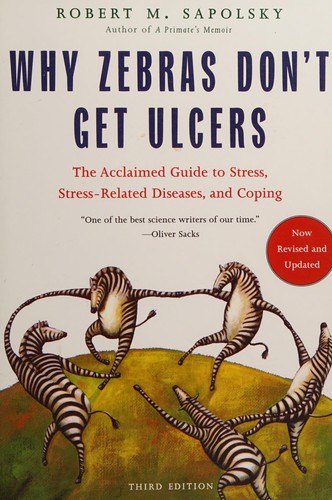
Why Zebras Don't Get Ulcers is Robert Sapolsky's definitive popular account of the biology of stress.
Robert M. Sapolsky · 1994 · 8h 40m
Full summary and key takeaways →The 12 questions
- 1.
Sapolsky's central comparison is between zebras (acute stress) and humans (chronic stress). What in your life most clearly represents the human version of psychological stress that never fully resolves?
- 2.
He argues that the stress response evolved for short-term physical emergencies and is mismatched to the social and psychological stressors of modern life. Is there any way to use physical activity to discharge the energy your stress response mobilizes?
- 3.
The book shows that perceived control reduces the stress response even when nothing objectively changes. Are there stressors in your life where increasing your sense of control — even through reappraisal — would reduce their impact?
- 4.
Sapolsky covers how social status shapes baseline stress levels. Do you think about your own social status and its effects on your physiology? Does the research change how you think about hierarchy in your workplace or social life?
- 5.
He argues that social support is one of the most powerful buffers of the stress response. How does the quality and quantity of your social connections compare to what the research suggests would be optimal?
- 6.
The evidence that chronic stress damages the hippocampus — the memory center — is striking. Does knowing that stress physically alters the brain change how urgently you treat stress management?
- 7.
Why Zebras Don't Get Ulcers was first published in 1994. How much has changed in stress research since then, and what aspects of Sapolsky's framework do you think are most durable?
- 8.
He covers the physiology of how exercise reduces stress. Does understanding the mechanism — cortisol clearance, system recalibration — change how you think about exercise as a stress management tool?
- 9.
Sapolsky is unusually funny for a stress researcher. Does the humor make the dark subject matter more or less bearable to engage with?
- 10.
He covers how early life adversity shapes the stress response permanently. What are the implications of that for how societies should invest in early childhood care?
- 11.
The book argues that predictability reduces the stress response. What domains of your life would benefit from more structure and predictability, and what are the costs of achieving that?
- 12.
If you could implement one stress-reduction practice based on the book's evidence, what would it be and what's preventing you from doing so?
How to run the discussion
- Pick six to eight, not all of them. An hour of real discussion covers fewer questions than anyone expects, and racing the list is what makes a book club feel like homework.
- Open with what people noticed, not what they concluded. Asking for a verdict first hardens opinions before anyone has heard each other.
- Let the disagreement run. The questions below that split a room are the ones worth the time; the ones everyone answers the same way can be skipped.
- Ask the quiet person a specific question. A direct, narrow question is far easier to answer than an open invitation to contribute.
Themes worth steering toward
If the conversation stalls, these are the threads that usually restart it.
Common questions
What are good book club questions for Why Zebras Don't Get Ulcers?
Here are 12 book club questions for Why Zebras Don't Get Ulcers by Robert M. Sapolsky, ordered to open easily and end somewhere worth arguing about. The strongest openers ask what each reader noticed rather than what they concluded, and the discussion usually turns on stress, physiology, chronic disease.
How long should a book club discussion of Why Zebras Don't Get Ulcers last?
Most groups run 60 to 90 minutes of actual discussion. That is roughly six to eight questions, not all of them, so pick the ones that suit your group rather than working down the list in order.
What are the main themes in Why Zebras Don't Get Ulcers?
Stress, Physiology, Chronic disease, Neuroscience, Psychology. Those are the threads most likely to divide a room, which makes them the useful places to steer a discussion that has gone quiet.
Picking the next one? See books like Why Zebras Don't Get Ulcers or questions for other book club picks.
