Talk to Winning the Loser's Game like its author wrote you back.
Get the ideas that fit your life — not generic summaries.
- Chat with the book
- Audiobook-style main ideas
- Adapts to your life and goals
- Helps you take action
What it argues
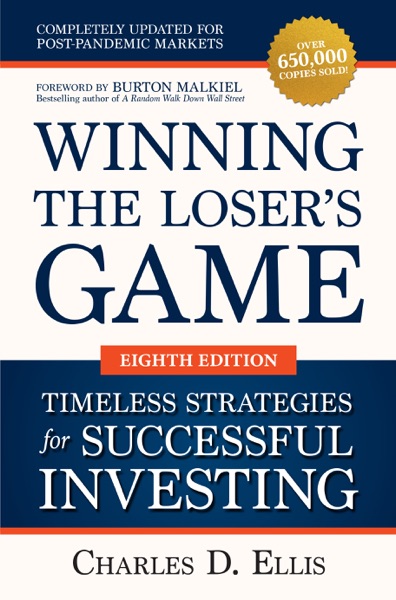
Winning the Loser's Game is Charles Ellis's case that most individual and institutional investors would be better served by passive index funds than by active management. First published in 1985 as an expansion of his 1975 essay "The Loser's Game," the book has been revised five times and remains among the clearest and most influential arguments for what has since become the dominant recommendation of academic finance.
The title's logic, borrowed from amateur tennis, is the book's central insight. In professional tennis, points are won by the winner's shots. In amateur tennis, points are lost by the loser's mistakes. The game looks the same but the winning strategy is different. Investing, Ellis argues, has shifted from a winner's game to a loser's game. In the 1940s, institutional investors were a minority of market participants and could outperform unsophisticated retail investors. By the 1970s, institutions dominated volume, and the competition was no longer amateurs but other highly skilled professional investors. In this environment, the way to win is to avoid mistakes — high fees, excessive trading, behavioral errors, market timing — not to attempt brilliant stock-picking that is unlikely to outperform a well-resourced competition.
What it gets right
- 1.
Investing has become a loser's game: the way to win is not to outperform the competition with brilliant picks, but to avoid the costly mistakes that compound into underperformance over time.
- 2.
Most actively managed funds underperform their benchmark indices after fees over long time horizons. The data on this is extensive and consistent.
- 3.
Fees are the most predictable drag on investment performance. A 1% annual fee difference compounds dramatically over twenty or thirty years of a portfolio's life.
What it covers
Who wrote it
Charles D. Ellis founded Greenwich Associates, an investment management consulting firm, in 1972 and served as a managing partner for three decades. He has served on the boards of the Vanguard Group, Yale University's investment committee, and the CFA Institute. His career has been dedicated to research on investment management practices and their relationship to client outcomes. In addition to Winning the Loser's Game, he has written several other books on investing and co-authored Capital: The Story of Long-Term Investment Excellence with Steve Leuthold.
