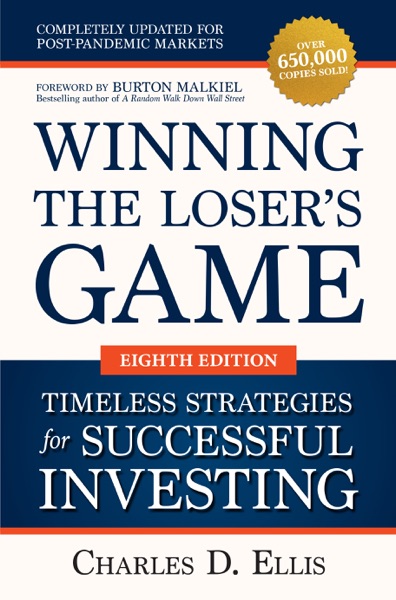
Winning the Loser's Game by Charles D. Ellis is a 1985 business book about investing, index funds, long-term thinking. Investing has become a loser's game: the way to win is not to outperform the competition with brilliant picks, but to avoid the costly mistakes that compound into underperformance over time.
Summary
Winning the Loser's Game is Charles Ellis's case that most individual and institutional investors would be better served by passive index funds than by active management. First published in 1985 as an expansion of his 1975 essay "The Loser's Game," the book has been revised five times and remains among the clearest and most influential arguments for what has since become the dominant recommendation of academic finance.
The title's logic, borrowed from amateur tennis, is the book's central insight. In professional tennis, points are won by the winner's shots. In amateur tennis, points are lost by the loser's mistakes. The game looks the same but the winning strategy is different. Investing, Ellis argues, has shifted from a winner's game to a loser's game. In the 1940s, institutional investors were a minority of market participants and could outperform unsophisticated retail investors. By the 1970s, institutions dominated volume, and the competition was no longer amateurs but other highly skilled professional investors. In this environment, the way to win is to avoid mistakes — high fees, excessive trading, behavioral errors, market timing — not to attempt brilliant stock-picking that is unlikely to outperform a well-resourced competition.
Ellis writes in measured, slightly formal prose. The arguments are careful and well-supported without being technically demanding. He covers the evidence on active management underperformance, the arithmetic of how fees compound destructively over time, the behavioral traps that lead investors to buy high and sell low, and the organizational dynamics of investment committees that force fund managers toward short-term thinking. The chapters on investment committee behavior are particularly sharp and draw on Ellis's long career as a consultant to institutional investors.
The practical conclusion is straightforward: buy the market at the lowest possible cost, stay the course through inevitable downturns, and avoid the temptation to time the market or chase performance. This advice was controversial in 1985 and has since been confirmed by decades of additional data. Ellis acknowledges that passive investing requires genuine psychological discipline — sitting through a bear market with broad index exposure is not emotionally easy — and he is honest about the parts of investing that no book can fully prepare you for.
Talk to Winning the Loser's Game like its author wrote you back.
Get the ideas that fit your life — not generic summaries.
- Chat with the book
- Audiobook-style main ideas
- Adapts to your life and goals
- Helps you take action
Key takeaways
- 1.
Investing has become a loser's game: the way to win is not to outperform the competition with brilliant picks, but to avoid the costly mistakes that compound into underperformance over time.
- 2.
Most actively managed funds underperform their benchmark indices after fees over long time horizons. The data on this is extensive and consistent.
- 3.
Fees are the most predictable drag on investment performance. A 1% annual fee difference compounds dramatically over twenty or thirty years of a portfolio's life.
- 4.
Behavioral errors — panic selling in downturns, chasing recent performance, overreacting to news — are the primary cause of individual investors' underperformance relative to the funds they invest in.
- 5.
Investment committees and institutional structures often push fund managers toward short-term thinking that is in tension with long-term performance. The organizational dynamics of active management are as much a problem as individual manager skill.
- 6.
Time in the market beats timing the market. The long-term upward drift of broad equity markets means that missing the best few days in any given decade dramatically reduces cumulative returns.
- 7.
The goal of an investment program is not to beat the market but to achieve the returns you need for your financial goals at the lowest possible risk and cost.
Discussion questions
Use these on your own, with a book club, or as chat starters in Superbook. Book club version, ready to copy or print →
- 1.
Ellis's central analogy is amateur tennis — winning by not losing. In what other domains does the loser's-game framing apply? Where in your professional life is avoiding mistakes more important than brilliant plays?
- 2.
The book was first published in 1985, before index funds were widely available. How has the investment landscape changed since then, and does Ellis's argument apply equally or more forcefully today?
- 3.
Ellis argues that most investors — including sophisticated institutions — underperform index benchmarks after fees. If you manage investments, does your experience match or contradict that claim?
- 4.
What would it mean in practice to apply the 'avoid mistakes' philosophy to your own investment behavior? What would you stop doing?
- 5.
The book argues that fees are the most predictable drag on performance. How do you currently think about fees in your own financial decisions, and does this book change that?
- 6.
Ellis is honest that passive investing requires psychological discipline — staying invested through bear markets is genuinely hard. What makes that discipline so difficult, and what would help?
- 7.
The investment committee chapters describe how institutional dynamics push toward short-term thinking even when all participants know better. Have you observed similar dynamics in any organization you've been part of?
- 8.
Ellis argues that the goal is not to beat the market but to achieve the returns you need. How does that reframing change the measure of a successful investment program?
- 9.
If the arguments in this book are correct and widely known, why do so many investors still choose active management? What persists in the appeal?
- 10.
The book assumes a long time horizon. What changes about the advice if your time horizon is compressed — for example, if you expect to need the funds within five years?
- 11.
Ellis's argument is almost entirely about equities. Does the same loser's-game logic apply to bond management, real estate, or private equity?
Themes
Frequently asked questions
-
What is Winning the Loser's Game about?
It's a clear, evidence-based argument that most investors should hold low-cost index funds rather than actively managed ones. Ellis shows that active management underperforms benchmarks after fees over long periods and explains the behavioral and structural reasons why investors make it worse.
-
Is this book still relevant given how much has changed in markets?
More relevant than ever. The evidence base Ellis cited in 1985 has been expanded massively by subsequent decades of data. The rise of ETFs has made the passive strategy he advocates far more accessible. The behavioral insights apply regardless of era.
-
Is this book for beginners or advanced investors?
Both. The core argument is accessible to beginners; the institutional chapters on investment committee dynamics are more useful to experienced professionals. The book is short enough that either audience can read the whole thing.
-
How does Winning the Loser's Game compare to A Random Walk Down Wall Street?
Both make the case for passive investing, but Ellis focuses more on the behavioral and organizational reasons investors fail, while Malkiel focuses more on the efficient market hypothesis and the evidence against stock-picking. Ellis is shorter and more directly practical.
-
What is the most actionable piece of advice in the book?
Check the expense ratios of your current investments and calculate the cumulative cost difference between your current funds and the cheapest index fund in the same category. The arithmetic is usually more persuasive than any argument.