Talk to Winning the Loser's Game like its author wrote you back.
Get the ideas that fit your life — not generic summaries.
- Chat with the book
- Audiobook-style main ideas
- Adapts to your life and goals
- Helps you take action
Winning the Loser's Game, in detail
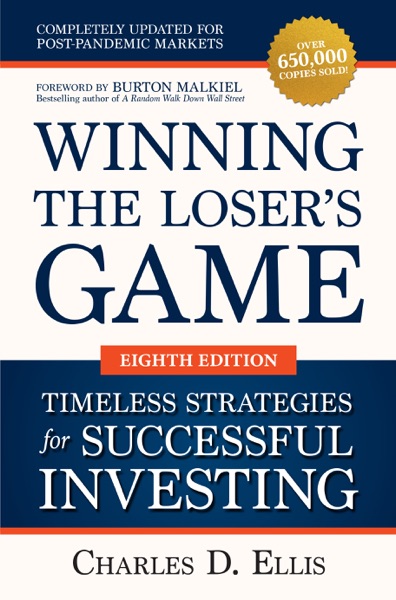
Winning the Loser's Game is Charles Ellis's case that most individual and institutional investors would be better served by passive index funds than by active management. First published in 1985 as an expansion of his 1975 essay "The Loser's Game," the book has been revised five times and remains among the clearest and most influential arguments for what has since become the dominant recommendation of academic finance.
The title's logic, borrowed from amateur tennis, is the book's central insight. In professional tennis, points are won by the winner's shots. In amateur tennis, points are lost by the loser's mistakes. The game looks the same but the winning strategy is different. Investing, Ellis argues, has shifted from a winner's game to a loser's game. In the 1940s, institutional investors were a minority of market participants and could outperform unsophisticated retail investors. By the 1970s, institutions dominated volume, and the competition was no longer amateurs but other highly skilled professional investors. In this environment, the way to win is to avoid mistakes — high fees, excessive trading, behavioral errors, market timing — not to attempt brilliant stock-picking that is unlikely to outperform a well-resourced competition.
Ellis writes in measured, slightly formal prose. The arguments are careful and well-supported without being technically demanding. He covers the evidence on active management underperformance, the arithmetic of how fees compound destructively over time, the behavioral traps that lead investors to buy high and sell low, and the organizational dynamics of investment committees that force fund managers toward short-term thinking. The chapters on investment committee behavior are particularly sharp and draw on Ellis's long career as a consultant to institutional investors.
The practical conclusion is straightforward: buy the market at the lowest possible cost, stay the course through inevitable downturns, and avoid the temptation to time the market or chase performance. This advice was controversial in 1985 and has since been confirmed by decades of additional data. Ellis acknowledges that passive investing requires genuine psychological discipline — sitting through a bear market with broad index exposure is not emotionally easy — and he is honest about the parts of investing that no book can fully prepare you for.
The big ideas
- 1.
Investing has become a loser's game: the way to win is not to outperform the competition with brilliant picks, but to avoid the costly mistakes that compound into underperformance over time.
- 2.
Most actively managed funds underperform their benchmark indices after fees over long time horizons. The data on this is extensive and consistent.
- 3.
Fees are the most predictable drag on investment performance. A 1% annual fee difference compounds dramatically over twenty or thirty years of a portfolio's life.
