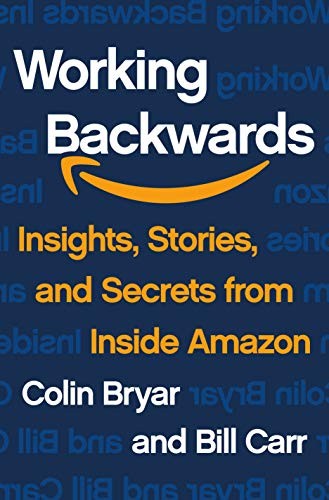
Working Backwards by Colin Bryar and Bill Carr is a 2021 business book about amazon, leadership principles, product development. Amazon's Leadership Principles function as a shared operating system rather than decorative values. They're used in hiring, reviews, and everyday debates, and they have real behavioral consequences.
Summary
Working Backwards is an insider account of how Amazon built its management system, written by two former Amazon executives who worked directly with Jeff Bezos over many years. Colin Bryar served as Bezos's chief of staff (his "shadow") from 2003 to 2005 before leading Amazon Kindle. Bill Carr ran digital music and video and oversaw the launch of Prime Video. Together, they spent decades inside the company's most consequential product and organizational decisions, and the book is an attempt to make Amazon's methods legible rather than mythological.
The book is organized around a handful of practices that Bryar and Carr argue are genuinely distinctive about Amazon and responsible for its unusual track record: the Leadership Principles (fourteen beliefs that function as a shared operating system), the ban on PowerPoint presentations in favor of six-page narrative memos, the "working backwards" product development process (starting with a press release and FAQ for a product that doesn't exist yet), and the concept of "two-pizza teams" designed to preserve speed and ownership as organizations scale.
The leadership principles get the most attention. Bezos designed them to be genuinely operational rather than decorative — they're used in hiring decisions, performance reviews, and everyday debates. "Customer obsession," "bias for action," and "dive deep" are not slogans; they're norms with real behavioral consequences. The authors show how the principles shaped decisions in products they were directly involved with, from the Kindle to Prime Video to Amazon's acquisition of physical stores.
The second half shifts to case studies: the development of Prime, Kindle, Prime Video, Amazon Studios, AWS's entry into devices, and more. These chapters are more narrative and will appeal most to readers with a product or business background. Bryar and Carr are careful to show both the successes and the failures, and they're honest about the organizational costs of some Amazon practices — the intensity, the "disagree and commit" culture's demands, and the difficulty of applying these methods in organizations that don't start from the same cultural foundation. Working Backwards is one of the more honest inside accounts of a major technology company's operating principles.
Talk to Working Backwards like its author wrote you back.
Get the ideas that fit your life — not generic summaries.
- Chat with the book
- Audiobook-style main ideas
- Adapts to your life and goals
- Helps you take action
Key takeaways
- 1.
Amazon's Leadership Principles function as a shared operating system rather than decorative values. They're used in hiring, reviews, and everyday debates, and they have real behavioral consequences.
- 2.
The six-page narrative memo replaced PowerPoint presentations at Amazon's senior levels. Writing forces clarity in a way that bullet points don't — a memo can't hide thin thinking behind confident slides.
- 3.
Working backwards means starting with the customer experience, not the technology or business model. The process begins with a press release and FAQ describing the finished product, then works backwards to what it would take to build it.
- 4.
Two-pizza teams (teams small enough to be fed by two pizzas) are a structural attempt to preserve speed, ownership, and accountability as an organization grows. Large teams optimize for coordination; small teams optimize for judgment.
- 5.
Single-threaded ownership means one person owns a problem and the team reporting to them owns nothing else. Diffuse ownership produces diffuse results.
- 6.
Disagree and commit is Amazon's prescribed mechanism for making decisions when consensus isn't reached. It allows the organization to move rather than stagnate, but requires genuine respect for the person with the authority to decide.
- 7.
Day 1 thinking is Bezos's shorthand for the mindset of a startup that hasn't yet been slowed by bureaucracy. Day 2 companies become irrelevant. The structural practices of Amazon are designed to resist Day 2 entropy.
- 8.
Amazon's unusual product success rate — Kindle, AWS, Prime, Alexa — comes partly from the press release/FAQ process, which forces teams to confront whether the product is actually good for customers before any code is written.
Discussion questions
Use these on your own, with a book club, or as chat starters in Superbook. Book club version, ready to copy or print →
- 1.
Amazon's Leadership Principles are designed to be operational rather than aspirational. Does your organization have values that function this way — that actually change decisions and behavior — or do they function more as branding?
- 2.
Bryar and Carr argue that the six-page memo forces clear thinking in a way that PowerPoint doesn't. Have you worked in environments that favored one format over the other? What difference did it make?
- 3.
The working-backwards process starts with a press release and FAQ describing a product that doesn't exist. How would that approach change your team's product development decisions if you tried it tomorrow?
- 4.
Single-threaded ownership means one person owns a problem completely. Where in your organization is ownership shared across multiple people or teams, and what does that cost you?
- 5.
The two-pizza team rule is a structural answer to the coordination cost problem. What's the actual size of the teams you work with, and do you see the coordination costs Bryar and Carr describe?
- 6.
Disagree and commit is described as a tool for moving forward without consensus. Have you seen it used well? Have you seen it used to shut down legitimate dissent?
- 7.
Amazon's practices were built from day one and reinforced by Bezos's direct involvement. How transferable do you think they are to organizations that didn't start with these principles? What would be lost in the translation?
- 8.
The book is honest about Amazon's intensity and cultural costs. Does the business performance justify those costs, in your view? What would you not adopt from the Amazon model even if it worked?
- 9.
They describe Day 1 thinking as a perpetual startup mindset. Have you worked in an organization that successfully maintained that mindset at scale? What preserved it?
- 10.
The case studies show multiple high-profile failures alongside successes. How does Amazon's willingness to experiment and fail publicly compare to organizations you've worked in?
- 11.
Bryar and Carr are both Amazon insiders. What blind spots might come with that perspective, and what evidence do you see in the book of them successfully accounting for those blind spots?
- 12.
If you could transplant one Amazon practice into your current organization, which would you choose and what obstacles would you anticipate?
Themes
Frequently asked questions
-
Is Working Backwards worth reading?
Yes, particularly if you work in product development, engineering leadership, or organizational design. It's one of the most concrete accounts of how a large technology company actually makes decisions. The Leadership Principles section alone is worth the read for anyone building a management system from scratch.
-
How long does it take to read Working Backwards?
About five to six hours for the roughly 300-page book. The first half (the practices) reads quickly; the second half (case studies) is denser and rewards slower reading if you're trying to extract lessons from specific product decisions.
-
What is the 'working backwards' process?
A product development method where the team starts by writing a press release describing the customer benefit of a finished product that doesn't yet exist, followed by a FAQ that addresses hard questions. The team then works backwards to understand what it would actually take to build it. The discipline forces customer focus before technical or business constraints narrow the thinking.
-
Can Amazon's methods work in other organizations?
Some can transfer; others depend heavily on cultural infrastructure that took Amazon years to build. The memo format, working-backwards process, and single-threaded ownership are widely applicable. The Leadership Principles as a hiring and performance tool require deep organizational commitment to work. Bryar and Carr acknowledge these limits honestly in the book.
-
Is this book for Amazon fans or is it critical too?
More balanced than most insider accounts. Both authors are clearly proud of what they built, but they include failures, acknowledge the intensity's costs, and are direct about the practices that are hardest to transplant. It reads as a serious attempt to document what actually worked rather than a corporate hagiography.
Similar books
High Output Management
Andrew S. Grove
No Rules Rules: Netflix and the Culture of Reinvention
Reed Hastings and Erin Meyer
The Hard Thing About Hard Things
Ben Horowitz

Accelerate
Nicole Forsgren, Jez Humble, and Gene Kim
