Business · Book club
Working Backwards book club questions
Here are 12 book club questions for Working Backwards by Colin Bryar and Bill Carr, ordered to open easily and end somewhere worth arguing about. Copy them, print them, or bring them up one at a time.
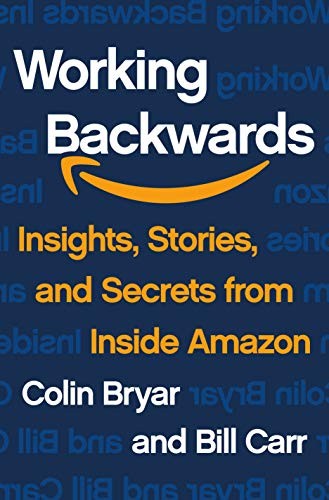
Working Backwards is an insider account of how Amazon built its management system, written by two former Amazon executives who worked directly with Jeff Bezos over many years.
Colin Bryar and Bill Carr · 2021 · 5h 45m
Full summary and key takeaways →The 12 questions
- 1.
Amazon's Leadership Principles are designed to be operational rather than aspirational. Does your organization have values that function this way — that actually change decisions and behavior — or do they function more as branding?
- 2.
Bryar and Carr argue that the six-page memo forces clear thinking in a way that PowerPoint doesn't. Have you worked in environments that favored one format over the other? What difference did it make?
- 3.
The working-backwards process starts with a press release and FAQ describing a product that doesn't exist. How would that approach change your team's product development decisions if you tried it tomorrow?
- 4.
Single-threaded ownership means one person owns a problem completely. Where in your organization is ownership shared across multiple people or teams, and what does that cost you?
- 5.
The two-pizza team rule is a structural answer to the coordination cost problem. What's the actual size of the teams you work with, and do you see the coordination costs Bryar and Carr describe?
- 6.
Disagree and commit is described as a tool for moving forward without consensus. Have you seen it used well? Have you seen it used to shut down legitimate dissent?
- 7.
Amazon's practices were built from day one and reinforced by Bezos's direct involvement. How transferable do you think they are to organizations that didn't start with these principles? What would be lost in the translation?
- 8.
The book is honest about Amazon's intensity and cultural costs. Does the business performance justify those costs, in your view? What would you not adopt from the Amazon model even if it worked?
- 9.
They describe Day 1 thinking as a perpetual startup mindset. Have you worked in an organization that successfully maintained that mindset at scale? What preserved it?
- 10.
The case studies show multiple high-profile failures alongside successes. How does Amazon's willingness to experiment and fail publicly compare to organizations you've worked in?
- 11.
Bryar and Carr are both Amazon insiders. What blind spots might come with that perspective, and what evidence do you see in the book of them successfully accounting for those blind spots?
- 12.
If you could transplant one Amazon practice into your current organization, which would you choose and what obstacles would you anticipate?
How to run the discussion
- Pick six to eight, not all of them. An hour of real discussion covers fewer questions than anyone expects, and racing the list is what makes a book club feel like homework.
- Open with what people noticed, not what they concluded. Asking for a verdict first hardens opinions before anyone has heard each other.
- Let the disagreement run. The questions below that split a room are the ones worth the time; the ones everyone answers the same way can be skipped.
- Ask the quiet person a specific question. A direct, narrow question is far easier to answer than an open invitation to contribute.
Themes worth steering toward
If the conversation stalls, these are the threads that usually restart it.
Common questions
What are good book club questions for Working Backwards?
Here are 12 book club questions for Working Backwards by Colin Bryar and Bill Carr, ordered to open easily and end somewhere worth arguing about. The strongest openers ask what each reader noticed rather than what they concluded, and the discussion usually turns on amazon, leadership principles, product development.
How long should a book club discussion of Working Backwards last?
Most groups run 60 to 90 minutes of actual discussion. That is roughly six to eight questions, not all of them, so pick the ones that suit your group rather than working down the list in order.
What are the main themes in Working Backwards?
Amazon, Leadership principles, Product development, Organizational culture, Decision making. Those are the threads most likely to divide a room, which makes them the useful places to steer a discussion that has gone quiet.
Picking the next one? See books like Working Backwards or questions for other book club picks.
