Psychology · Book club
You Are Not So Smart book club questions
Here are 11 book club questions for You Are Not So Smart by David McRaney, ordered to open easily and end somewhere worth arguing about. Copy them, print them, or bring them up one at a time.
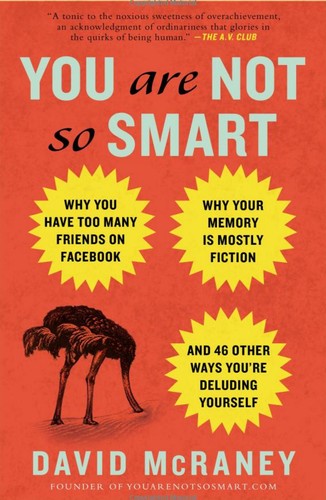
David McRaney is a journalist who started a blog called "You Are Not So Smart" about self-delusion in 2009, and turned it into this book in 2011.
David McRaney · 2011 · 4h 20m
Full summary and key takeaways →The 11 questions
- 1.
McRaney focuses on self-delusion rather than external error. Which of the biases he describes is most uncomfortable to recognize in yourself?
- 2.
The backfire effect suggests that confronting false beliefs with evidence can strengthen them. What does that imply for how you try to change someone's mind?
- 3.
The just-world hypothesis produces victim-blaming. Can you identify a case where you have explained someone's misfortune in terms of their choices rather than their circumstances?
- 4.
Procrastination as self-regulation failure means we steal from our future selves. How do you think about the relationship between your present choices and the future person who will live with them?
- 5.
The Dunning-Kruger effect says incompetence blocks accurate self-assessment. What domains are you confident in? What would genuine external assessment of those domains reveal?
- 6.
He argues that we confabulate reasons for our choices rather than reporting actual decision processes. Can you think of a recent choice where you told a story about why you made it that may not have been the actual cause?
- 7.
The spotlight effect says we overestimate how much others are watching us. How does knowing this change how you behave in public or professional settings?
- 8.
The book was adapted from a blog. Does the shorter, essay format of each chapter feel like enough treatment of each topic, or do you want more depth?
- 9.
McRaney presents himself as subject to the same biases he describes. Does that approach increase his credibility or reduce it?
- 10.
Which chapter describes a pattern you have observed most consistently in others, not just yourself?
- 11.
If you could inoculate a teenager against one of the tendencies McRaney describes, which would you choose and why?
How to run the discussion
- Pick six to eight, not all of them. An hour of real discussion covers fewer questions than anyone expects, and racing the list is what makes a book club feel like homework.
- Open with what people noticed, not what they concluded. Asking for a verdict first hardens opinions before anyone has heard each other.
- Let the disagreement run. The questions below that split a room are the ones worth the time; the ones everyone answers the same way can be skipped.
- Ask the quiet person a specific question. A direct, narrow question is far easier to answer than an open invitation to contribute.
Themes worth steering toward
If the conversation stalls, these are the threads that usually restart it.
Common questions
What are good book club questions for You Are Not So Smart?
Here are 11 book club questions for You Are Not So Smart by David McRaney, ordered to open easily and end somewhere worth arguing about. The strongest openers ask what each reader noticed rather than what they concluded, and the discussion usually turns on self-delusion, cognitive bias, reasoning.
How long should a book club discussion of You Are Not So Smart last?
Most groups run 60 to 90 minutes of actual discussion. That is roughly six to eight questions, not all of them, so pick the ones that suit your group rather than working down the list in order.
What are the main themes in You Are Not So Smart?
Self-delusion, Cognitive bias, Reasoning, Motivation, Decision-making. Those are the threads most likely to divide a room, which makes them the useful places to steer a discussion that has gone quiet.
Picking the next one? See books like You Are Not So Smart or questions for other book club picks.
