Health · Book club
Younger Next Year book club questions
Here are 12 book club questions for Younger Next Year by Chris Crowley, ordered to open easily and end somewhere worth arguing about. Copy them, print them, or bring them up one at a time.
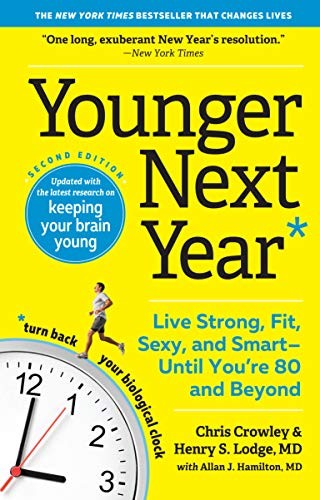
Younger Next Year is the book that resulted when Chris Crowley, a retired New York lawyer in his mid-sixties, and Henry Lodge, his internist, decided to write down the case Lodge had been making in his practice for years: that the physical and cognitive decline most people experience in the second half of life is not inevitable, and that exercise is the most powerful tool available to interrupt it.
Chris Crowley · 2004 · 4h 45m
Full summary and key takeaways →The 12 questions
- 1.
Lodge argues that most age-related physical decline is decay from disuse rather than inevitable deterioration. How does that reframe the relationship between aging and personal responsibility?
- 2.
The book prescribes six days of exercise per week. What are the actual obstacles — not excuses, but real constraints — that make that number unreachable for you or people you know?
- 3.
Crowley writes from personal experience as a non-athlete who transformed his fitness in his sixties. What makes his voice more or less credible to you than a lifelong athlete making the same argument?
- 4.
Lodge connects social connection to biology — isolation triggers the same decay signals as physical inactivity. How does that change how you think about loneliness as a health issue?
- 5.
The book is aimed primarily at men, though a companion edition for women exists. What parts of the argument feel most specific to male experience, and what translates universally?
- 6.
Lodge argues that aerobic exercise is the single most powerful tool available to a 50-year-old to improve their trajectory. If that's true, what would it take to actually act on it?
- 7.
The book discusses the psychological challenge of losing a career identity as a biological risk factor. How does that framing change how you think about retirement planning?
- 8.
What's the difference between the kind of exercise the book recommends and what most middle-aged people actually do? What accounts for the gap?
- 9.
Lodge uses evolutionary biology to explain why the body responds to exercise signals the way it does. How useful do you find evolutionary framings for practical health advice?
- 10.
Crowley is candid about the difficulty of sustained motivation over years. What motivation strategies has he found useful, and how do they compare to what actually works for you?
- 11.
The book argues that serious strength training is as important as aerobic exercise. How does that compare to how strength training is marketed and practiced in gyms you've been to?
- 12.
If you could only take one recommendation from this book and apply it consistently for a year, which would you choose?
How to run the discussion
- Pick six to eight, not all of them. An hour of real discussion covers fewer questions than anyone expects, and racing the list is what makes a book club feel like homework.
- Open with what people noticed, not what they concluded. Asking for a verdict first hardens opinions before anyone has heard each other.
- Let the disagreement run. The questions below that split a room are the ones worth the time; the ones everyone answers the same way can be skipped.
- Ask the quiet person a specific question. A direct, narrow question is far easier to answer than an open invitation to contribute.
Themes worth steering toward
If the conversation stalls, these are the threads that usually restart it.
Common questions
What are good book club questions for Younger Next Year?
Here are 12 book club questions for Younger Next Year by Chris Crowley, ordered to open easily and end somewhere worth arguing about. The strongest openers ask what each reader noticed rather than what they concluded, and the discussion usually turns on aging, exercise, longevity.
How long should a book club discussion of Younger Next Year last?
Most groups run 60 to 90 minutes of actual discussion. That is roughly six to eight questions, not all of them, so pick the ones that suit your group rather than working down the list in order.
What are the main themes in Younger Next Year?
Aging, Exercise, Longevity, Men's health, Lifestyle medicine. Those are the threads most likely to divide a room, which makes them the useful places to steer a discussion that has gone quiet.
Picking the next one? See books like Younger Next Year or questions for other book club picks.
