Self-help · Book club
Your Money or Your Life book club questions
Here are 12 book club questions for Your Money or Your Life by Vicki Robin, ordered to open easily and end somewhere worth arguing about. Copy them, print them, or bring them up one at a time.
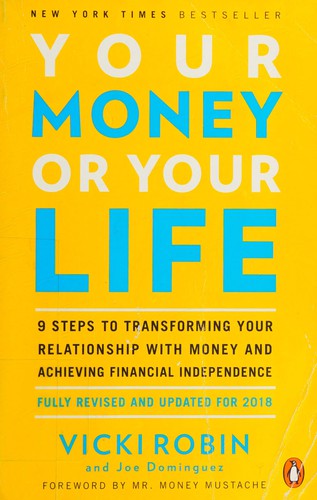
Your Money or Your Life is Vicki Robin and Joe Dominguez's argument that money is something we trade our life energy for, and that most people in modern consumer society have made that trade without ever stopping to examine the terms.
Vicki Robin · 1992 · 4h 15m
Full summary and key takeaways →The 12 questions
- 1.
Robin asks you to calculate your real hourly wage by including all work-related costs and time. What does that number look like for you, and does it change how you think about individual purchases?
- 2.
The life energy concept reframes spending from 'is this affordable?' to 'is this worth the portion of my life I'm trading for it?' Which of your regular expenditures pass that test and which don't?
- 3.
The book was written in 1992 and grew out of 1960s and 70s counterculture. Does that origin give its critique of consumerism more credibility, less, or about the same as it would have if written today?
- 4.
Financial independence is defined as the crossover point where investment income covers expenses. How far away is that point for you, and what would reaching it actually change about your life?
- 5.
Robin distinguishes between enough and more. What is 'enough' for you in specific terms — not philosophically but practically? What would you need to have in order to genuinely feel financially sufficient?
- 6.
The nine-step program requires significant ongoing effort — tracking every dollar, graphing spending monthly, reviewing each category. How much of that structure would you actually sustain?
- 7.
The book argues that work for most people involves significant psychological costs that don't show up in salary. Is that true for your work, or does your work provide enough meaning to justify the time?
- 8.
Robin critiques mass consumption at a structural level, not just as an individual habit. Do you find that critique persuasive, or does it feel like it's imposing values on choices that should be personal?
- 9.
What would you do with your time if paid work were optional? Have you ever tested that — during a sabbatical, unemployment, or extended break?
- 10.
The book argues that many people consume to compensate for jobs they find unfulfilling. Is there spending in your own life that is essentially a reward for work you don't love?
- 11.
How does the concept of voluntary simplicity land for you — as liberation, as deprivation, or as something in between? What would you gain and what would you give up?
- 12.
The FIRE movement that this book helped inspire has attracted criticism for being available mainly to high earners. Is the book's framework genuinely applicable across income levels, or does it assume a certain financial cushion?
How to run the discussion
- Pick six to eight, not all of them. An hour of real discussion covers fewer questions than anyone expects, and racing the list is what makes a book club feel like homework.
- Open with what people noticed, not what they concluded. Asking for a verdict first hardens opinions before anyone has heard each other.
- Let the disagreement run. The questions below that split a room are the ones worth the time; the ones everyone answers the same way can be skipped.
- Ask the quiet person a specific question. A direct, narrow question is far easier to answer than an open invitation to contribute.
Themes worth steering toward
If the conversation stalls, these are the threads that usually restart it.
Common questions
What are good book club questions for Your Money or Your Life?
Here are 12 book club questions for Your Money or Your Life by Vicki Robin, ordered to open easily and end somewhere worth arguing about. The strongest openers ask what each reader noticed rather than what they concluded, and the discussion usually turns on financial independence, life energy, frugality.
How long should a book club discussion of Your Money or Your Life last?
Most groups run 60 to 90 minutes of actual discussion. That is roughly six to eight questions, not all of them, so pick the ones that suit your group rather than working down the list in order.
What are the main themes in Your Money or Your Life?
Financial independence, Life energy, Frugality, Values and money, Consumption. Those are the threads most likely to divide a room, which makes them the useful places to steer a discussion that has gone quiet.
Picking the next one? See books like Your Money or Your Life or questions for other book club picks.
