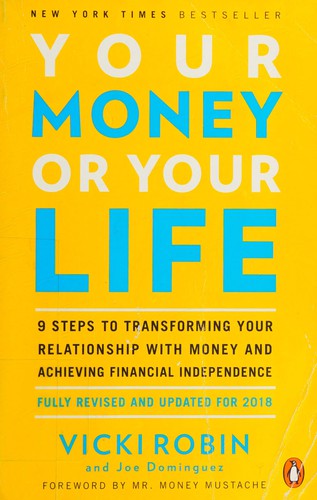
Your Money or Your Life by Vicki Robin is a 1992 self-help book about financial independence, life energy, frugality. Money is life energy. Every dollar you spend represents a portion of your finite time on earth, traded for wages, then converted back into goods and services.
Summary
Your Money or Your Life is Vicki Robin and Joe Dominguez's argument that money is something we trade our life energy for, and that most people in modern consumer society have made that trade without ever stopping to examine the terms. First published in 1992 and revised in 2008, the book is credited as a foundational text for the FIRE (financial independence, retire early) movement and for a broader generation of readers who wanted to redesign their relationship with work and money rather than simply optimize within the existing frame.
The central reframe is the "life energy" concept. Every dollar you spend represents a portion of your finite time on earth — not just the hours you work to earn it, but the commuting, the decompressing, the consuming in ways that compensate for work you don't like, the maintaining of possessions you bought to reward yourself. When you calculate your real hourly wage by factoring in all work-related expenses and time, the actual exchange rate for your life energy is usually lower than people assume. This calculation, which the book walks you through step by step, often produces a genuine moment of reckoning.
The nine-step program at the book's core moves from that initial reckoning through tracking every dollar of spending and income, graphing your monthly income and expenses, evaluating each spending category in terms of fulfillment per unit of life energy, identifying the crossover point at which investment income covers expenses (financial independence), and finally changing spending patterns based on values rather than habit or social pressure. The steps are concrete and somewhat tedious — they require discipline — but readers who complete them consistently report significant shifts in both financial position and relationship to work.
The book is less about investment strategy than about the philosophical relationship between money, time, and purpose. Robin is skeptical of consumerism at a structural level, and the book's politics surface occasionally in critiques of advertising and mass consumption. The updated 2008 edition engages with the rise of index investing and provides more specific guidance on reaching financial independence than the original. Even for readers who don't adopt the nine-step program in full, the life energy framework is genuinely useful for examining whether specific expenditures are worth what they cost.
Talk to Your Money or Your Life like its author wrote you back.
Get the ideas that fit your life — not generic summaries.
- Chat with the book
- Audiobook-style main ideas
- Adapts to your life and goals
- Helps you take action
Key takeaways
- 1.
Money is life energy. Every dollar you spend represents a portion of your finite time on earth, traded for wages, then converted back into goods and services.
- 2.
Your real hourly wage is lower than your nominal wage. When you account for work-related expenses and time, the actual exchange rate for your life energy changes the calculation on every purchase.
- 3.
Track every dollar that comes in and goes out, not to restrict yourself but to see clearly what your money is actually doing. Most people are surprised by the pattern.
- 4.
Financial independence is the crossover point where investment income equals or exceeds expenses. Once you reach it, paid work becomes optional rather than mandatory.
- 5.
Evaluate each spending category by asking: did this purchase provide fulfillment in proportion to the life energy it cost? This question is more useful than any budget category.
- 6.
Consumer culture manufactures desire — it does not reflect it. Most spending on status, novelty, and comfort is driven by advertising and social pressure, not by genuine preference.
- 7.
The relationship between spending and fulfillment follows a curve. There is a level of spending that produces genuine enough — more spending beyond that level produces less satisfaction per dollar.
- 8.
Work is not the only way to contribute. The book argues that financial independence opens space for unpaid contribution, creativity, and relationship that conventional careers foreclose.
Discussion questions
Use these on your own, with a book club, or as chat starters in Superbook. Book club version, ready to copy or print →
- 1.
Robin asks you to calculate your real hourly wage by including all work-related costs and time. What does that number look like for you, and does it change how you think about individual purchases?
- 2.
The life energy concept reframes spending from 'is this affordable?' to 'is this worth the portion of my life I'm trading for it?' Which of your regular expenditures pass that test and which don't?
- 3.
The book was written in 1992 and grew out of 1960s and 70s counterculture. Does that origin give its critique of consumerism more credibility, less, or about the same as it would have if written today?
- 4.
Financial independence is defined as the crossover point where investment income covers expenses. How far away is that point for you, and what would reaching it actually change about your life?
- 5.
Robin distinguishes between enough and more. What is 'enough' for you in specific terms — not philosophically but practically? What would you need to have in order to genuinely feel financially sufficient?
- 6.
The nine-step program requires significant ongoing effort — tracking every dollar, graphing spending monthly, reviewing each category. How much of that structure would you actually sustain?
- 7.
The book argues that work for most people involves significant psychological costs that don't show up in salary. Is that true for your work, or does your work provide enough meaning to justify the time?
- 8.
Robin critiques mass consumption at a structural level, not just as an individual habit. Do you find that critique persuasive, or does it feel like it's imposing values on choices that should be personal?
- 9.
What would you do with your time if paid work were optional? Have you ever tested that — during a sabbatical, unemployment, or extended break?
- 10.
The book argues that many people consume to compensate for jobs they find unfulfilling. Is there spending in your own life that is essentially a reward for work you don't love?
- 11.
How does the concept of voluntary simplicity land for you — as liberation, as deprivation, or as something in between? What would you gain and what would you give up?
- 12.
The FIRE movement that this book helped inspire has attracted criticism for being available mainly to high earners. Is the book's framework genuinely applicable across income levels, or does it assume a certain financial cushion?
Themes
Frequently asked questions
-
What is the nine-step program in Your Money or Your Life?
A structured process for redesigning your relationship with money. It includes calculating your real hourly wage, tracking every dollar of income and expenses, graphing your finances monthly, evaluating each spending category by fulfillment per unit of life energy, and working toward the crossover point where investment income covers all expenses.
-
Is Your Money or Your Life about early retirement?
Not exactly. It's about financial independence — the point at which paid work is optional — and about designing a life aligned with your values. Early retirement is one possible outcome, but the book is more focused on rethinking your relationship with work and consumption than on a specific timeline.
-
How is Your Money or Your Life different from other personal finance books?
Most personal finance books focus on how to earn more, invest better, or budget more effectively within the existing structure of your life. This book challenges the structure itself — asking whether the work-spend-work cycle makes sense at all, and whether there is a fundamentally different way to organize your relationship with time and money.
-
Is the nine-step program realistic for most people?
Completing all nine steps requires significant sustained effort and is not realistic for everyone. Many readers find value in the life energy concept and the fulfillment evaluation framework without completing the full program. Even partial application of the framework tends to change how people think about individual spending decisions.
-
Does Your Money or Your Life give investment advice?
The updated 2008 edition discusses low-cost index funds and bond ladders as vehicles for generating the passive income needed to reach the crossover point. The original 1992 edition recommended Treasury bonds specifically, which was a product of its time. The book's investment guidance is broadly conventional — the distinctive contribution is on the spending and values side.