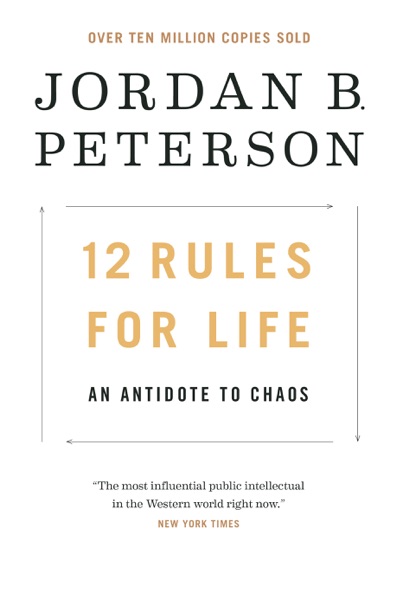
12 Rules for Life by Jordan Peterson is a 2018 self-help book about responsibility, meaning, order and chaos. Meaning, not happiness, is the antidote to suffering. Peterson argues that people who orient toward responsibility and truth — not toward pleasure-seeking — find that their suffering becomes bearable.
Summary
12 Rules for Life is Jordan Peterson's attempt to distill what clinical psychology, comparative mythology, the Bible, and evolutionary biology say about how to live. The book's twelve rules are simple imperatives — "Stand up straight with your shoulders back," "Tell the truth, or at least don't lie," "Compare yourself to who you were yesterday, not to who someone else is today" — but each rule is an entry point into a much longer argument. Peterson's underlying claim is that life is genuinely difficult, that suffering is unavoidable, and that the antidote is not happiness-seeking but meaning-seeking through voluntary embrace of responsibility.
The book's organizing metaphor is order and chaos. Peterson argues that human beings are wired to inhabit the border between these two: too much order is tyranny, too much chaos is anxiety. The rules are a map for maintaining that balance. Many of them concern behavior change at the most basic level — posture, telling the truth, keeping your room clean — but Peterson frames even mundane prescriptions in relation to grand mythological and evolutionary narratives. A chapter on standing up straight connects lobster neurology to serotonin, to social hierarchy, to the Book of Job. This method produces passages of genuine insight alongside passages that stretch the connections past what they can bear.
Peterson writes as a clinical psychologist with decades of experience treating people who have destroyed their lives through self-deception, bitterness, and failure to take responsibility. The book's emotional core is his argument that people often choose chaos — through nihilism, victimhood narratives, or deliberate self-sabotage — as a way of avoiding the responsibility that order demands. His prescription is to start small: make your bed, tell the truth in small things, clean up what is immediately in front of you. Large-scale social transformation begins with individual transformation.
The book is uneven. Some chapters are among the clearest writing Peterson has produced; others are labyrinthine. The biblical and mythological readings are dense and require patience. The book also leans heavily on the claim that Jungian archetypes map cleanly onto evolutionary biology, a claim that many biologists and psychologists do not accept. Readers who engage seriously with the underlying argument — that responsibility, not rights, is the foundation of a meaningful life — will find the book rewarding. Readers primarily interested in practical self-improvement may find the densely layered argumentation more than they bargained for.
Talk to 12 Rules for Life like its author wrote you back.
Get the ideas that fit your life — not generic summaries.
- Chat with the book
- Audiobook-style main ideas
- Adapts to your life and goals
- Helps you take action
Key takeaways
- 1.
Meaning, not happiness, is the antidote to suffering. Peterson argues that people who orient toward responsibility and truth — not toward pleasure-seeking — find that their suffering becomes bearable.
- 2.
Voluntary embrace of difficulty builds the capacity to function in the world. Avoiding what is hard produces anxiety; facing it produces competence and self-respect.
- 3.
Start with what is immediately in front of you. Before fixing the world, fix your room. Before advising others, tell the truth in your own life.
- 4.
Social hierarchy is not arbitrary — it is the product of biological competition that long predates capitalism. Status anxiety and dominance motivation are features of evolved systems, not modern pathology.
- 5.
The rule to compare yourself to who you were yesterday rather than to others is a practical implementation of the psychological insight that envy is corrosive and personal progress is measurable.
- 6.
Telling the truth is not just ethical — it is structural. Living lies creates increasingly unstable internal architectures that eventually collapse. Small deceptions compound into large failures.
- 7.
Children need rules and boundaries, not just freedom. The goal of good parenting is to produce a child who can function in society, not one that simply pleases the parent in the short term.
- 8.
Chaos and order are both necessary. The ideal is to stand at the border — to venture into the unknown with enough structure to orient yourself and enough openness to discover something new.
Discussion questions
Use these on your own, with a book club, or as chat starters in Superbook. Book club version, ready to copy or print →
- 1.
Peterson argues that meaning is more important than happiness as a life goal. Does that distinction feel real to you from your own experience?
- 2.
The book's rule about telling the truth extends beyond outright lying to 'say only what you genuinely believe.' How much of your typical day involves small speech acts that violate that standard?
- 3.
Peterson's argument about responsibility resonates with many readers who feel over-explained-to and under-challenged. Do you think he diagnoses a real cultural pathology, or is his critique too broad?
- 4.
The evolutionary and mythological framings that Peterson uses — lobsters and the Bible, Jungian archetypes and neuroscience — are the most contested parts of the book. Do you find the connections illuminating or overreached?
- 5.
The rule 'clean your room' is explicitly a prescription for small, manageable steps toward order. Where in your own life would a literal or metaphorical 'clean your room' be the right intervention?
- 6.
Peterson says that comparisons with other people corrode motivation, while comparisons with your past self produce useful information. How do you currently use comparison, and does it serve you?
- 7.
Several chapters deal with raising children — specifically that parents should not be their child's friend and that children need limits. Do you find this perspective useful or problematic?
- 8.
The book is partly a clinical record: Peterson has treated many people who have destroyed their lives through evasion of responsibility. How does that clinical context change how you receive the prescriptions?
- 9.
Some readers find Peterson's book genuinely life-changing; others find it overblown and the mythological scaffolding unnecessary. What determines whether this kind of philosophically heavy self-help resonates with someone?
- 10.
Peterson frames chaos and order as fundamental categories. Can you think of a time when you moved too far toward one extreme and what it cost you?
- 11.
The book is explicitly anti-ideological in some ways but is widely perceived as politically aligned. How much does the political reception of a book of ideas affect your ability to evaluate it on its own terms?
- 12.
Peterson's core message is that individuals should focus on their own transformation before attempting to transform the world. Is that an inspiring principle, a deflection from structural problems, or both?
Themes
Frequently asked questions
-
What is 12 Rules for Life actually about?
It's a self-help and philosophy book built on the claim that meaning, responsibility, and truth are the foundations of a functional life. Each of the twelve rules is an entry point into a longer argument about psychology, mythology, and how to navigate order and chaos.
-
Is 12 Rules for Life worth reading?
Depends on your patience for dense, layered argumentation. The chapters on telling the truth, on comparisons with yourself rather than others, and on responsibility are genuinely useful. Readers who find the biblical and Jungian scaffolding too heavy may find the core ideas accessible in Peterson's more focused lectures.
-
Do I have to agree with Peterson politically to get value from this book?
No. The book's core prescriptions — tell the truth, take responsibility, start with what is in front of you — are not politically partisan. The political context surrounding Peterson has colored many readers' experience of the book, but the ideas stand on their own merits.
-
How does 12 Rules for Life differ from self-help books like Atomic Habits?
Atomic Habits is practical and system-focused. 12 Rules for Life is philosophical and meaning-focused. Clear tells you how to change behavior; Peterson tells you why it matters to try. They operate at different levels and complement each other.
-
What is the most actionable rule in the book?
Rule 4: compare yourself to who you were yesterday, not to who someone else is today. It is the simplest to apply and addresses one of the most corrosive and pervasive sources of motivational dysfunction — social comparison.
Similar books
12 Rules for Life vs.
Deciding between two books? 12 Rules for Life vs The Subtle Art of Not Giving a F*ck .
