Business · Book club
7 Powers: The Foundations of Business Strategy book club questions
Here are 12 book club questions for 7 Powers: The Foundations of Business Strategy by Hamilton Helmer, ordered to open easily and end somewhere worth arguing about. Copy them, print them, or bring them up one at a time.
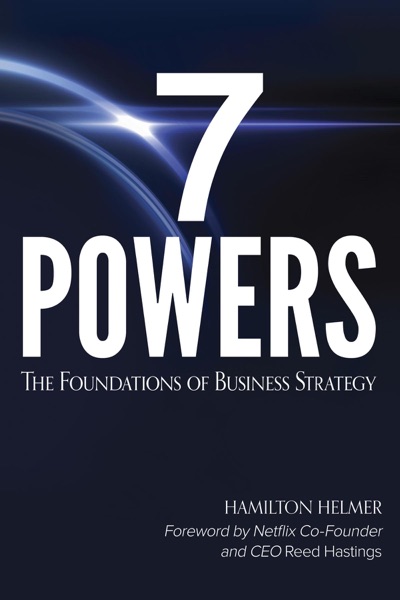
7 Powers is Hamilton Helmer's attempt to distill the full landscape of business strategy into a single rigorous framework.
Hamilton Helmer · 2016 · 3h 45m
Full summary and key takeaways →The 12 questions
- 1.
Think of a company you admire. Which of Helmer's seven powers, if any, does it actually have? Is the barrier as solid as it first appears?
- 2.
Counter-positioning is defined partly by the incumbent's unwillingness to respond. Can you think of an incumbent that surprised everyone by successfully copying a disruptive challenger?
- 3.
Helmer argues power must usually be established at Takeoff. How does that change how you'd think about the strategic priorities of an early-stage company versus a mature one?
- 4.
The dual-condition test — benefit plus barrier — rules out a lot of things companies call competitive advantages. What's something widely cited as a moat that probably fails this test?
- 5.
Network economies require that adding users makes the product more valuable for existing users. Does your own product or company genuinely have this property, or is it being assumed?
- 6.
Switching costs can trap customers, but they also trap companies in their existing relationships. How do you build a business with high switching costs without becoming complacent?
- 7.
Process power is built over years and is nearly invisible from the outside. Can you identify a company whose process power is underappreciated by the market right now?
- 8.
Helmer uses Amazon, Netflix, and Intel as case studies repeatedly. How well do you think his framework ages as those companies' strategies evolve?
- 9.
The book is focused on durable competitive advantage. But some industries move fast enough that durable advantage is the wrong goal. When is Helmer's framework less relevant?
- 10.
Branding, in Helmer's definition, requires a willingness to pay a premium plus meaningful risk of disappointment. What's a brand you believed in that eventually failed this test?
- 11.
Scale economies vary enormously by industry. In your own industry, what does the scale curve actually look like, and at what size does it flatten?
- 12.
Helmer is primarily an investor lens, not an operator lens. What questions does this framework not answer that a founding team would need to figure out on their own?
How to run the discussion
- Pick six to eight, not all of them. An hour of real discussion covers fewer questions than anyone expects, and racing the list is what makes a book club feel like homework.
- Open with what people noticed, not what they concluded. Asking for a verdict first hardens opinions before anyone has heard each other.
- Let the disagreement run. The questions below that split a room are the ones worth the time; the ones everyone answers the same way can be skipped.
- Ask the quiet person a specific question. A direct, narrow question is far easier to answer than an open invitation to contribute.
Themes worth steering toward
If the conversation stalls, these are the threads that usually restart it.
Common questions
What are good book club questions for 7 Powers: The Foundations of Business Strategy?
Here are 12 book club questions for 7 Powers: The Foundations of Business Strategy by Hamilton Helmer, ordered to open easily and end somewhere worth arguing about. The strongest openers ask what each reader noticed rather than what they concluded, and the discussion usually turns on competitive advantage, business strategy, moats.
How long should a book club discussion of 7 Powers: The Foundations of Business Strategy last?
Most groups run 60 to 90 minutes of actual discussion. That is roughly six to eight questions, not all of them, so pick the ones that suit your group rather than working down the list in order.
What are the main themes in 7 Powers: The Foundations of Business Strategy?
Competitive advantage, Business strategy, Moats, Pricing power, Market dynamics. Those are the threads most likely to divide a room, which makes them the useful places to steer a discussion that has gone quiet.
Picking the next one? See books like 7 Powers: The Foundations of Business Strategy or questions for other book club picks.
