7 Powers: The Foundations of Business Strategy by Hamilton Helmer is a 2016 business book about competitive advantage, business strategy, moats. Power requires two conditions simultaneously: a benefit (you earn more) and a barrier (competitors can't easily eliminate that benefit). The benefit alone is not a moat.
Summary
7 Powers is Hamilton Helmer's attempt to distill the full landscape of business strategy into a single rigorous framework. The premise is that durable business success requires power — a condition that simultaneously produces differential returns and creates barriers against competitors who want to close that gap. Helmer, drawing on decades of work as a strategy consultant and investor, identifies exactly seven distinct sources of such power, and argues that all enduring competitive advantage traces back to at least one of them.
The seven powers are scale economies, network economies, counter-positioning, switching costs, branding, cornered resource, and process power. Scale economies arise when per-unit cost falls as volume grows. Network economies make a product more valuable as more people use it. Counter-positioning occurs when a challenger adopts a business model that incumbents won't copy because it would cannibalize their existing profits. Switching costs trap customers through the pain of transition. Branding creates a price premium through accumulated trust and perception. A cornered resource is exclusive access to a valuable input — talent, a patent, a natural monopoly. Process power comes from operational learning so embedded that competitors can't replicate it quickly. Each power is defined precisely: Helmer gives both the "benefit" (the economic advantage the firm enjoys) and the "barrier" (what stops competitors from eroding it). This dual-condition definition is one of the book's most useful contributions.
The framework also addresses dynamics — how and when each power can be established. Helmer argues that most power must be won during what he calls the "Takeoff" phase of a market's development, when the game is still being shaped. Trying to establish power after a market has settled into a competitive equilibrium is typically futile. This insight pushes strategy toward the early, uncertain phase of company-building rather than incremental optimization in maturity.
The book is short and dense rather than padded. Helmer writes like a practitioner who has seen enough deals and business plans to know what matters, not a professor building toward a textbook. The framework is genuinely useful for evaluating public companies, choosing startup strategies, and analyzing why well-run firms still decline. Its limits: it is primarily a tool for diagnosis and evaluation rather than for execution or organizational building. And like most single-framework books, it works best when held alongside other lenses — Porter's Five Forces, for instance, maps competitive structure while Helmer maps sources of defensibility.
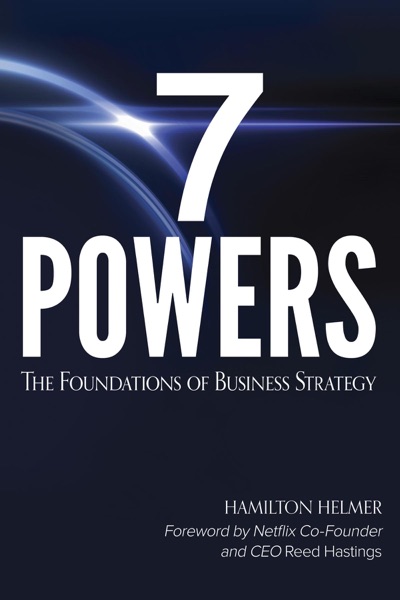
Talk to 7 Powers: The Foundations of Business Strategy like its author wrote you back.
Get the ideas that fit your life — not generic summaries.
- Chat with the book
- Audiobook-style main ideas
- Adapts to your life and goals
- Helps you take action
Key takeaways
- 1.
Power requires two conditions simultaneously: a benefit (you earn more) and a barrier (competitors can't easily eliminate that benefit). The benefit alone is not a moat.
- 2.
There are exactly seven sources of business power: scale economies, network economies, counter-positioning, switching costs, branding, cornered resource, and process power.
- 3.
Counter-positioning is one of the most underappreciated powers. A new entrant adopts a model the incumbent could copy but won't, because copying would undermine the incumbent's existing profit base.
- 4.
Most power must be established during the market's Takeoff phase. Power acquired in maturity is rare; the window for structural advantage usually closes early.
- 5.
Network economies are among the strongest powers when they exist, but they only apply when each new user genuinely makes the product more valuable for existing users — many businesses falsely claim them.
- 6.
Branding as a power requires that customers are willing to pay a persistent price premium and that there is a real risk of disappointment if they choose an alternative. It is harder to build than it looks.
- 7.
Process power comes from organizational learning compounded over years. It is hard to copy precisely because it emerges from cumulative experience, not any single practice or technology.
- 8.
The strength of each power varies. Helmer's 'power strength' analysis shows that not all moats are equal: scale economies in software differ dramatically from scale economies in airlines.
Discussion questions
Use these on your own, with a book club, or as chat starters in Superbook. Book club version, ready to copy or print →
- 1.
Think of a company you admire. Which of Helmer's seven powers, if any, does it actually have? Is the barrier as solid as it first appears?
- 2.
Counter-positioning is defined partly by the incumbent's unwillingness to respond. Can you think of an incumbent that surprised everyone by successfully copying a disruptive challenger?
- 3.
Helmer argues power must usually be established at Takeoff. How does that change how you'd think about the strategic priorities of an early-stage company versus a mature one?
- 4.
The dual-condition test — benefit plus barrier — rules out a lot of things companies call competitive advantages. What's something widely cited as a moat that probably fails this test?
- 5.
Network economies require that adding users makes the product more valuable for existing users. Does your own product or company genuinely have this property, or is it being assumed?
- 6.
Switching costs can trap customers, but they also trap companies in their existing relationships. How do you build a business with high switching costs without becoming complacent?
- 7.
Process power is built over years and is nearly invisible from the outside. Can you identify a company whose process power is underappreciated by the market right now?
- 8.
Helmer uses Amazon, Netflix, and Intel as case studies repeatedly. How well do you think his framework ages as those companies' strategies evolve?
- 9.
The book is focused on durable competitive advantage. But some industries move fast enough that durable advantage is the wrong goal. When is Helmer's framework less relevant?
- 10.
Branding, in Helmer's definition, requires a willingness to pay a premium plus meaningful risk of disappointment. What's a brand you believed in that eventually failed this test?
- 11.
Scale economies vary enormously by industry. In your own industry, what does the scale curve actually look like, and at what size does it flatten?
- 12.
Helmer is primarily an investor lens, not an operator lens. What questions does this framework not answer that a founding team would need to figure out on their own?
Themes
Frequently asked questions
-
Is 7 Powers worth reading for founders and investors?
Yes, especially for anyone evaluating whether a business has real competitive advantages or just temporary advantages. The framework forces precision: most things called moats fail the dual-condition test. The book is short enough to read in an afternoon and pays back much more than that in clearer thinking about competitive position.
-
How long is 7 Powers?
Around 220 pages — short for a strategy book. The writing is dense and analytical rather than padded with case-study filler, so the reading time is roughly three to four hours. Many readers find it worth re-reading a second time more slowly with a specific company in mind.
-
What is the most important of the 7 powers?
Helmer doesn't rank them, but network economies and counter-positioning tend to produce the strongest and most durable advantages when they exist. Counter-positioning in particular is structurally hard for incumbents to fight; network economies can be nearly impossible to erode once established.
-
How does 7 Powers compare to Porter's Five Forces?
They complement each other. Porter's framework maps the competitive structure of an industry — who has power over whom in the value chain. Helmer's framework asks a different question: within that structure, what specific conditions create durable firm-level advantage? Using both gives a fuller picture.
-
Who should read 7 Powers?
Investors evaluating durable competitive position, founders deciding where to build strategic defensibility, and strategists at mature companies trying to diagnose why growth has slowed. Less useful for operational execution or people management — Helmer is purely about competitive structure.
Similar books

Good to Great
Jim Collins
Zero to One: Notes on Startups, or How to Build the Future
Peter Thiel

The Innovator's Dilemma
Clayton M. Christensen
Competitive Strategy
Michael E. Porter
