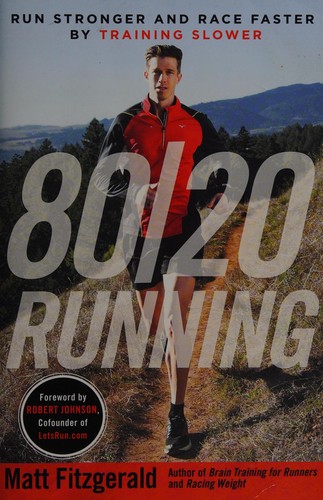
80/20 Running by Matt Fitzgerald is a 2014 health book about running, training intensity, endurance. Elite endurance athletes in all sports consistently do approximately eighty percent of their training at low intensity (below the first lactate threshold) and only twenty percent at moderate to high intensity.
Summary
80/20 Running is Matt Fitzgerald's evidence-based argument that the most common mistake recreational runners make is training too hard, too often. Drawing on research into the training patterns of elite endurance athletes, Fitzgerald shows that the world's best runners, swimmers, cyclists, and rowers consistently do approximately eighty percent of their training at low intensity — well below the lactate threshold — and only twenty percent at moderate to high intensity. Recreational athletes, by contrast, tend to cluster their training in a "moderate intensity zone" that is too hard to recover from quickly but not hard enough to drive the adaptations that come from true high-intensity work.
The 80/20 principle is backed by multiple lines of evidence. Physiologically, low-intensity training produces large aerobic adaptations — mitochondrial density, capillary development, fat oxidation efficiency — without generating the stress hormones that interfere with recovery. High-intensity work, done sparingly, generates additional stimulus that low-intensity work alone cannot produce. Moderate-intensity training produces a worst-of-both-worlds outcome: significant fatigue without the maximum adaptive signal of either pole.
The research evidence Fitzgerald presents comes primarily from studies of elite athletes' training logs across multiple endurance sports, showing consistent adherence to the 80/20 split regardless of whether the athletes or their coaches could articulate the principle theoretically. He also cites intervention studies showing that recreational athletes who adopted the distribution improved more than control groups who trained as usual — primarily by slowing down their easy days rather than adding hard ones.
The practical sections of the book provide heart rate zones for calibrating intensity, sample training plans at multiple levels, and guidance on making the psychological adjustment from "working hard" to "going easy enough." That psychological challenge — the feeling that easy running is not productive — is the main obstacle Fitzgerald addresses, because most runners' intuitions about productive training effort are calibrated incorrectly. The book is technical without being inaccessible, and the underlying principle is both simple and counterintuitive enough to make it genuinely useful for most runners who haven't encountered it.
Talk to 80/20 Running like its author wrote you back.
Get the ideas that fit your life — not generic summaries.
- Chat with the book
- Audiobook-style main ideas
- Adapts to your life and goals
- Helps you take action
Key takeaways
- 1.
Elite endurance athletes in all sports consistently do approximately eighty percent of their training at low intensity (below the first lactate threshold) and only twenty percent at moderate to high intensity.
- 2.
Most recreational runners do too much moderate-intensity work — harder than easy, easier than hard — which produces significant fatigue without the maximum adaptive stimulus of either pole.
- 3.
Low-intensity training drives powerful aerobic adaptations: increased mitochondrial density, improved fat oxidation, and cardiovascular efficiency that are produced most effectively below the lactate threshold.
- 4.
High-intensity work, done in the upper twenty percent of training volume, adds stimulus that low-intensity work alone cannot provide, particularly for anaerobic capacity and lactate tolerance.
- 5.
The 80/20 distribution applies across endurance sports regardless of event distance — from five-kilometer races to ultramarathons — suggesting it reflects fundamental physiology rather than sport-specific strategy.
- 6.
The lactate threshold is the primary training intensity boundary: work below it produces aerobic adaptations with minimal recovery cost; work above it is more expensive to recover from and should be used sparingly.
- 7.
Heart rate monitoring is the most practical tool for enforcing the 80/20 distribution, because perceived effort systematically overestimates how hard easy runs feel and underestimates how hard hard runs are.
- 8.
Recreational runners who slow their easy days and introduce genuine high-intensity intervals improve more than runners who continue with moderate-intensity training — the evidence is counterintuitive but consistent.
Discussion questions
Use these on your own, with a book club, or as chat starters in Superbook. Book club version, ready to copy or print →
- 1.
The main message is to slow down most of your running. Does that feel counterintuitive? Why do you think most recreational runners default to moderate intensity?
- 2.
Fitzgerald argues that elite runners' training practices are the best evidence for what works, regardless of whether those athletes can articulate the reason. Is that a reliable way to identify optimal training?
- 3.
Have you tracked your training intensity distribution? If you ran your last few weeks through the 80/20 lens, what would the split actually be?
- 4.
The book requires accepting that easy running — conversational pace — is productive training. What would make it psychologically easier to run that slowly?
- 5.
Heart rate monitoring enforces the 80/20 split by providing objective intensity data. Do you use a heart rate monitor? What has it revealed about your pacing?
- 6.
The principle applies across endurance sports. Do you think there's an analogous principle in strength training or other physical disciplines — that most work should be at lower intensity?
- 7.
Fitzgerald argues that moderate-intensity training is the worst of both worlds. Does that reframe how you think about the comfortable hard run that most recreational athletes default to?
- 8.
The book provides training plans at multiple levels. Have you ever followed a structured training plan? What is your experience with plan adherence versus improvisation?
- 9.
If slowing down your easy runs significantly improved your race times, what would that suggest about the value of intuition versus evidence in training decisions?
- 10.
The 80/20 principle runs counter to the 'no pain, no gain' philosophy that dominates fitness culture. Why does that culture persist despite evidence pointing in the opposite direction?
- 11.
Fitzgerald covers the psychological adjustment required to run slowly. What other evidence-based health prescriptions require this kind of counterintuitive compliance?
- 12.
If you have a running goal, what would the 80/20 version of your training look like? What would you have to change?
Themes
Frequently asked questions
-
Is 80/20 Running backed by real science?
Yes. Fitzgerald draws on multiple research threads: studies of elite athletes' actual training logs across endurance sports, physiological research on low-intensity adaptations versus moderate-intensity fatigue, and intervention studies showing recreational athletes' improvement from redistributing training intensity. The underlying principle is well-supported even if the exact 80/20 ratio is an approximation.
-
How slow is 'easy' in the 80/20 framework?
Below the first lactate threshold, which for most runners means a conversational pace — comfortable enough to speak in complete sentences. For many recreational runners, this is significantly slower than their habitual easy run pace. Heart rate Zone 1-2 is the practical target.
-
Does 80/20 Running include training plans?
Yes — the book provides detailed training plans for five-kilometer to marathon distances at multiple fitness levels. Each plan distributes workouts according to the 80/20 principle, with the specific heart rate zones and workout types specified.
-
Can the 80/20 principle apply to sports other than running?
Fitzgerald argues yes — the research spans swimming, cycling, rowing, cross-country skiing, and other endurance sports, all showing similar intensity distributions among elite performers. The underlying physiology is not running-specific.
-
Who should read 80/20 Running?
Any recreational runner who has hit a plateau, is chronically fatigued from training, or wants to improve race times. Particularly useful for runners who train 'hard' but struggle to make progress — the most likely diagnosis is that their easy days are too fast and they're not doing genuine quality work.