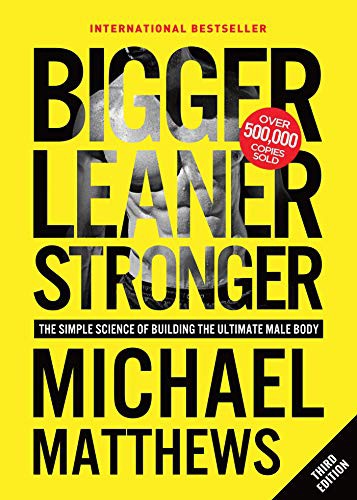
Bigger Leaner Stronger by Michael Matthews is a 2012 health book about strength training, muscle building, nutrition. Progressive overload — systematically increasing weight or volume over time — is the primary driver of muscle growth, and most other training variables are secondary.
Summary
Bigger Leaner Stronger is Michael Matthews's practical guide to building a lean, muscular physique through evidence-based strength training and flexible dieting. First published in 2012 and now in its third edition, the book is aimed at men starting or restarting a serious training program and frustrated by the fitness industry's tendency to make simple things complicated and expensive. Matthews's central argument is that the fundamentals — progressive overload with compound movements, adequate protein, caloric control — are responsible for virtually all of the results that training produces, and that everything else is marginal at best.
The book opens with a debunking section covering the most common myths in fitness: that you need to train with high reps to get "toned," that doing cardio is necessary for fat loss, that you need supplements to make progress, that changing your workout constantly prevents plateaus, and that strength training is dangerous for joints. Matthews takes each myth through the scientific literature — the references are real and the citations are appropriate — and replaces them with evidence-based principles. This section is probably the most valuable for beginners who arrive at the gym with a head full of misinformation.
The training program is built around the "big three" compound lifts — squat, bench press, and deadlift — supplemented by overhead press, rows, and isolation work. The programming philosophy is heavy weight and low reps (four to six per set) to prioritize strength development and neuromuscular efficiency, with progression tracked systematically. Matthews argues, with support from strength science, that heavy compound training produces more muscle and less injury than the lighter, higher-volume approaches popular in commercial gyms.
The nutrition section covers protein targets (roughly one gram per pound of body weight), flexible dieting through calorie and macronutrient tracking, and the evidence (or lack of it) for specific supplements. Matthews's supplement recommendations are minimal — creatine, caffeine, and adequate micronutrients — and his skepticism of the supplement industry is unambiguous. The practical sections include detailed programming, a meal-planning framework, and troubleshooting for common stalls. The book is largely a no-frills practical manual, and its success reflects how much readers value the combination of evidence and specificity.
Talk to Bigger Leaner Stronger like its author wrote you back.
Get the ideas that fit your life — not generic summaries.
- Chat with the book
- Audiobook-style main ideas
- Adapts to your life and goals
- Helps you take action
Key takeaways
- 1.
Progressive overload — systematically increasing weight or volume over time — is the primary driver of muscle growth, and most other training variables are secondary.
- 2.
Heavy compound movements (squat, deadlift, bench, overhead press, row) produce more total muscle stimulation and more strength development than isolation machines and light, high-rep training.
- 3.
Caloric surplus for muscle building and caloric deficit for fat loss are the fundamental nutritional requirements — no specific food category or meal timing protocol overrides energy balance.
- 4.
Protein requirements for muscle building are approximately one gram per pound of body weight per day; total calories and protein are the variables that matter most, not meal frequency or food type.
- 5.
Most supplements are either ineffective or have benefits too small to justify their cost; creatine monohydrate is the main exception with consistent evidence for strength and muscle gain.
- 6.
Training frequency for most natural lifters should allow full recovery between sessions for each muscle group — typically two to three times per week per muscle group with adequate volume.
- 7.
Flexible dieting — tracking macronutrients and calories across any food choices — produces better long-term adherence and comparable results to rigid clean-eating approaches.
- 8.
The fitness industry profits from complexity and novelty; the actual science of muscle building is simple and stable, which is commercially inconvenient.
Discussion questions
Use these on your own, with a book club, or as chat starters in Superbook. Book club version, ready to copy or print →
- 1.
Matthews argues that the fitness industry deliberately makes simple things complicated. Have you encountered advice that confused you about training or diet that now seems unnecessarily complex?
- 2.
The program centers on heavy compound lifts rather than machine-based or isolation training. What has your experience with different training approaches taught you about what actually produces results?
- 3.
He advocates for flexible dieting — tracking macros across any food choices — over clean eating. Does that approach appeal to you? What are its limitations?
- 4.
Matthews claims most supplements are a waste of money. Have you ever bought a supplement expecting results that didn't materialize? What influenced that decision?
- 5.
Progressive overload means adding weight to the bar consistently over months and years. What is your relationship with measurable progress in physical training — do you track it?
- 6.
The book is aimed at men wanting to build muscle. How does the fitness literature's demographic focus on men shape what advice is most visible and culturally available?
- 7.
Matthews argues that training to failure is unnecessary and counterproductive for natural lifters. How does that contradict or confirm what you've been told about training hard?
- 8.
The evidence-based approach means disregarding a lot of bro-science that circulates in gyms. How do you evaluate fitness advice when you encounter it?
- 9.
He covers the psychology of discipline in training — specifically why people quit — alongside the exercise science. Which of his arguments about consistency do you find most applicable?
- 10.
Bigger Leaner Stronger is written for complete beginners as well as experienced lifters. If you're in the latter category, what has your experience confirmed or complicated in his framework?
- 11.
The book promises significant physical transformation in one year. Is that timeframe realistic in your experience? What's the gap between promise and result in fitness books generally?
- 12.
Matthews self-publishes and built his following without traditional publishing support. Does knowing that affect how you assess the book's credibility?
Themes
Frequently asked questions
-
Is Bigger Leaner Stronger worth reading?
Yes, particularly for beginners or people who have been training without a systematic approach. Matthews does a good job of clearing misinformation and presenting the actual evidence on what produces muscle growth. Experienced lifters will find most of the information familiar, but the programming section is practically useful at any level.
-
What kind of training does Bigger Leaner Stronger recommend?
Heavy compound lifts — squat, bench, deadlift, overhead press, rows — in low-rep ranges (four to six reps per set) with progressive overload as the primary training principle. Cardiovascular exercise is covered but treated as supplementary to strength training for body composition.
-
Does Bigger Leaner Stronger require a commercial gym membership?
Not strictly, but the program is designed around a barbell and squat rack. Home gyms with a barbell can work. Many of the exercises are impractical without appropriate equipment.
-
How long is the transformation program in the book?
Matthews describes a one-year arc for significant body composition change, though he notes that progress is fastest in the first three to six months. The specific programming is laid out in annual cycles.
-
Is there a version of this book for women?
Yes — Thinner Leaner Stronger applies the same training and nutrition framework to women's goals and physiology. Most of the core science is the same; the differences are in programming emphasis and target body composition.