Health · Book club
80/20 Running book club questions
Here are 12 book club questions for 80/20 Running by Matt Fitzgerald, ordered to open easily and end somewhere worth arguing about. Copy them, print them, or bring them up one at a time.
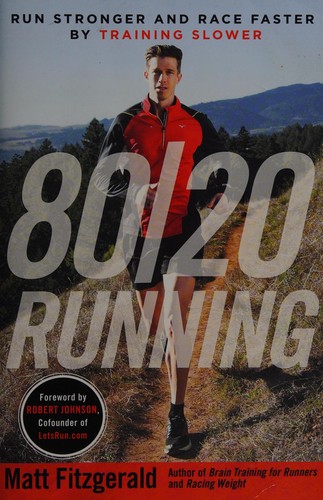
80/20 Running is Matt Fitzgerald's evidence-based argument that the most common mistake recreational runners make is training too hard, too often.
Matt Fitzgerald · 2014 · 5h 20m
Full summary and key takeaways →The 12 questions
- 1.
The main message is to slow down most of your running. Does that feel counterintuitive? Why do you think most recreational runners default to moderate intensity?
- 2.
Fitzgerald argues that elite runners' training practices are the best evidence for what works, regardless of whether those athletes can articulate the reason. Is that a reliable way to identify optimal training?
- 3.
Have you tracked your training intensity distribution? If you ran your last few weeks through the 80/20 lens, what would the split actually be?
- 4.
The book requires accepting that easy running — conversational pace — is productive training. What would make it psychologically easier to run that slowly?
- 5.
Heart rate monitoring enforces the 80/20 split by providing objective intensity data. Do you use a heart rate monitor? What has it revealed about your pacing?
- 6.
The principle applies across endurance sports. Do you think there's an analogous principle in strength training or other physical disciplines — that most work should be at lower intensity?
- 7.
Fitzgerald argues that moderate-intensity training is the worst of both worlds. Does that reframe how you think about the comfortable hard run that most recreational athletes default to?
- 8.
The book provides training plans at multiple levels. Have you ever followed a structured training plan? What is your experience with plan adherence versus improvisation?
- 9.
If slowing down your easy runs significantly improved your race times, what would that suggest about the value of intuition versus evidence in training decisions?
- 10.
The 80/20 principle runs counter to the 'no pain, no gain' philosophy that dominates fitness culture. Why does that culture persist despite evidence pointing in the opposite direction?
- 11.
Fitzgerald covers the psychological adjustment required to run slowly. What other evidence-based health prescriptions require this kind of counterintuitive compliance?
- 12.
If you have a running goal, what would the 80/20 version of your training look like? What would you have to change?
How to run the discussion
- Pick six to eight, not all of them. An hour of real discussion covers fewer questions than anyone expects, and racing the list is what makes a book club feel like homework.
- Open with what people noticed, not what they concluded. Asking for a verdict first hardens opinions before anyone has heard each other.
- Let the disagreement run. The questions below that split a room are the ones worth the time; the ones everyone answers the same way can be skipped.
- Ask the quiet person a specific question. A direct, narrow question is far easier to answer than an open invitation to contribute.
Themes worth steering toward
If the conversation stalls, these are the threads that usually restart it.
Common questions
What are good book club questions for 80/20 Running?
Here are 12 book club questions for 80/20 Running by Matt Fitzgerald, ordered to open easily and end somewhere worth arguing about. The strongest openers ask what each reader noticed rather than what they concluded, and the discussion usually turns on running, training intensity, endurance.
How long should a book club discussion of 80/20 Running last?
Most groups run 60 to 90 minutes of actual discussion. That is roughly six to eight questions, not all of them, so pick the ones that suit your group rather than working down the list in order.
What are the main themes in 80/20 Running?
Running, Training intensity, Endurance, Performance, Exercise science. Those are the threads most likely to divide a room, which makes them the useful places to steer a discussion that has gone quiet.
Picking the next one? See books like 80/20 Running or questions for other book club picks.
