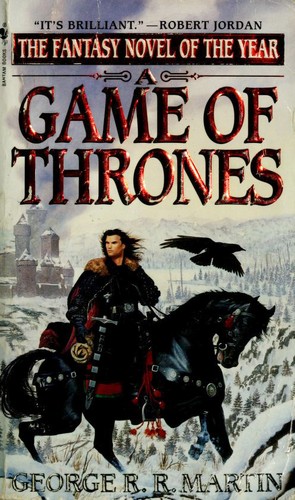
A Game of Thrones by George R.R. Martin is a 1996 fantasy book about power and corruption, honor and survival, dynastic ambition. Martin deliberately inverts the fantasy convention of the noble hero-protagonist: Ned Stark's honor is not a strength in the world of King's Landing, and the book makes you feel that as a real loss.
Summary
A Game of Thrones is the first volume of George R.R. Martin's A Song of Ice and Fire series, and the book that demonstrated high fantasy could be as morally serious as literary fiction. Set in the medieval-esque continent of Westeros, it follows multiple noble families — principally the honorable Starks of the cold north and the calculating Lannisters of the wealthy south — as they converge on a power struggle for the Iron Throne. In the far background, across a long summer that has lasted for years, winter is coming and with it something darker than political intrigue.
The book's central theme is the cost of honor in a world that doesn't reward it. Ned Stark is the novel's apparent protagonist: decent, principled, incapable of the expedient lie. Martin uses him to ask what happens when a man built for a different era — one of oaths and direct dealing — enters a court that runs on information, leverage, and betrayal. The answer is brutal and deliberate. Martin is not interested in showing that honor always loses; he is interested in showing that it has a price, and that price is real. The broader cast — Daenerys across the Narrow Sea, Tyrion Lannister navigating prejudice and family, Jon Snow at the Wall facing something beyond politics — adds layers that the show's first season, for all its quality, was unable to fully capture.
What makes Martin's approach distinctive is his refusal of fantasy conventions. The narrative perspective rotates across multiple characters without a single hero's journey at the center. No one is safe. Secondary characters developed over hundreds of pages can die without warning. The magic is subtle and distant, present more as a rumor and a threat than as a solution to the political mess at the foreground. Martin owes more to War and Peace and the Wars of the Roses than he does to Tolkien, and the book reads accordingly — dense, specific, and genuinely surprising on first encounter.
A Game of Thrones rewards patient readers willing to track a large cast and tolerate genuine ambiguity about who to root for. At 300,000 words it is long, and it does not resolve: it is an opening move in a much larger game. Readers who bounced off the violence or the sexual content have a fair point — both are present and not always justified by the narrative. But those who stayed found it changed what they expected from genre fiction.
Talk to A Game of Thrones like its author wrote you back.
Get the ideas that fit your life — not generic summaries.
- Chat with the book
- Audiobook-style main ideas
- Adapts to your life and goals
- Helps you take action
Key takeaways
- 1.
Martin deliberately inverts the fantasy convention of the noble hero-protagonist: Ned Stark's honor is not a strength in the world of King's Landing, and the book makes you feel that as a real loss.
- 2.
The rotating POV structure means you spend time inside perspectives you initially distrust — Jaime, Cersei, Tyrion — and by the time you understand them you have already judged them.
- 3.
Winter as a concept functions the way death does in life: always coming, always pushed to the back of political calculation, and always more consequential than the things people are actually fighting about.
- 4.
Daenerys's arc from traded bride to leader in exile is the most complete character transformation in the book — and it is accomplished without magic, through accumulated choices and small acts of will.
- 5.
Tyrion Lannister is arguably the novel's moral center: not good exactly, but honest about himself and the world in a way no one else in King's Landing manages to be.
- 6.
The book's violence is rarely cathartic. Martin writes deaths and wounds in ways that deflate rather than satisfy, which is a deliberate choice to resist the pleasures of genre heroism.
- 7.
Martin's world-building is geological — the history is present in the language, the architecture, the grudges — but it never stops the story to explain itself.
- 8.
The book ends not on resolution but on escalation, which is honest about what it is: not a novel but the first installment of something much larger, and the opening move of a very long game.
Discussion questions
Use these on your own, with a book club, or as chat starters in Superbook. Book club version, ready to copy or print →
- 1.
Ned Stark knows his honor will cost him and proceeds anyway. Is that admirable, delusional, or both? Does the book want you to admire him or pity him?
- 2.
The rotating POV structure means we spend significant time inside Cersei and Jaime's perspectives. By the end of the book, how much sympathy do you have for each of them? Is that sympathy manipulated or earned?
- 3.
Martin has said his inspiration was the Wars of the Roses. Does the book feel more like fantasy or historical fiction? What's lost and what's gained by setting it in a secondary world?
- 4.
Jon Snow chooses the Night's Watch over family and inheritance. The book doesn't clearly endorse or condemn that choice. What do you think the narrative thinks of it?
- 5.
Daenerys starts the book as a prop in her brother's ambitions. Track her choices across the novel: at what point does she stop being acted on and start acting? What tips the balance?
- 6.
Tyrion Lannister is defined in part by how other characters underestimate him because of his size. The book uses his perspective to comment on power and perception. How well does it work compared to how the show handled it?
- 7.
The Others — the threat from beyond the Wall — are barely present in this book. Does their near-absence make them more or less threatening? Is Martin right to keep them in the background?
- 8.
By the end of the novel, who do you trust? Which characters feel genuinely unpredictable, and which feel like they have fixed moral alignments despite the book's stated moral ambiguity?
- 9.
The sexual violence in the book has been debated at length. Does it serve the story or does it feel gratuitous? Where is the line, and does Martin stay on the right side of it?
- 10.
The series is famously unfinished. Does knowing that change how you feel about investing in the characters and their arcs?
- 11.
Compare Ned Stark's failure to, say, Eddard's equivalents in real historical fiction about medieval courts. Is his naivety realistic for a man of his background, or does it feel rigged for the plot?
- 12.
The book ends with Daenerys hatching dragons. Does that moment feel earned, or does it suggest the supernatural cavalry will eventually arrive to solve what is fundamentally a political problem?
Themes
Frequently asked questions
-
Do I need to watch the show before reading the book?
The show is based on the book, not the other way around. You can read without having seen the show; the book is considerably more detailed and the internal character perspectives are richer than television can convey. If you've watched the show, the first four seasons track the books closely enough that you will know major plot points.
-
Is A Game of Thrones worth reading if I watched the show?
Yes, especially for the POV chapters that didn't translate well to screen — Tyrion's inner voice, Sansa's evolving perceptions, and anything involving the Night's Watch. The density of the prose rewards rereading even after multiple seasons.
-
How long does it take to read?
At average pace, around 20 hours. Most readers take several weeks. The chapters are long and the cast is large; the included appendix of houses and characters is genuinely useful to consult.
-
Is the violence too much?
The violence is substantial and occasionally graphic. So is the sexual content. Both are more prevalent than in most fantasy. If you found the show too intense, the book will likely feel the same or worse, since what television showed was already an adaptation of the more graphic source material.
-
Should I start the series knowing it's unfinished?
That is a legitimate concern. Martin has not published The Winds of Winter as of 2026. You are committing to at least five books with an uncertain ending. Some readers find the journey worth it regardless; others reasonably prefer to wait.