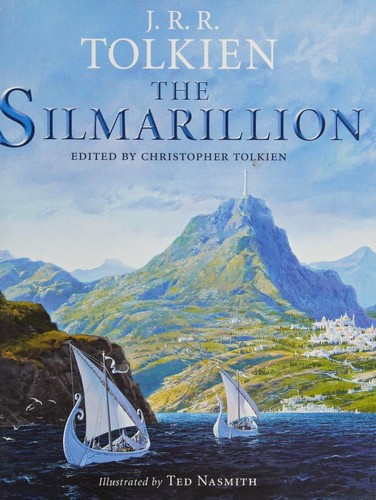
The Silmarillion by J.R.R. Tolkien is a 1977 fantasy book about creation and destruction, pride and hubris, loss and grief. The Silmarillion is myth, not novel — written in the register of scripture and legend, which means it rewards a different kind of attention than fiction usually demands.
Summary
The Silmarillion is Tolkien's attempt to do for English literature what the Norse Eddas and Finnish Kalevala did for their cultures: create a complete mythology from scratch. Published posthumously in 1977 by his son Christopher from decades of drafts and fragments, the book covers the creation of the universe, the first wars between good and evil, and the deep history of elves and men that forms the foundation beneath The Lord of the Rings. It is not a novel. It is closer to the Old Testament or Hesiod's Theogony — a collection of myths, legends, and cosmological accounts.
At its core, The Silmarillion is a tragedy about beauty, pride, and loss. The Silmarils — three jewels containing the light of the Two Trees of Valinor — become the obsession that drives a dynasty of Elven princes to oath-bound catastrophe. Fëanor's refusal to surrender them, the Kinslaying at Alqualondë, the doom of Mandos, and the long centuries of war that follow form the emotional spine of the book. The central question is whether anything of beauty can be created without becoming an instrument of destruction — whether love of the good can curdle into possessiveness, betrayal, and ruin.
What makes the book distinctive is its register. Tolkien writes in a high, archaic style — the prose of myth, not of fiction. Sentences are stately and impersonal. Characters appear and disappear across centuries without the psychological intimacy of a novel. This is entirely intentional: Tolkien was building a legend-cycle where the distance of time is part of the meaning. Embedded within the mythology are several shorter tales — Beren and Lúthien, the Children of Húrin, the Fall of Gondolin — that read more like conventional narratives and are widely considered among the most powerful stories in the entire legendarium.
Readers who approach The Silmarillion expecting The Lord of the Rings will be disappointed, and that disappointment is fair. This is a book for people who loved Middle-earth so much they want to understand where it came from — who want the etymology behind the names, the genealogy behind the alliances, the theology behind the world. Read after The Lord of the Rings (never before), it transforms retrospectively everything you encountered there. Read cold, it can feel relentless and remote.
Talk to The Silmarillion like its author wrote you back.
Get the ideas that fit your life — not generic summaries.
- Chat with the book
- Audiobook-style main ideas
- Adapts to your life and goals
- Helps you take action
Key takeaways
- 1.
The Silmarillion is myth, not novel — written in the register of scripture and legend, which means it rewards a different kind of attention than fiction usually demands.
- 2.
Fëanor is one of fantasy literature's most compelling tragedies: brilliant, passionate, and utterly destroyed by his inability to give away what he loves most.
- 3.
The Oath of Fëanor functions the way Greek fate does — a self-imposed doom that characters cannot escape and that justifies everything terrible they subsequently do.
- 4.
Tolkien's cosmology is explicitly theological: Ilúvatar creates through music, Melkor's rebellion introduces discord, and the theme of the music includes even the discord as part of a larger design.
- 5.
The tale of Beren and Lúthien — a mortal man and an immortal elf-princess — is Tolkien's most personal story; he had Lúthien inscribed on his wife Edith's gravestone.
- 6.
The recurring motif of doom and oath shows Tolkien's deep engagement with Northern European heroic literature, where tragedy comes not from weakness but from heroic virtue taken too far.
- 7.
The Silmarillion makes explicit that Middle-earth's history is one of loss and diminishment — each age is less than the one before, and the great things of the world are always passing.
- 8.
Christopher Tolkien's editorial work in assembling this from drafts spanning fifty years is itself a remarkable act of filial devotion and scholarly labor.
Discussion questions
Use these on your own, with a book club, or as chat starters in Superbook. Book club version, ready to copy or print →
- 1.
Fëanor is described as the greatest of the Elves — gifted, brilliant, fierce. Does the book present his fall as inevitable given who he was, or as a genuine moral failure he could have avoided?
- 2.
The Oath of Fëanor binds his sons to acts they know are wrong. The book treats oath-breaking as equally monstrous. Is there a coherent ethical framework here, or is Tolkien simply describing a worldview of doom?
- 3.
Melkor — later Morgoth — is the original Dark Lord, and Sauron is merely his lieutenant. How does knowing this change how you read The Lord of the Rings? Does Sauron feel diminished?
- 4.
The Valar are essentially angelic powers who watch Middle-earth but often fail to intervene at crucial moments. Does the book justify their passivity, or critique it?
- 5.
Tolkien embedded Beren and Lúthien in the mythology as a tribute to his wife Edith. Does knowing that backstory change how you read the tale? Does it feel personal in the text?
- 6.
The Fall of Gondolin and the Children of Húrin were Tolkien's two favorite chapters of the legendarium. What do they share? What makes them feel different from the broader mythological sections?
- 7.
The Silmarillion ends on a note of loss — the world diminished, the great Elves departed. Is this a pessimistic book, or does Tolkien find something redemptive in the pattern of grief and sacrifice?
- 8.
Reading The Silmarillion after The Lord of the Rings, which detail or backstory changed how you understood the main trilogy most?
- 9.
Tolkien spent fifty years on this material and never published it in his lifetime. What do you think held him back? Is there any sense in which it is deliberately unfinished?
- 10.
The prose style is deliberately archaic and impersonal. Did it work for you? Were there moments where the distance made the tragedy hit harder rather than softer?
- 11.
Compared to actual mythologies — the Norse Eddas, Greek myth, the Mahabharata — where does The Silmarillion hold up and where does it feel like imitation?
- 12.
The book presents evil as discord — literally, Melkor's theme in the music of creation. Is this a satisfying account of evil, or does it make Morgoth feel less threatening than Sauron?
Themes
Frequently asked questions
-
Do I need to read The Lord of the Rings first?
Yes — read The Silmarillion after The Lord of the Rings, never before. Without that foundation the names, places, and stakes will feel abstract and the emotional weight of the mythology will be lost.
-
Is The Silmarillion hard to read?
It is genuinely difficult compared to Tolkien's novels. The prose is archaic, the genealogies are dense, and dozens of characters share similar Elvish names. Most readers need a reference map and the index. That said, the embedded tales — Beren and Lúthien, the Children of Húrin — read like conventional narratives and are much more accessible.
-
What is The Silmarillion about, without spoilers?
It is the creation myth and deep history of Middle-earth: how the world was made, how evil entered it, and how the first great wars between elves and the Dark Lord were fought over three jewels of incomparable beauty and power.
-
Why did Tolkien never publish it in his lifetime?
He kept revising it and could never settle on a final form. The mythology was always the foundation of his work, not a finished product — he saw it as an evolving project rather than a book he would deliver to readers.
-
Who should skip The Silmarillion?
Anyone who wants another adventure story in the vein of The Hobbit. This is mythological and tragic in register, not adventurous. If the appendices at the end of The Return of the King bored you, this book will too.