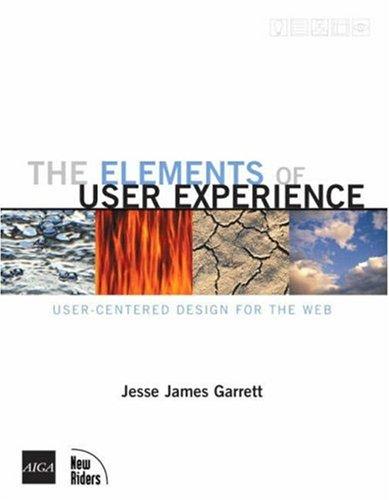
The Elements of User Experience by Jesse James Garrett is a 2002 self-help book about user experience design, information architecture, product design. User experience can be divided into five planes — Strategy, Scope, Structure, Skeleton, Surface — and problems at higher planes cannot be solved by better decisions at lower ones.
Summary
The Elements of User Experience is Jesse James Garrett's attempt to give the field of web design a shared vocabulary and a structural framework at a moment — 2002 — when web design was still being understood as a single discipline rather than several interrelated ones. The book is best known for the "Elements" diagram, a visual model that separates the work of creating a web product into five planes: Strategy, Scope, Structure, Skeleton, and Surface. The diagram appeared first as a free download in 2000 and was downloaded hundreds of thousands of times before the book that explained it was published.
Garrett's argument is that user experience problems usually trace back to decisions made at the wrong level of abstraction. Teams spend weeks debating the visual surface of a product — color, typography, imagery — while the structural and strategic decisions that actually determine user success remain unmade or implicit. The five planes model is designed to make those decisions visible and to enforce a sequence: surface decisions should emerge from skeleton decisions, which should emerge from structural ones, which should emerge from scope, which should emerge from strategy.
The strategy plane covers the purposes the product serves — for the business and for the user. The scope plane translates those purposes into specific features and content. Structure covers information architecture and interaction design: how the pieces relate and how users navigate between them. Skeleton covers interface design, navigation design, and information design: where things are on the page. Surface is the final visual layer.
The book is short, clearly written, and has aged better than most early UX texts. The framework predates the smartphone era and was designed primarily around websites, but Garrett's second edition (2011) updated it for mobile and application contexts. The core model remains in active use in design education and practice. Its weakness is that the planes can seem cleaner in the diagram than they are in actual project work, where strategy and surface decisions sometimes collapse into each other. But as a conceptual map for orienting a design team's discussions, it remains one of the most useful tools in the field's foundation documents.
Talk to The Elements of User Experience like its author wrote you back.
Get the ideas that fit your life — not generic summaries.
- Chat with the book
- Audiobook-style main ideas
- Adapts to your life and goals
- Helps you take action
Key takeaways
- 1.
User experience can be divided into five planes — Strategy, Scope, Structure, Skeleton, Surface — and problems at higher planes cannot be solved by better decisions at lower ones.
- 2.
Strategy is the first plane because it asks the most fundamental questions: what does the product do, for whom, and why? Teams that skip strategy and go straight to features build the wrong things well.
- 3.
Information architecture — how content is organized and labeled — shapes user behavior as much as visual design does, and receives far less attention in most design processes.
- 4.
The surface plane (visual design) is the most visible and the last to be decided correctly. Teams that start with the surface work backward and usually have to undo significant work later.
- 5.
Interaction design and information architecture are distinct disciplines that must work together. Confusing them — treating the navigation as an interface problem rather than a structural one — produces products that are hard to use.
- 6.
User experience is not a single skill but a set of coordinated decisions made across multiple layers of abstraction. Teams need shared vocabulary to make those decisions well.
- 7.
The gap between what a business wants a product to do and what a user needs from it is the fundamental source of poor user experience. Strategy is where that gap must be honestly confronted.
Discussion questions
Use these on your own, with a book club, or as chat starters in Superbook. Book club version, ready to copy or print →
- 1.
Garrett argues that problems at higher planes cannot be fixed at lower ones. Can you think of a product you've used where this failure was visible — where surface design couldn't compensate for structural or strategic problems?
- 2.
What does the product or service you work on (or use most) look like when mapped onto the five planes? Where are the decisions least clear?
- 3.
The book was written primarily about websites in the early 2000s. How well does the framework map onto mobile apps, voice interfaces, or AI-driven products today?
- 4.
Garrett separates information architecture from interaction design. In your experience working on or using products, are these actually treated as distinct disciplines?
- 5.
Strategy asks what the product does for the user and for the business. When those two purposes conflict — as they often do — how should that conflict be resolved?
- 6.
Why do you think so many design processes start with the surface and work backward? What institutional pressures make that pattern persistent?
- 7.
The five planes model is a simplification. What does it leave out, and what consequences does leaving those things out have for how teams work?
- 8.
Information architecture is largely invisible to users who navigate it successfully. Does that invisibility make it harder to argue for investing in it?
- 9.
The book was published in 2002. Has the growth of user research, A/B testing, and data-driven design changed where the strategic decisions in product design actually get made?
- 10.
Garrett's diagram circulated as a free download before the book existed. What does that pattern — theoretical framework spread as a visual before as a text — tell you about how design knowledge spreads?
- 11.
If you were to apply the five planes to a non-digital product — a physical object, a service, an event — what would each plane correspond to?
Themes
Frequently asked questions
-
Is The Elements of User Experience still relevant today?
Yes as a foundational framework, though the specific examples are dated. The five-plane model is still used in design education and project planning. The core insight — that surface problems trace to structural and strategic decisions — has not been superseded.
-
How long is The Elements of User Experience?
About 190 pages in the second edition — roughly a two-hour read. It is deliberately brief. The value is in the framework, not the depth of coverage; deeper treatments of each plane are covered in specialized books on information architecture, interaction design, and visual design.
-
What is the Elements diagram?
A visual model published in 2000 that maps the five planes of user experience (Strategy, Scope, Structure, Skeleton, Surface) and the disciplines that operate at each plane. It became the most widely shared diagram in early UX education before the book was published.
-
Who should read this book?
Anyone working on digital products who wants a conceptual map of what UX actually involves. Especially useful for people from non-design backgrounds — product managers, engineers, founders — who collaborate with designers and need shared vocabulary.
-
What's the most actionable idea in the book?
The discipline of working top-down: answer the strategy questions before making scope decisions, resolve scope before addressing structure, and so on. In practice, this means resisting the temptation to design the interface before the information architecture is resolved.