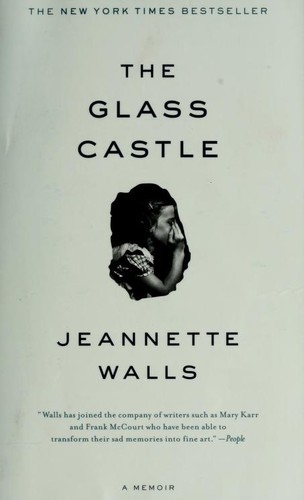
The Glass Castle: A Memoir by Jeannette Walls is a 2005 memoir book about family dysfunction, resilience, poverty. Rex Walls was a gifted, charismatic man who could not subordinate his personal freedom and addictions to the needs of his children. The book makes no attempt to resolve this contradiction.
Summary
The Glass Castle is Jeannette Walls's memoir about growing up as the second of four children in a family that moved constantly across the American Southwest and West Virginia, rarely had enough to eat, and existed almost entirely outside conventional institutions. Her father Rex was brilliant, charming, and alcoholic — a man who could explain the stars and plan impossible engineering projects but couldn't hold a job or stop drinking. Her mother Rose Mary was an artist who valued creative freedom over the obligations of feeding children. The title refers to Rex's lifelong promise to build his family a spectacular glass house powered by solar energy, a promise he never came close to keeping.
Walls tells the story in plain, unguarded prose that trusts readers to draw their own conclusions. She doesn't editorialize heavily about her parents. She describes the family digging through dumpsters for food, children sleeping in cardboard boxes for warmth, her father spending grocery money on alcohol, and her mother hoarding a chocolate bar while her children went hungry. She also describes him teaching her to swim by throwing her into a pool and her parents pointing out constellations on clear desert nights. The book holds both realities at once, which is what makes it work.
The family's years in Welch, West Virginia — Rex's hometown — are the memoir's bleakest stretch. The house was literally crumbling: no heat, no plumbing, a hole in the floor. Walls and her siblings learned early that survival depended on themselves, not their parents. The older children eventually made their way to New York City, where Walls built a career as a gossip columnist while her parents, by choice, lived on the streets of Manhattan for a period.
What the memoir resists is easy catharsis. Walls doesn't conclude that her parents were simply bad people, nor does she frame her survival as triumph over them. The Glass Castle asks harder questions about love, loyalty, and what adults owe their children — and leaves many of them open. Readers who grew up in stable homes sometimes find it difficult to accept that Walls is not angrier. That discomfort is part of what the book is doing.
Talk to The Glass Castle: A Memoir like its author wrote you back.
Get the ideas that fit your life — not generic summaries.
- Chat with the book
- Audiobook-style main ideas
- Adapts to your life and goals
- Helps you take action
Key takeaways
- 1.
Rex Walls was a gifted, charismatic man who could not subordinate his personal freedom and addictions to the needs of his children. The book makes no attempt to resolve this contradiction.
- 2.
Walls's childhood produced real competence. Scrounging for food, navigating unstable environments, and solving problems without adult help gave the children skills that proved useful later — at a steep cost.
- 3.
Rose Mary Walls treated motherhood as a constraint on her artistic identity. Her refusal to use a teaching salary to feed her children is the memoir's hardest scene to rationalize.
- 4.
The glass castle is Rex's defining metaphor: an ambitious, beautiful vision he will always be about to build. Walls uses it carefully — it's both a literal broken promise and a way of understanding her father's character.
- 5.
The children's eventual escape to New York depended on each other more than on any institution. Lori saved money in a secret fund for years; Jeannette followed her. The family unit was toxic but the sibling bonds were genuinely protective.
- 6.
Walls wrote the book while her parents were alive and known in New York. The act of writing it required her to decide what she actually thought of them, and the memoir's complicated tone reflects how unresolved that was.
- 7.
Poverty is not just material in the memoir. The Walls family often had options — a teaching job, a house with a deed — that they refused. Walls doesn't let readers reduce the story to a simple lack of money.
- 8.
Forgiveness in the memoir is not absolution. Walls maintains a relationship with her parents in adulthood, and the book doesn't pretend that's easy or that the harm done to the children was acceptable.
Discussion questions
Use these on your own, with a book club, or as chat starters in Superbook. Book club version, ready to copy or print →
- 1.
Walls depicts her father with genuine affection alongside clear-eyed accounts of his failures. Which of the two Rex Walls — the brilliant dreamer or the negligent parent — do you find it harder to hold in mind at the same time?
- 2.
Rose Mary's refusal to prioritize her children's basic needs over her own desires is the detail many readers find hardest to forgive. What, if anything, do you think explains it?
- 3.
Walls describes her childhood as genuinely formative in positive ways — competence, self-reliance, a particular way of seeing the world. Do you think those gains justify or merely complicate the harm?
- 4.
The memoir resists anger in a way that makes some readers uncomfortable. Does Walls's relatively measured tone feel honest to you, or like a kind of self-protection?
- 5.
What does the glass castle itself represent to you by the end of the book? Has its meaning changed from what it seemed to be in the early chapters?
- 6.
The Walls children each respond differently to the same upbringing — some thrive in New York, one returns to the family pattern. What do you think accounts for the different outcomes?
- 7.
Walls was writing about living people, including her mother, who was well aware the book existed. How do you think that constraint shaped what she included and what she left out?
- 8.
Rex teaches Jeannette to swim by throwing her in the water. She describes this as one of his genuine gifts to her. Is that a reasonable interpretation, or is it an example of a survivor reframing harm?
- 9.
At what point in the book, if any, did you think the children should have been removed from the family? What prevented it, and what does that tell you about how the systems around the family worked?
- 10.
Walls maintains a relationship with her parents as an adult, including giving them money. Do you think that was the right choice? What would you have done?
- 11.
The book is often assigned in schools as an inspirational story of resilience. Does that framing fit the book you read, or does it miss something important?
- 12.
Which scene in the memoir stayed with you longest after you finished? What does it say about what the book is actually about?
Themes
Frequently asked questions
-
What is The Glass Castle about?
It's Jeannette Walls's memoir about growing up in a chaotic, nomadic family led by a brilliant but alcoholic father and a self-focused artist mother who prioritized personal freedom over their children's basic needs. The book traces the family from the Arizona desert through rural West Virginia to New York City, where Walls eventually built a career while her parents lived on the streets.
-
Is The Glass Castle worth reading?
Yes, particularly for the quality of the writing and the moral complexity Walls sustains throughout. It doesn't offer easy judgments about its subjects, which makes it more valuable and more uncomfortable than a straightforward abuse memoir. Readers looking for catharsis or a clear villain may find it frustrating.
-
How long is The Glass Castle?
The book is around 288 pages and takes roughly five to five-and-a-half hours to read at an average pace. It reads quickly — Walls's prose is plain and the chapters are short — but many readers slow down in the West Virginia section, which is the densest part of the book.
-
Who should read The Glass Castle?
Anyone interested in memoirs about unconventional childhoods, questions of family loyalty and forgiveness, or the mechanics of poverty in America. It's also useful for readers thinking about what children can survive and what the lasting costs look like. It is not a comfortable or uplifting read in the conventional sense.
-
Is the story in The Glass Castle true?
Walls has confirmed the events are accurate to the best of her memory. Her mother, Rose Mary, initially disputed the portrayal but later acknowledged its accuracy. The family was real, the poverty was real, and Walls was a known journalist in New York while her parents were intermittently homeless there — a fact she had hidden for years before the book was published.
Similar books
Educated: A Memoir
Tara Westover

Wild: From Lost to Found on the Pacific Crest Trail
Cheryl Strayed
Born a Crime: Stories from a South African Childhood
Trevor Noah
Man's Search for Meaning
Viktor E. Frankl
The Glass Castle vs.
Deciding between two books? The Glass Castle vs Educated .
