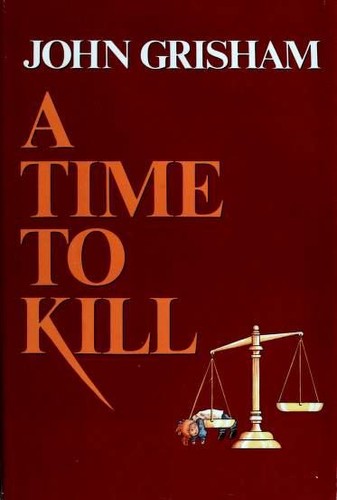
A Time to Kill by John Grisham is a 1989 thriller book about racial injustice, vigilante justice, law and morality. The novel forces a genuine moral question: if the legal system cannot reliably deliver justice to Black Americans, is extralegal violence defensible — and who gets to decide?
Summary
In Clanton, Mississippi, two white men rape and nearly kill ten-year-old Tonya Hailey. Her father, Carl Lee Hailey, shoots them dead in the courthouse. Jake Brigance, a young white defense attorney and Carl Lee's friend, agrees to defend him. The question the novel asks — and lingers over for nearly 500 pages — is whether a Black man in Mississippi can get a fair trial for killing white men who raped his daughter, even if those white men deserved to die.
Grisham's first novel is considerably more serious and more politically engaged than the legal thrillers that followed it. This is a book about race and the American South, and it does not flinch. The Ku Klux Klan mobilizes against Carl Lee. Jake's house is burned down. His secretary is attacked. The trial is surrounded by National Guard troops. Grisham shows the systemic forces that make a Black man's acquittal nearly impossible in Ford County — not because individual jurors are cartoonishly evil, but because the entire social and legal apparatus is built to produce a particular outcome.
The novel is also an honest exploration of the limits of Jake Brigance's liberalism. He believes in Carl Lee's cause, he risks his life for it, and yet there are moments when Grisham shows us the gap between white advocacy and actual solidarity. The ending — which hinges on Jake's final summation — is one of the most emotionally effective moments Grisham has written, and it works because the novel has earned it over five hundred pages of methodical setup.
Longer and morally weightier than The Firm or The Pelican Brief, A Time to Kill is where Grisham's career began, and in some ways it is his most ambitious book. It is not subtle — the villains are mostly villainous and the hero is mostly heroic — but it is genuinely felt. Readers looking for a quick thriller should start elsewhere in Grisham's catalog. Readers willing to spend time in Ford County will find something that earns the word "important."
Talk to A Time to Kill like its author wrote you back.
Get the ideas that fit your life — not generic summaries.
- Chat with the book
- Audiobook-style main ideas
- Adapts to your life and goals
- Helps you take action
Key takeaways
- 1.
The novel forces a genuine moral question: if the legal system cannot reliably deliver justice to Black Americans, is extralegal violence defensible — and who gets to decide?
- 2.
Carl Lee Hailey is the moral center, but the novel is told largely from Jake Brigance's perspective — a deliberate choice that places the reader in the position of white witness.
- 3.
Grisham shows the legal system not as corrupt but as structurally biased: the problem is not bad actors but a system designed to produce predictable outcomes.
- 4.
The KKK in this novel is not a backdrop; it is an active force, and Grisham traces how a community that publicly opposes it privately enables it.
- 5.
The closing argument is the novel's emotional payoff — it works because Grisham has spent 500 pages making you understand why it needs to be said.
- 6.
Jake's friendship with Carl Lee is real but unequal — a microcosm of the limits of white liberal sympathy in a society structured against genuine equality.
- 7.
The novel is set in 1984, fifteen years after the Civil Rights Act. Grisham's argument is that legal change does not equal social change.
Discussion questions
Use these on your own, with a book club, or as chat starters in Superbook. Book club version, ready to copy or print →
- 1.
Carl Lee Hailey killed two men who raped his daughter. Was he right to do it? Does the novel want you to say yes, and if so, is that a problem?
- 2.
Jake Brigance is sympathetic and genuinely risks everything for his client. Does the novel ever show the limits of his liberalism? Where?
- 3.
The closing argument asks the jury to imagine Tonya Hailey as a white girl. Is that a brilliant legal move or a troubling concession to the jury's racism?
- 4.
Grisham wrote this novel in 1989 and set it in 1984. Does it read as period-specific, or does it describe something still ongoing?
- 5.
The KKK mobilizes openly in Clanton and is met with minimal official resistance. Is Grisham being historically accurate, or overstating the case?
- 6.
The women in this novel — Carla, Ellen Roark, Tonya's mother — are defined largely by their proximity to the men. Does that undercut the novel's progressive politics?
- 7.
The novel has a clear moral architecture: some characters are good, some are bad, a few are in between. Does that simplicity serve the story or limit it?
- 8.
Jake's house is burned down, his friend is nearly killed. At what point, if any, does the novel suggest a limit to what can be asked of an advocate?
- 9.
How does Ford County function as a character in this novel? What does Grisham want us to understand about the American South through it?
- 10.
The verdict is the ending the novel builds toward. Did it feel earned, or does it feel like Grisham giving the reader the ending they wanted rather than the one the world would have produced?
- 11.
If you had to name the one thing this novel is about — beyond its plot — what would it be?
- 12.
How does this compare to To Kill a Mockingbird, which covers similar territory? What does Grisham do that Lee doesn't, and vice versa?
Themes
Frequently asked questions
-
Is A Time to Kill worth reading?
Yes, especially for readers interested in race and the American legal system. It's Grisham's most politically engaged novel, and unlike his later thrillers it has genuine moral weight. At nearly 500 pages it demands more than most Grisham, but it delivers more.
-
Is A Time to Kill Grisham's best novel?
Many readers think so, including Grisham himself. It's certainly his most ambitious. The Firm and The Pelican Brief are better-engineered thrillers; A Time to Kill is more serious about what it's trying to say.
-
Is there a film adaptation?
Yes — the 1996 film directed by Joel Schumacher and starring Matthew McConaughey, Sandra Bullock, and Samuel L. Jackson is a solid adaptation. McConaughey was largely unknown at the time; the film helped launch his career.
-
How does A Time to Kill compare to To Kill a Mockingbird?
Both are Southern legal dramas about race and justice, but they're very different books. Mockingbird is narrated by a child, uses symbolism heavily, and is formally elegant. A Time to Kill is raw, detailed, and politically direct. Grisham is consciously working in the same territory without trying to be Atticus Finch.
-
Who shouldn't read this book?
Readers who want a fast-paced Grisham thriller will find this slower and heavier. The first 100 pages build the world methodically before the legal drama begins. Readers who are disturbed by graphic depictions of violence against a child should be aware the opening scenes are unflinching.
Similar books
Just Mercy: A Story of Justice and Redemption
Bryan Stevenson
The New Jim Crow: Mass Incarceration in the Age of Colorblindness
Michelle Alexander
In Cold Blood
Truman Capote
The Firm
John Grisham
