Science · Book club
Behave: The Biology of Humans at Our Best and Worst book club questions
Here are 12 book club questions for Behave: The Biology of Humans at Our Best and Worst by Robert M. Sapolsky, ordered to open easily and end somewhere worth arguing about. Copy them, print them, or bring them up one at a time.
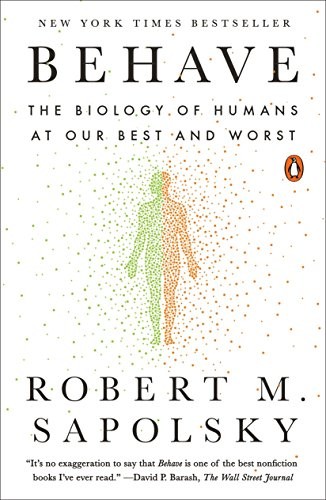
Behave is Robert Sapolsky's attempt to explain why humans do what they do — the violence, the altruism, the tribalism, the heroism — by working through every layer of biology that contributes to a single act.
Robert M. Sapolsky · 2017 · 15h 15m
Full summary and key takeaways →The 12 questions
- 1.
Sapolsky argues that behavior is always multiply determined. Which layer of explanation — genes, hormones, childhood, culture — do you most instinctively reach for when trying to explain someone's behavior, and why?
- 2.
The book documents how 'us vs. them' thinking is built into the brain at a level that operates before conscious awareness. Has knowing this ever actually changed how you responded to an in-group/out-group impulse?
- 3.
Sapolsky is a committed determinist. Does the biological account he gives of behavior change how you think about personal responsibility — your own or others'?
- 4.
The data on early childhood adversity and adult outcomes is stark. What obligations does that create for people and institutions who have the power to shape early childhood environments?
- 5.
Testosterone amplifies status-contest behavior rather than causing aggression directly. Does that nuance change how you think about testosterone's role in culture, institutions, or political life?
- 6.
Oxytocin increases both bonding and tribalism. Think of a time when in-group loyalty led you to treat an outsider worse than you otherwise would have. Was oxytocin doing its job there?
- 7.
The prefrontal cortex isn't fully developed until the mid-twenties. How much of that do you factor into how you judge the behavior of teenagers and young adults — people you know personally or public figures?
- 8.
Sapolsky says the most important intervention for reducing violence is improving early childhood conditions. Do you think the systems and institutions you live inside actually act on that knowledge?
- 9.
The book covers moral philosophy in the last section — Kantian ethics, utilitarianism, Rawlsian justice — and tries to evaluate them in light of the biology. Which framework holds up best under that scrutiny, in your view?
- 10.
Sapolsky documents how context shifts behavior dramatically — the same person in different situations. Think of a time when your behavior was much worse (or much better) than your self-image would predict. What was the context doing?
- 11.
The book argues that punishment systems built on retribution are less effective than ones built on changing the conditions that produce behavior. Where do you see that tension playing out in policy debates you follow?
- 12.
Sapolsky writes with open advocacy at some points — on capital punishment, on how we treat the mentally ill, on free will. Does an author's explicit moral position help or hurt a science book for you?
How to run the discussion
- Pick six to eight, not all of them. An hour of real discussion covers fewer questions than anyone expects, and racing the list is what makes a book club feel like homework.
- Open with what people noticed, not what they concluded. Asking for a verdict first hardens opinions before anyone has heard each other.
- Let the disagreement run. The questions below that split a room are the ones worth the time; the ones everyone answers the same way can be skipped.
- Ask the quiet person a specific question. A direct, narrow question is far easier to answer than an open invitation to contribute.
Themes worth steering toward
If the conversation stalls, these are the threads that usually restart it.
Common questions
What are good book club questions for Behave: The Biology of Humans at Our Best and Worst?
Here are 12 book club questions for Behave: The Biology of Humans at Our Best and Worst by Robert M. Sapolsky, ordered to open easily and end somewhere worth arguing about. The strongest openers ask what each reader noticed rather than what they concluded, and the discussion usually turns on human behavior, neuroscience, evolution.
How long should a book club discussion of Behave: The Biology of Humans at Our Best and Worst last?
Most groups run 60 to 90 minutes of actual discussion. That is roughly six to eight questions, not all of them, so pick the ones that suit your group rather than working down the list in order.
What are the main themes in Behave: The Biology of Humans at Our Best and Worst?
Human behavior, Neuroscience, Evolution, Morality, Aggression. Those are the threads most likely to divide a room, which makes them the useful places to steer a discussion that has gone quiet.
Picking the next one? See books like Behave: The Biology of Humans at Our Best and Worst or questions for other book club picks.
