Psychology · Book club
Blink: The Power of Thinking Without Thinking book club questions
Here are 12 book club questions for Blink: The Power of Thinking Without Thinking by Malcolm Gladwell, ordered to open easily and end somewhere worth arguing about. Copy them, print them, or bring them up one at a time.
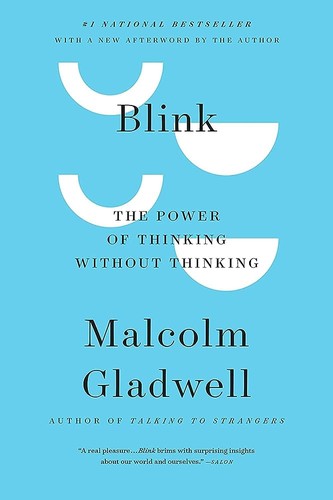
Blink is Malcolm Gladwell's argument that fast, unconscious decisions — the ones made in the first two seconds of encountering something — are often just as reliable as slow, deliberate analysis, and sometimes more so.
Malcolm Gladwell · 2005 · 5h 45m
Full summary and key takeaways →The 12 questions
- 1.
Gladwell argues the adaptive unconscious is a powerful decision-making tool. What is a domain in your life where you trust your gut more than your reasoning — and is that trust earned?
- 2.
Think of a time your first impression of a person or situation turned out to be wrong. What cues were you reading that misled you?
- 3.
The book distinguishes between blinks built on genuine expertise and blinks built on unconscious bias. How would you tell the difference in your own snap judgments?
- 4.
Gottman claims to predict divorce from watching a few minutes of a couple talking. What does this suggest about how much we reveal when we think we are presenting ourselves well?
- 5.
The Getty Museum bought a fake kouros partly because the authentication process generated so much data that doubt felt unreasonable. When has accumulating more information made a decision harder rather than easier for you?
- 6.
Gladwell says musicians auditioned behind a screen performed better on average. Where in your professional life is an equivalent screen missing — something that would force evaluation on the right criteria?
- 7.
The Warren Harding Effect suggests that looking the part matters more than we want to admit. Which decisions in your life might be influenced by someone simply seeming correct for a role?
- 8.
Gladwell describes how police officers under extreme stress sometimes make tragic errors because their unconscious reads threat cues incorrectly. What high-stakes situations in your own life require slowing down an instinct rather than following it?
- 9.
The book suggests that experts sometimes cannot explain their best judgments. When you have acted on a feeling that you could not articulate, how did you decide whether to trust it?
- 10.
Gladwell criticizes over-reliance on thick data in areas like market research. Is there a domain where you think your organization or field gathers too much data and ignores better-calibrated intuition?
- 11.
If thin-slicing works because it filters out noise, what noise are you currently allowing into decisions that would be sharper without it?
- 12.
Blink spends significant time on cases where intuition fails catastrophically. Does knowing the failure modes change how much you trust your own quick judgments?
How to run the discussion
- Pick six to eight, not all of them. An hour of real discussion covers fewer questions than anyone expects, and racing the list is what makes a book club feel like homework.
- Open with what people noticed, not what they concluded. Asking for a verdict first hardens opinions before anyone has heard each other.
- Let the disagreement run. The questions below that split a room are the ones worth the time; the ones everyone answers the same way can be skipped.
- Ask the quiet person a specific question. A direct, narrow question is far easier to answer than an open invitation to contribute.
Themes worth steering toward
If the conversation stalls, these are the threads that usually restart it.
Common questions
What are good book club questions for Blink: The Power of Thinking Without Thinking?
Here are 12 book club questions for Blink: The Power of Thinking Without Thinking by Malcolm Gladwell, ordered to open easily and end somewhere worth arguing about. The strongest openers ask what each reader noticed rather than what they concluded, and the discussion usually turns on intuition, decision-making, unconscious cognition.
How long should a book club discussion of Blink: The Power of Thinking Without Thinking last?
Most groups run 60 to 90 minutes of actual discussion. That is roughly six to eight questions, not all of them, so pick the ones that suit your group rather than working down the list in order.
What are the main themes in Blink: The Power of Thinking Without Thinking?
Intuition, Decision-making, Unconscious cognition, Pattern recognition, Bias. Those are the threads most likely to divide a room, which makes them the useful places to steer a discussion that has gone quiet.
Picking the next one? See books like Blink: The Power of Thinking Without Thinking or questions for other book club picks.
