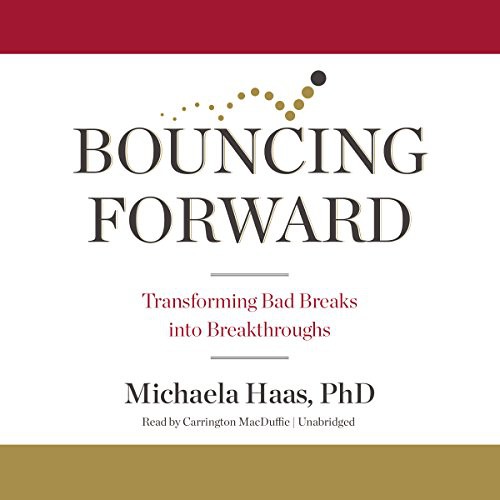
Bouncing Forward by Michaela Haas is a 2015 health book about resilience, post-traumatic growth, trauma recovery. Post-traumatic growth is not the same as resilience. Resilience is returning to the previous state; growth is emerging with expanded capacity, perspective, or purpose that was not there before.
Summary
Bouncing Forward is Michaela Haas's examination of post-traumatic growth — the documented phenomenon in which people who survive severe trauma often report not just recovery but meaningful transformation. Haas, a scholar and journalist with a background in Buddhist studies, conducted extensive interviews with survivors of loss, illness, violence, displacement, and disaster, as well as with researchers in trauma psychology, to build a case that resilience is not merely returning to baseline but potentially emerging with expanded capacity, deeper relationships, and stronger sense of purpose.
The book draws a clear distinction between resilience (bouncing back to the previous state) and post-traumatic growth (bouncing forward to a new one). Haas argues the mainstream framing of resilience as a return to normal undersells what is actually possible after severe adversity. She presents research showing that a significant proportion of trauma survivors — studies suggest between 30 and 70 percent in various populations — report some form of positive change, including increased appreciation for life, stronger personal relationships, new possibilities, spiritual deepening, or enhanced personal strength.
Haas's approach is integrative. She combines clinical research with Buddhist teachings on impermanence and suffering, and draws on interviews with survivors including veterans, cancer patients, and refugees. The book avoids the toxic positivity trap of claiming trauma is secretly a gift. Haas is clear that post-traumatic growth does not negate suffering and does not occur for everyone. The growth, when it happens, is often in tension with ongoing pain rather than its replacement.
The limitation is that the book is more inspirational than prescriptive. Haas tells stories of transformation compellingly but provides less guidance on the specific psychological conditions that produce growth rather than simply recovery or deterioration. Readers in active crisis may find the case studies meaningful but the actionable framework thin. As a reframing of what is possible after loss and adversity, it is genuinely useful.
Talk to Bouncing Forward like its author wrote you back.
Get the ideas that fit your life — not generic summaries.
- Chat with the book
- Audiobook-style main ideas
- Adapts to your life and goals
- Helps you take action
Key takeaways
- 1.
Post-traumatic growth is not the same as resilience. Resilience is returning to the previous state; growth is emerging with expanded capacity, perspective, or purpose that was not there before.
- 2.
Between 30 and 70 percent of trauma survivors across various studies report some form of positive change after adversity — a finding that contradicts the assumption that trauma only destroys.
- 3.
Growth after trauma typically involves five domains: closer relationships, new possibilities, enhanced personal strength, spiritual deepening, and greater appreciation for life.
- 4.
Post-traumatic growth coexists with ongoing suffering rather than replacing it. The transformation is often felt in tension with pain, not as a resolution of it.
- 5.
Narrative making — finding or constructing meaning from traumatic experience — is among the most reliable predictors of growth rather than deterioration.
- 6.
Social support is not optional in trauma recovery. The quality of relationships in the immediate aftermath of trauma significantly influences long-term outcomes.
- 7.
Buddhist teachings on impermanence and non-attachment provide a framework for engaging with loss that complements psychological research on post-traumatic growth.
- 8.
The framing of what is possible after trauma matters. People who believe recovery can involve growth show different outcomes than those who expect only permanent damage.
Discussion questions
Use these on your own, with a book club, or as chat starters in Superbook. Book club version, ready to copy or print →
- 1.
Haas distinguishes between bouncing back and bouncing forward. Looking at your own experience of adversity, which of the two would you say you've done?
- 2.
Post-traumatic growth doesn't negate suffering — it coexists with it. Does that nuance change how you think about the concept?
- 3.
What are the cultural narratives in your community about recovering from hardship? Do they allow for growth, or mostly for survival?
- 4.
Haas integrates Buddhist teachings into the psychological framework. Did that combination add depth or feel incongruous to you?
- 5.
The book suggests that meaning-making is central to growth after trauma. How do you currently make meaning from difficult experiences in your life?
- 6.
Which of the five growth domains — relationships, new possibilities, personal strength, spirituality, appreciation — do you think you have the most potential to develop through adversity?
- 7.
Haas is careful to avoid the implication that all trauma eventually produces growth. Why is that caveat important, and what happens when it is omitted?
- 8.
What role did social support play in your own most significant experience of adversity? Did you receive what you needed?
- 9.
The distinction between resilience (returning to normal) and growth (exceeding it) assumes there was something limited about the previous state. Do you agree with that assumption?
- 10.
The book profiles survivors of extreme trauma alongside people navigating more ordinary losses. Does the range of examples strengthen or weaken the argument?
- 11.
Post-traumatic growth research shows that expectations about what is possible after trauma affect outcomes. How do you currently talk to others about recovering from difficulty?
- 12.
If you could design a community environment that supported post-traumatic growth, what would be different from what currently exists?
Themes
Frequently asked questions
-
What is Bouncing Forward about?
It examines post-traumatic growth — the documented phenomenon in which a significant proportion of trauma survivors report not just recovery but meaningful transformation — and makes the case that this is possible without minimizing the reality of suffering.
-
Is Bouncing Forward worth reading?
Yes, particularly for people navigating significant loss or adversity, or those who work with trauma survivors. The case study collection is compelling and the integration of research with Buddhist perspectives is thoughtful. Those looking for a step-by-step recovery protocol may want something more prescriptive.
-
How does Bouncing Forward differ from standard resilience books?
Most resilience literature focuses on returning to baseline function after adversity. Haas argues the more interesting and better-documented phenomenon is the emergence of new capacities, perspectives, and purposes that did not exist before the trauma.
-
Who should read this book?
People in or after difficult periods who want a framework for thinking about what is possible beyond survival, mental health practitioners interested in post-traumatic growth research, and anyone interested in the intersection of Buddhist philosophy and clinical psychology.
-
Does post-traumatic growth apply to everyday adversity or only major trauma?
The research Haas cites covers a spectrum from extreme events (war, serious illness, bereavement) to significant life disruptions. The growth mechanisms — meaning-making, social support, revised assumptions about the world — appear relevant across a range of adversity severity.
Similar books
The Body Keeps the Score
Bessel van der Kolk
Daring Greatly
Brené Brown
Grit: The Power of Passion and Perseverance
Angela Duckworth
Being Mortal: Medicine and What Matters in the End
Atul Gawande
