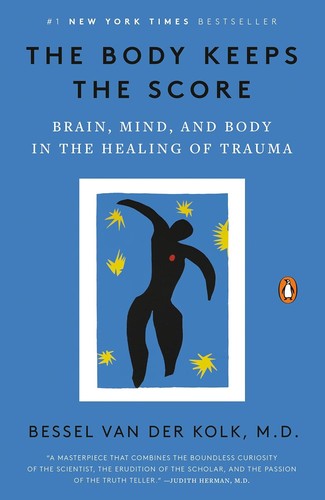
The Body Keeps the Score by Bessel van der Kolk is a 2014 psychology book about trauma, neuroscience, healing. Trauma is stored in the body, not just the mind. The nervous system learns to treat ordinary situations as dangerous, and this pattern persists long after the original threat is gone.
Summary
The Body Keeps the Score is Bessel van der Kolk's account of four decades spent studying and treating trauma, from Vietnam veterans at the VA in the 1970s to survivors of childhood abuse, accidents, and domestic violence. Van der Kolk's central argument is that trauma is not primarily a psychological event stored in memory — it is a physiological one, encoded in the body itself. The nervous system learns to treat ordinary moments as dangerous, and no amount of talking alone can reach the parts of the brain that keep replaying the alarm.
The book moves through three main territories. First, van der Kolk explains what trauma does to the brain and body: how the amygdala stays on high alert, how the prefrontal cortex goes offline under threat, how survivors lose the ability to feel safe in their own skin. He draws heavily on neuroimaging research, much of it his own, to show that trauma changes brain structure in measurable ways. This is not metaphor. The body literally keeps the score of overwhelming experience.
Second, van der Kolk surveys the limitations of talk therapy and medication. He is not dismissive — he acknowledges that both help some people — but his argument is that treatments focused on narrative and cognition often leave the body untouched, and that the body is where the real work needs to happen. The middle sections of the book introduce the approaches he finds most promising: EMDR, yoga, theater, neurofeedback, and body-based therapies that help survivors regain a felt sense of safety from the inside rather than through understanding alone.
Third, the book addresses developmental trauma — what happens when the damage begins in early childhood, before language or coherent memory. These chapters are the most sobering. Van der Kolk argues that the DSM's categories poorly capture the diffuse, pervasive effects of chronic early trauma, and that systems meant to help — schools, foster care, the criminal justice system — often make things worse. The writing is clinical but not cold, and the case histories throughout give the research a human face. The book is long and occasionally repetitive, but for clinicians, survivors, and anyone who loves someone struggling with trauma, it remains one of the most rigorous and humane accounts available.
Talk to The Body Keeps the Score like its author wrote you back.
Get the ideas that fit your life — not generic summaries.
- Chat with the book
- Audiobook-style main ideas
- Adapts to your life and goals
- Helps you take action
Key takeaways
- 1.
Trauma is stored in the body, not just the mind. The nervous system learns to treat ordinary situations as dangerous, and this pattern persists long after the original threat is gone.
- 2.
The prefrontal cortex — the seat of reason and language — goes partially offline during trauma responses. This is why survivors often cannot simply think their way to safety.
- 3.
Trauma changes brain structure in measurable ways. Neuroimaging shows altered activity in the amygdala, prefrontal cortex, and insula in people with PTSD.
- 4.
Talk therapy alone is often insufficient for trauma. Treatments that engage the body — EMDR, yoga, somatic therapies, neurofeedback — can reach what cognitive approaches miss.
- 5.
Developmental trauma, especially chronic abuse or neglect in early childhood, has pervasive and lasting effects that differ fundamentally from single-incident PTSD.
- 6.
Survivors often lose access to the present moment. They live in time warps — past threat flooding present experience — and recovery depends on restoring the ability to feel safe now.
- 7.
Social support is one of the strongest predictors of resilience after trauma. The capacity to rely on others is itself shaped by early attachment experiences.
- 8.
The body's signals are data, not noise. Learning to feel what the body is doing — without being overwhelmed by it — is a core element of trauma recovery.
- 9.
Systems meant to help traumatized people — courts, schools, hospitals — frequently retraumatize them because they are designed around compliance and control rather than safety and agency.
Discussion questions
Use these on your own, with a book club, or as chat starters in Superbook. Book club version, ready to copy or print →
- 1.
Van der Kolk argues that the body holds trauma in ways language cannot fully reach. Has there been a time in your own life when a physical response preceded or overrode your rational understanding of a situation?
- 2.
The book makes a case that talk therapy is often not enough. What does this suggest about how we should think about mental health treatment more broadly?
- 3.
Van der Kolk describes the feeling of being trapped in the past as a defining feature of trauma. What conditions in everyday life — not necessarily traumatic — can produce a similar sense of being stuck?
- 4.
The research on EMDR and yoga as trauma treatments was controversial when van der Kolk first pursued it. What does the resistance to these approaches say about how the medical establishment evaluates evidence?
- 5.
Van der Kolk is sharply critical of how the DSM categorizes trauma-related conditions. What do you think is lost when human suffering is translated into diagnostic categories?
- 6.
The chapters on developmental trauma are among the most difficult in the book. What obligations do they suggest society has toward children in environments of chronic stress or abuse?
- 7.
The book argues that social connection is protective against lasting trauma. What does this imply about the design of institutions — prisons, schools, hospitals — that routinely isolate people?
- 8.
Van der Kolk describes patients who harmed themselves as a way to feel real or in control. How does the book change or complicate how you think about self-destructive behavior?
- 9.
Several chapters describe how theater, writing, and movement have helped trauma survivors. Why might expressive and physical practices reach something that structured psychotherapy does not?
- 10.
The book draws heavily on van der Kolk's own clinical experience and research. Does the personal investment make the arguments more compelling, or does it introduce bias you find yourself pushing back on?
- 11.
Van der Kolk argues that agency — the sense that your actions matter — is central to recovery. Where in your own life has regaining a sense of agency shifted how you felt about something difficult?
- 12.
If you were designing a school or workplace with the research in this book in mind, what would you change about how it handles stress, conflict, and people in crisis?
Themes
Frequently asked questions
-
What is The Body Keeps the Score about?
It is Bessel van der Kolk's account of trauma research and treatment spanning four decades. The central argument is that trauma is stored in the body and nervous system, not just in memory or thought, and that effective treatment must engage the body, not only the mind.
-
Is The Body Keeps the Score worth reading?
Yes, for most people who want a rigorous, accessible account of trauma science. It is long and occasionally repetitive, and a few of its treatment claims have attracted methodological criticism. But as an introduction to how trauma affects the brain and body, it is unusually thorough and compassionate.
-
Who should read The Body Keeps the Score?
Clinicians, trauma survivors, caregivers, and anyone close to someone struggling with PTSD or developmental trauma. It is also valuable for teachers, social workers, and policy people who work with traumatized populations and want to understand what they are actually dealing with.
-
Who shouldn't read this book?
Readers who are currently in acute trauma recovery may find the case histories and clinical detail activating rather than helpful. It is best read with some stability and ideally alongside a therapeutic relationship rather than as a substitute for one.
-
How long does it take to read The Body Keeps the Score?
Around eleven hours at average reading pace for the 464-page book. It is dense in places and rewards slow reading. Many readers work through it in sections — the neuroscience chapters, then the treatment chapters — rather than straight through.
-
What is the most important idea in the book?
That trauma recovery is not primarily a matter of understanding what happened — it is a matter of restoring the felt sense of safety in the present moment. This shifts the focus from insight to embodied experience, which has real implications for which treatments actually work.