Health · Book club
Burnout book club questions
Here are 12 book club questions for Burnout by Emily Nagoski and Amelia Nagoski, ordered to open easily and end somewhere worth arguing about. Copy them, print them, or bring them up one at a time.
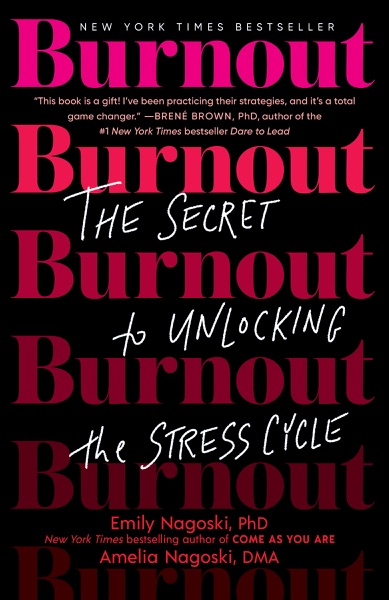
Burnout is Emily and Amelia Nagoski's book about why so many women feel exhausted despite doing everything they're supposed to do — and what to do about it.
Emily Nagoski and Amelia Nagoski · 2019 · 5h 0m
Full summary and key takeaways →The 12 questions
- 1.
The book's central distinction is between stressors and stress responses. Before reading it, were you treating them as the same thing — and does the distinction change how you think about your own exhaustion?
- 2.
The Nagoskis say most people never complete their stress cycles. What does a completed stress cycle actually feel like, and can you identify times in your life when you've experienced it?
- 3.
Human Giver Syndrome is described as a cultural expectation primarily on women. Do you recognize it in your own life or the lives of people you know — and is it exclusively gendered?
- 4.
The book prescribes physical movement as the most reliable stress-cycle completion tool. Is this realistic for people who are already overwhelmed and time-poor? What would make it more accessible?
- 5.
The authors are sisters, and a narrative thread about their own relationship runs through the book. Does that structure help or hinder the argument?
- 6.
The book is addressed primarily to women. Does that limit its usefulness — and how would a version of this argument directed at men need to be different, if at all?
- 7.
What are the structural, not individual, changes that the Nagoskis imply are necessary? Do they make a sufficient case for those — and what would realistically create them?
- 8.
The idea that rest doesn't work if you take it before completing stress cycles suggests that taking a vacation while still in acute stress may not actually restore you. Does this match your experience?
- 9.
The book presents the science fairly confidently. Are there claims that felt overreached to you — and does it matter if the basic practical advice is sound even if some details are simplified?
- 10.
Social connection as a stress-cycle completion mechanism suggests that isolation amplifies burnout. What does this imply about remote work, loneliness epidemics, and urban design?
- 11.
The book argues that burnout is not a personal failing but a systemic outcome. Does framing it that way change what you think individuals should do about it — or does it feel like an excuse?
- 12.
If you were to implement one recommendation from the book starting tomorrow, what would it be — and what's the most realistic obstacle to it?
How to run the discussion
- Pick six to eight, not all of them. An hour of real discussion covers fewer questions than anyone expects, and racing the list is what makes a book club feel like homework.
- Open with what people noticed, not what they concluded. Asking for a verdict first hardens opinions before anyone has heard each other.
- Let the disagreement run. The questions below that split a room are the ones worth the time; the ones everyone answers the same way can be skipped.
- Ask the quiet person a specific question. A direct, narrow question is far easier to answer than an open invitation to contribute.
Themes worth steering toward
If the conversation stalls, these are the threads that usually restart it.
Common questions
What are good book club questions for Burnout?
Here are 12 book club questions for Burnout by Emily Nagoski and Amelia Nagoski, ordered to open easily and end somewhere worth arguing about. The strongest openers ask what each reader noticed rather than what they concluded, and the discussion usually turns on stress and recovery, emotional physiology, gender and expectations.
How long should a book club discussion of Burnout last?
Most groups run 60 to 90 minutes of actual discussion. That is roughly six to eight questions, not all of them, so pick the ones that suit your group rather than working down the list in order.
What are the main themes in Burnout?
Stress and recovery, Emotional physiology, Gender and expectations, Burnout and exhaustion, Self-compassion. Those are the threads most likely to divide a room, which makes them the useful places to steer a discussion that has gone quiet.
Picking the next one? See books like Burnout or questions for other book club picks.
