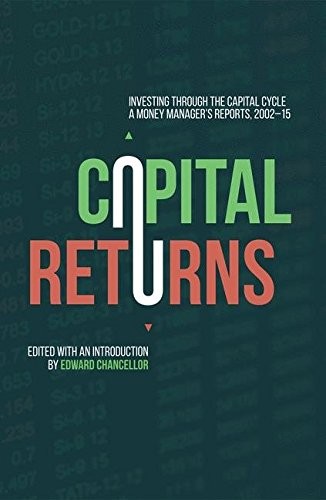
Capital Returns by Edward Chancellor is a 2015 business book about capital allocation, investment cycles, competitive advantage. Investment returns are driven more by supply dynamics than by demand growth. Capital cycle analysis studies where investment capital is flowing to anticipate future margin pressure or recovery.
Summary
Capital Returns is Edward Chancellor's edited collection of investment letters from Marathon Asset Management, a London-based fund manager, covering roughly the period from 2002 to 2015. The book is organized around a single framework, the capital cycle, and it applies that framework to dozens of industries across multiple market cycles. Chancellor, the author of Devil Take the Hindmost and a former investment strategist, writes the connecting essays and provides intellectual context. The result is one of the most practically useful books on long-term investing published in the last two decades.
The capital cycle framework is the book's engine. The argument is that investment returns in any industry are driven primarily by the supply side — specifically by how much capital is flowing into or out of that industry. When an industry earns high returns, capital floods in; supply expands; competition intensifies; margins fall. When an industry earns poor returns, capital flees; supply contracts; the survivors' margins recover. Most investors focus on demand forecasts: how fast will the market grow? Marathon's argument is that supply dynamics are more tractable and more predictive. Watching where capital is being deployed — through IPO volumes, capital expenditure trends, new entrants, and debt issuance — gives you a systematic way to identify industries at cyclical turning points.
The practical implication is contrarian. The industries most hated by investors — the ones with collapsing capital expenditure, shrinking competitive fields, and poor recent returns — are often the ones about to inflect positively. The industries most loved — the ones attracting torrents of new capital — are often setting up a supply glut and margin compression that will disappoint the optimists within a few years. Marathon applies this framework not just to cyclical industries like mining or shipping, but to technology companies, financial services, and consumer businesses.
The book is unusual in being structured as actual investment analysis rather than theory. The letters are dated, and readers can track how the framework performed against subsequent reality. The writing is dense with specific company and industry examples, which makes it more valuable than most investing frameworks books and more demanding. For serious investors, portfolio managers, and equity analysts, Capital Returns is close to essential reading. For general business readers, it offers a genuinely different lens on how industries evolve.
Talk to Capital Returns like its author wrote you back.
Get the ideas that fit your life — not generic summaries.
- Chat with the book
- Audiobook-style main ideas
- Adapts to your life and goals
- Helps you take action
Key takeaways
- 1.
Investment returns are driven more by supply dynamics than by demand growth. Capital cycle analysis studies where investment capital is flowing to anticipate future margin pressure or recovery.
- 2.
When an industry earns high returns, it attracts capital that eventually destroys those returns. The cycle is systematic and observable through IPO activity, capital expenditure, and debt issuance.
- 3.
The best investments are often in industries that have suffered capital starvation — sectors where supply has contracted and incumbents are well-positioned for a recovery that pessimistic investors have priced out.
- 4.
Management quality matters most in how capital is allocated. Companies run by managers who resist empire-building and return excess capital to shareholders tend to outperform over full cycles.
- 5.
The technology sector is not exempt from capital cycle dynamics. Periods of massive venture funding create supply gluts in software, hardware, and services just as in physical industries.
- 6.
Short-cycle businesses — where new supply can come to market quickly — are more vulnerable to capital cycle disruption than long-cycle businesses where investment takes years to bear fruit.
- 7.
Accounting quality and earnings sustainability deserve the same analytical attention as growth projections. Marathon's letters return repeatedly to how to identify earnings that are illusory.
- 8.
Patience is structural. The capital cycle framework requires holding positions through the full cycle, which is often three to seven years. That patience is unavailable to managers facing quarterly redemptions.
Discussion questions
Use these on your own, with a book club, or as chat starters in Superbook. Book club version, ready to copy or print →
- 1.
The capital cycle framework argues that supply analysis is more tractable than demand forecasting. Can you think of an industry where you've watched this cycle play out?
- 2.
Marathon's framework predicts that capital-rich industries will disappoint and capital-starved ones will recover. What industry today looks most like each type?
- 3.
The book argues that most investors focus on demand when they should focus on supply. Why do you think demand analysis is so dominant in financial media and equity research?
- 4.
Capital Returns is structured as actual investment letters written before the outcomes were known. Did reading knowing the framework but before checking the results change how you evaluated the analysis?
- 5.
Marathon's approach requires holding positions for years through apparent underperformance. What institutional and psychological pressures make that patience difficult to maintain?
- 6.
Chancellor argues that management quality shows up primarily in capital allocation decisions. How would you evaluate the capital allocation discipline of a management team you respect?
- 7.
The book covers the 2008 financial crisis through the capital cycle lens — excess financial-sector leverage as a supply problem. Is that framing more or less useful than standard narrative accounts of the crisis?
- 8.
Which industries in your professional experience look like they are currently attracting unsustainable levels of capital, and how do you think the cycle will play out?
- 9.
The capital cycle framework is contrarian by design. What personal or institutional biases make contrarian investing psychologically difficult even when intellectually correct?
- 10.
Marathon applies cycle analysis to technology companies. Does the argument that tech is not structurally different from cyclical industries strike you as correct, or does something about software economics change the analysis?
- 11.
How does the capital cycle framework relate to the concept of competitive moats? Are these complementary or in tension?
- 12.
If you were designing an equity research process from scratch using this framework, what would you measure first in each new sector you covered?
Themes
Frequently asked questions
-
What is the capital cycle and why does it matter?
The capital cycle describes how capital flows into profitable industries, increases supply, compresses margins, and then flows out as returns deteriorate — triggering a recovery in the survivors. Tracking where capital is going gives investors a predictive tool that demand forecasting alone cannot provide.
-
Who should read Capital Returns?
Professional investors, equity analysts, and serious private investors who think in multi-year holding periods. The book is dense with specific investment examples and assumes basic familiarity with financial statements and equity markets.
-
Is this book suitable for beginning investors?
Not as a starting point. The framework is powerful but the presentation assumes you can interpret company financials and understand industry economics. Read it after gaining basic investing literacy.
-
How does Capital Returns compare to other investing frameworks books?
It is more empirical and more industry-specific than most. Because the content is actual investment letters written before outcomes were known, it demonstrates the framework being applied in real time rather than in retrospective examples chosen to illustrate a thesis.
-
What is the most actionable idea in the book?
Track capital expenditure trends and IPO volumes in any industry you're analyzing. When capital is pouring in and new competitors are proliferating, be skeptical. When capital expenditure has been falling for years and competitors have exited, the setup for a recovery is improving.
Similar books
The Intelligent Investor
Benjamin Graham

Poor Charlie's Almanack
Charlie Munger
A Man for All Markets
Edward O. Thorp
Against the Gods: The Remarkable Story of Risk
Peter L. Bernstein
