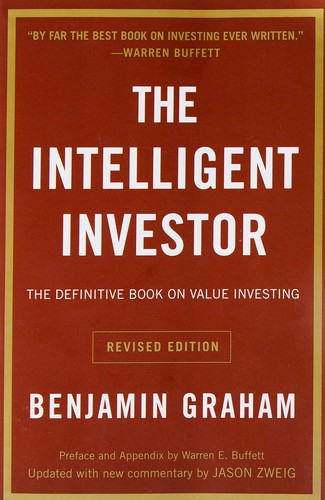
The Intelligent Investor by Benjamin Graham is a 1949 economics book about value investing, risk management, behavioral finance. The market is a voting machine in the short run and a weighing machine in the long run. Price and value diverge constantly. The investor's edge is patience.
Summary
The Intelligent Investor is Benjamin Graham's case that successful investing has less to do with picking the right stocks than with managing your own behavior. First published in 1949 and revised several times before Graham's death in 1976, it remains the foundational text of value investing — the approach that informed Warren Buffett, who studied under Graham at Columbia and called this book "by far the best book on investing ever written."
Graham's central distinction is between the investor and the speculator. A speculator bets on price movements. An investor analyzes the underlying business, buys at a price that offers a margin of safety, and holds through market noise. Most people who think they are investing are speculating. The book is largely an effort to help readers tell the difference in their own behavior.
The most enduring idea is Mr. Market, Graham's allegory for the stock market as an emotionally unstable business partner who offers to buy or sell his stake every day at a price set by his mood. When Mr. Market is euphoric, his prices are too high. When he is despairing, his prices are too low. The intelligent investor has no obligation to act on Mr. Market's offers — but is free to take advantage of them when the price is obviously wrong. This framing separates market volatility from actual business value, which is the psychological foundation of every sensible long-term portfolio.
Graham distinguishes between defensive investors (who want safety and minimal effort) and enterprising investors (who are willing to do substantial research for better returns). Most people, he argues, should be defensive: hold a mix of bonds and diversified common stocks, rebalance periodically, and resist the temptation to chase performance. Enterprising investors can do more, but only through genuine analysis — not through tips, rumors, or narrative.
The updated edition includes commentary by Jason Zweig that connects Graham's 1970s examples to modern markets without diluting the original arguments. The result is dense in places, occasionally dated in its specific examples, but clearer in its core principles than anything written since.
Talk to The Intelligent Investor like its author wrote you back.
Get the ideas that fit your life — not generic summaries.
- Chat with the book
- Audiobook-style main ideas
- Adapts to your life and goals
- Helps you take action
Key takeaways
- 1.
The market is a voting machine in the short run and a weighing machine in the long run. Price and value diverge constantly. The investor's edge is patience.
- 2.
Margin of safety is the central concept. Buy at a price significantly below your estimate of intrinsic value so that errors in your analysis don't ruin you.
- 3.
Mr. Market is your servant, not your guide. The market's daily mood swings are an opportunity to act, not a signal to follow.
- 4.
Most investors should be defensive: a simple mix of stocks and bonds, low costs, periodic rebalancing, and no market timing. Complexity is usually the enemy.
- 5.
Distinguish between investment and speculation. An investment promises safety of principal and an adequate return. Everything else is speculation, whatever you call it.
- 6.
Price is what you pay; value is what you get. The two are rarely the same, and the gap between them is where returns come from.
- 7.
Inflation is a permanent threat to purchasing power. Bonds alone are not safe. A portfolio needs exposure to equities to maintain real wealth over time.
- 8.
The enterprising investor earns better returns only through real work: financial statement analysis, disciplined criteria, and independent judgment. There are no shortcuts.
Discussion questions
Use these on your own, with a book club, or as chat starters in Superbook. Book club version, ready to copy or print →
- 1.
Graham's Mr. Market allegory reframes market volatility as opportunity rather than risk. How does your actual behavior during market drops compare to how Mr. Market is supposed to make you feel?
- 2.
Graham distinguishes defensive from enterprising investors. Which are you, honestly — and does your portfolio reflect that self-assessment or contradict it?
- 3.
The concept of margin of safety asks you to be wrong and still be okay. Where else in your financial life are you relying on everything going right?
- 4.
Graham wrote that the investor's chief problem — and worst enemy — is likely himself. What specific behavior of yours has cost you money in the markets?
- 5.
If you stopped looking at your portfolio for a year, what would actually change? What does your answer reveal about whether you're investing or speculating?
- 6.
Graham argues that most investors should accept average market returns through diversification. What would you have to give up — intellectually or emotionally — to act on that advice?
- 7.
The book distinguishes between the price of a stock and the value of the underlying business. How do you actually make that distinction in practice when you buy something?
- 8.
Graham's approach requires patience measured in years, not months. What in your life makes it hard to think in that time frame about money?
- 9.
Zweig's commentary in the updated edition argues that Graham's principles survived the dot-com crash, the 2008 financial crisis, and every other episode of market madness. What recent market event tested your own principles most severely?
- 10.
The book was written in an era before index funds existed. Graham's defensive investor prescription is essentially what a total-market index fund now delivers automatically. Does that change anything about how you invest?
- 11.
Graham says the intelligent investor is realistic about what they don't know. What is something you currently believe about the market that you hold with more confidence than you probably should?
- 12.
What's the difference between having conviction in a stock and being emotionally attached to it? Have you ever confused the two?
Themes
Frequently asked questions
-
Is The Intelligent Investor still relevant?
Yes, more than ever. The psychological principles — Mr. Market, margin of safety, the distinction between price and value — describe human behavior that has not changed. The specific examples are dated but the framework applies directly to modern markets, and Jason Zweig's commentary in the revised edition makes the translation explicit.
-
How difficult is The Intelligent Investor to read?
It's dense but not technical in the way a finance textbook is. Graham writes in clear prose, and the core ideas in each chapter are accessible. The harder parts are the specific stock-screening criteria in the middle chapters, which most readers skip without losing much. Budget six to eight hours and take notes.
-
What is the main idea of The Intelligent Investor?
That successful investing is mostly about temperament, not intellect. Graham's core argument is that the market misprice assets regularly because it is driven by emotion, and that the investor who stays rational, demands a margin of safety, and thinks in terms of underlying business value will outperform over time — not because they are smarter, but because they are calmer.
-
Should I read The Intelligent Investor or A Random Walk Down Wall Street first?
They make different arguments. Graham argues you can beat the market through disciplined analysis; Malkiel argues you probably can't and should index instead. Reading both gives you the honest tension in investing. Most people find Malkiel easier to read first, then Graham for depth.
-
What is the margin of safety concept?
It means buying a stock at a price significantly below your estimate of its true worth, so that even if your analysis is wrong in several ways, you still don't lose money. Graham treats it as the central concept of investing — the gap between price and value is your insurance against being wrong.
Similar books
The Intelligent Investor vs.
Deciding between two books? The Intelligent Investor vs The Psychology of Money .
