Science · Book club
Chaos: Making a New Science book club questions
Here are 12 book club questions for Chaos: Making a New Science by James Gleick, ordered to open easily and end somewhere worth arguing about. Copy them, print them, or bring them up one at a time.
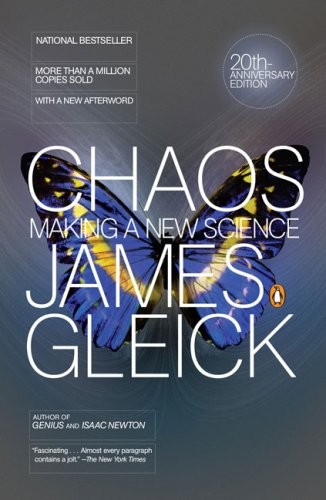
Chaos: Making a New Science, published in 1987, tells the story of how a loose network of scientists working across meteorology, mathematics, biology, and physics in the 1960s and 1970s developed chaos theory — the study of systems that are deterministic but unpredictable because tiny differences in initial conditions produce wildly different outcomes.
James Gleick · 1987 · 8h 0m
Full summary and key takeaways →The 12 questions
- 1.
Lorenz's discovery came from a rounding error in a simulation. What does that accident suggest about how major scientific insights happen?
- 2.
The butterfly effect implies that long-range weather forecasting is theoretically impossible beyond a certain horizon. Does that limit bother you, or does it seem like just a practical constraint?
- 3.
Chaos theory was resisted by mainstream physics for years. Why do established scientific communities resist ideas that later turn out to be important?
- 4.
Fractals describe the rough shapes of nature more accurately than the smooth shapes of Euclidean geometry. Where do you see fractal-like self-similarity in everyday life?
- 5.
Many of the chaos theorists in the book were working across disciplinary boundaries — using physics tools on biology problems, or mathematics on fluid dynamics. What enables that kind of boundary-crossing?
- 6.
The book argues that classical science systematically idealized away the complexity it couldn't handle. What are the costs and benefits of that idealization strategy?
- 7.
Feigenbaum found that different systems — electrical circuits, fluid dynamics, population models — all undergo the same quantitative transition to chaos. What does that universality mean?
- 8.
Gleick suggests chaos theory changed how scientists think about prediction and control. Has it changed how you think about either?
- 9.
The researchers in the book were often mavericks working outside the mainstream. Is nonconformity a cause of scientific innovation or just correlated with it?
- 10.
Chaos is deterministic but unpredictable. Does the distinction between determinism and predictability matter for how you think about free will?
- 11.
The book was written in 1987. How has chaos theory developed since, and has it fulfilled its early promise?
- 12.
What field outside natural science might benefit most from applying chaos theory's insights about sensitive dependence and complex dynamics?
How to run the discussion
- Pick six to eight, not all of them. An hour of real discussion covers fewer questions than anyone expects, and racing the list is what makes a book club feel like homework.
- Open with what people noticed, not what they concluded. Asking for a verdict first hardens opinions before anyone has heard each other.
- Let the disagreement run. The questions below that split a room are the ones worth the time; the ones everyone answers the same way can be skipped.
- Ask the quiet person a specific question. A direct, narrow question is far easier to answer than an open invitation to contribute.
Themes worth steering toward
If the conversation stalls, these are the threads that usually restart it.
Common questions
What are good book club questions for Chaos: Making a New Science?
Here are 12 book club questions for Chaos: Making a New Science by James Gleick, ordered to open easily and end somewhere worth arguing about. The strongest openers ask what each reader noticed rather than what they concluded, and the discussion usually turns on chaos theory, complexity, systems.
How long should a book club discussion of Chaos: Making a New Science last?
Most groups run 60 to 90 minutes of actual discussion. That is roughly six to eight questions, not all of them, so pick the ones that suit your group rather than working down the list in order.
What are the main themes in Chaos: Making a New Science?
Chaos theory, Complexity, Systems, Scientific discovery, Mathematics. Those are the threads most likely to divide a room, which makes them the useful places to steer a discussion that has gone quiet.
Picking the next one? See books like Chaos: Making a New Science or questions for other book club picks.
