Business · Book club
Competing Against Luck book club questions
Here are 11 book club questions for Competing Against Luck by Clayton M. Christensen, ordered to open easily and end somewhere worth arguing about. Copy them, print them, or bring them up one at a time.
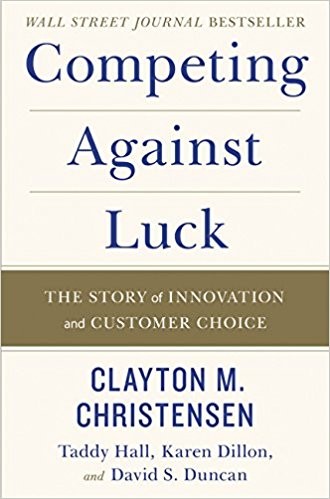
Competing Against Luck is Clayton Christensen's most complete development of the Jobs to Be Done framework, which he introduced briefly in The Innovator's Solution.
Clayton M. Christensen · 2016 · 5h 0m
Full summary and key takeaways →The 11 questions
- 1.
What job does a product you use regularly actually do for you? Is the product explicitly designed for that job, or did you adapt a product designed for a different job?
- 2.
Christensen says the competing hire is what customers would use if your product didn't exist. What are the real competing hires for a product in your market, and are any of them surprising?
- 3.
The functional-emotional-social job distinction is one of the most useful in the book. Think of a brand loyalty you have: which dimension of the job is driving it?
- 4.
What does Jobs-to-Be-Done research look like in practice? What questions would you ask, and how would you analyze the answers to identify the job versus just the stated preference?
- 5.
Christensen argues most product failures are due to solving the wrong job. What is a product you've seen that was well-executed but failed because it addressed the wrong job?
- 6.
The milkshake example is famous and compelling. What is a product in your industry where similarly non-obvious competing hires or job dimensions would change your product strategy?
- 7.
How does Jobs to Be Done interact with Agile and iterative product development? Can you run short sprints when the goal is to understand the job rather than to ship features quickly?
- 8.
Christensen says big data can't reveal causation — it can't tell you why. What types of research complement big data to provide the causal insight Jobs-to-Be-Done requires?
- 9.
What would it take to build Jobs-to-Be-Done as an organizational capability rather than as a one-time product research technique? What would you need to change?
- 10.
How does the Jobs framework apply to B2B products, where the buyer is often not the end user and the job may be organizational rather than personal?
- 11.
Christensen's theory has both academic and practitioner adherents, but also critics who say it is too vague to be falsifiable. What would make you more or less confident that you've correctly identified a customer's job?
How to run the discussion
- Pick six to eight, not all of them. An hour of real discussion covers fewer questions than anyone expects, and racing the list is what makes a book club feel like homework.
- Open with what people noticed, not what they concluded. Asking for a verdict first hardens opinions before anyone has heard each other.
- Let the disagreement run. The questions below that split a room are the ones worth the time; the ones everyone answers the same way can be skipped.
- Ask the quiet person a specific question. A direct, narrow question is far easier to answer than an open invitation to contribute.
Themes worth steering toward
If the conversation stalls, these are the threads that usually restart it.
Common questions
What are good book club questions for Competing Against Luck?
Here are 11 book club questions for Competing Against Luck by Clayton M. Christensen, ordered to open easily and end somewhere worth arguing about. The strongest openers ask what each reader noticed rather than what they concluded, and the discussion usually turns on innovation, marketing, customer discovery.
How long should a book club discussion of Competing Against Luck last?
Most groups run 60 to 90 minutes of actual discussion. That is roughly six to eight questions, not all of them, so pick the ones that suit your group rather than working down the list in order.
What are the main themes in Competing Against Luck?
Innovation, Marketing, Customer discovery, Product strategy, Strategy. Those are the threads most likely to divide a room, which makes them the useful places to steer a discussion that has gone quiet.
Picking the next one? See books like Competing Against Luck or questions for other book club picks.
