Business · Book club
Crossing the Chasm book club questions
Here are 12 book club questions for Crossing the Chasm by Geoffrey A. Moore, ordered to open easily and end somewhere worth arguing about. Copy them, print them, or bring them up one at a time.
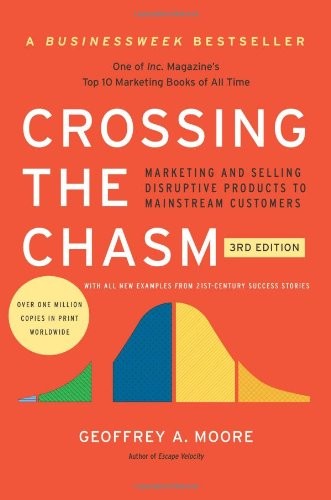
Crossing the Chasm is Geoffrey Moore's analysis of why so many technology companies succeed with early adopters and then stall before reaching mainstream customers.
Geoffrey A. Moore · 1991 · 5h 20m
Full summary and key takeaways →The 12 questions
- 1.
Moore's chasm is about the gap between visionaries and pragmatists. Can you think of a technology product you've seen stall at exactly that point? What happened?
- 2.
What makes a good beachhead market? What criteria would you use to choose yours if you were launching a new B2B product today?
- 3.
Moore says pragmatists want references from customers like themselves. How does a company get those first pragmatist references when it hasn't yet sold to pragmatists?
- 4.
The whole product concept — everything a customer needs to succeed, not just the core software — is central to the chasm argument. What components are missing from a whole product you rely on?
- 5.
Has a technology you use personally crossed the chasm? What changed in the product, marketing, or company when it did?
- 6.
Moore distinguishes between market segments based on references, not industries. How would you apply that definition to map segments in a market you know well?
- 7.
Early Adopter sales often require relationship-heavy, custom-deal approaches. How does a company switch from that mode to the more scalable, systematic selling that pragmatists require?
- 8.
The bowling pin strategy requires winning one segment completely before moving to the next. What organizational pressures push companies to expand too early?
- 9.
Does the chasm concept apply to non-technology businesses? Where do you see analogous adoption gaps in other markets?
- 10.
Moore argues the Early Majority is actually the biggest market opportunity. Why do so many companies keep chasing visionaries instead of systematically crossing to pragmatists?
- 11.
What would Crossing the Chasm say about a consumer startup that has viral adoption among college students but struggles to convert to broader audiences?
- 12.
Moore wrote the first edition in 1991. Which aspects of his framework have aged best, and which feel most dated given how software is now bought and sold?
How to run the discussion
- Pick six to eight, not all of them. An hour of real discussion covers fewer questions than anyone expects, and racing the list is what makes a book club feel like homework.
- Open with what people noticed, not what they concluded. Asking for a verdict first hardens opinions before anyone has heard each other.
- Let the disagreement run. The questions below that split a room are the ones worth the time; the ones everyone answers the same way can be skipped.
- Ask the quiet person a specific question. A direct, narrow question is far easier to answer than an open invitation to contribute.
Themes worth steering toward
If the conversation stalls, these are the threads that usually restart it.
Common questions
What are good book club questions for Crossing the Chasm?
Here are 12 book club questions for Crossing the Chasm by Geoffrey A. Moore, ordered to open easily and end somewhere worth arguing about. The strongest openers ask what each reader noticed rather than what they concluded, and the discussion usually turns on marketing, technology adoption, startups.
How long should a book club discussion of Crossing the Chasm last?
Most groups run 60 to 90 minutes of actual discussion. That is roughly six to eight questions, not all of them, so pick the ones that suit your group rather than working down the list in order.
What are the main themes in Crossing the Chasm?
Marketing, Technology adoption, Startups, Product strategy, B2B. Those are the threads most likely to divide a room, which makes them the useful places to steer a discussion that has gone quiet.
Picking the next one? See books like Crossing the Chasm or questions for other book club picks.
